

Three-grain sweet paste 三合泥
A rich, spoon-eaten sweet from western Sichuan, with a storied Chengdu version made by toasting and finely grinding grains and beans, then frying the paste with fat, sugar, nuts and sometimes candied fruit. Its exact grain mix and current availability vary by maker.
What it is
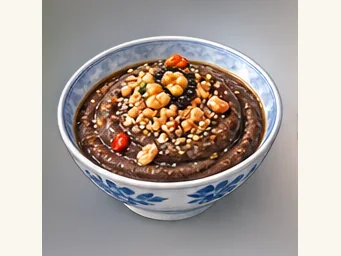
三合泥 (sānhé ní, literally “three-combined paste”) is a warm, dense sweet associated with western Sichuan and with Chengdu’s older snack trade. The “three” is not a dependable recipe specification: accounts describe different combinations, including glutinous rice, black beans and sesame, or rice, glutinous rice and soybeans. Chengdu accounts also describe nuts and candied fruit as additions, not mandatory ingredients.
A historical account of Chengdu vendors describes grains and beans toasted and milled, then stirred with sweetened liquid and fat until they form a cohesive base. A serving could be finished in a small pan with pork fat, crushed peanuts and walnuts, and diced candied fruit. That is a documented vendor style, not a city-wide formula; ingredients and ratios differ between versions. An older food feature describes the finished sweet as glossy and dark, with a soft, sticky texture and an aroma of toasted sesame, nuts and grain. The fat makes it rounded and rich rather than pudding-light.
How to eat it
It is served warm and eaten slowly by spoonfuls. The traditional vendor story describes small-pan frying to order and pairing the sweet with hot tea to balance its richness, but this should be understood as a historical serving practice, not a guaranteed feature of present-day shops. Ask the kitchen what grains, nuts, sweetener and cooking fat are in its version, and whether it contains candied fruit. A small portion is a practical way to try it alongside less rich snacks.
Some regional accounts describe a very different, three-colour presentation made from separate red-date, lotus-seed and green-bean pastes. It is a named variation rather than a required form of Chengdu 三合泥.
Where to eat it
You can find Three-grain sweet paste all over Chengdu, so there is no need to seek out one particular restaurant. To find one near you, search for “三合泥” in Meituan (美团) or Amap (高德地图) and check recent reviews, distance and opening hours.
More dishes to compare
Explore related local specialties and compare their names, preparation notes and ordering guidance.
Lai tangyuan 赖汤圆 →
Glutinous-rice dough is wrapped around a sweet filling and boiled until the dumplings become tender. Sesame-based fillings are familiar, with shop-specific variations in sweetness and richness. The wrapper is soft and elastic, surrounding a hot, fragrant center that can flow when bitten. Plain cooking liquid lets the filling remain the focus.
Gaiwan tea 盖碗茶 →
Loose tea is brewed in a three-piece gaiwan: bowl, lid and saucer. The lid helps retain warmth and can be tilted to hold back leaves while drinking. The flavor depends on the tea chosen, and successive additions of hot water change its strength and aroma.
Sources & reading
Recipes and servings vary between kitchens.