

Tianjin Braised Pork 天津烧肉
Tianjin Braised Pork is featured among the local specialties of Tianjin.
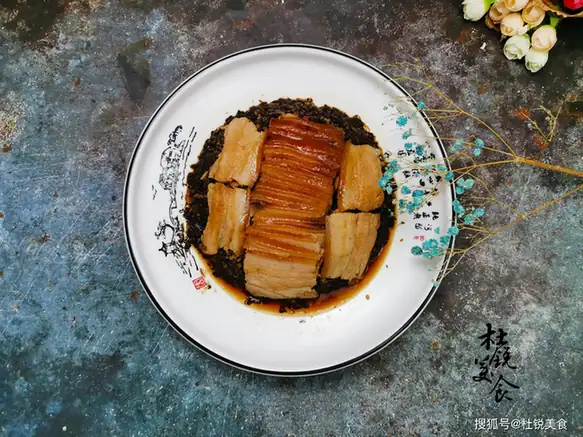
Image notes
Resized for the web; the photo itself has not been edited.
Tianjin Braised Pork (天津烧肉) is a braised pork dish of Tianjin cuisine, recorded among the representative works of the chef Shi Junsheng, one of the city's twentieth-century masters.
How the pork is cooked
The 烧 in the name carries its braised sense: the meat is cooked through in a seasoned liquid rather than grilled. The method suits a fatty cut with some connective tissue, so pork belly or shoulder is the natural choice rather than lean loin. The meat is usually blanched or seared first, then simmered with soy, sugar and aromatics until the fat softens and the sauce coats each piece.
Taste and texture
Long braising turns the fat soft and the meat tender, and the sauce is savoury with a mild sweetness. Compared with a crisp roast, the texture is spoonable rather than crisp, and the seasoning runs deep into the meat. It is a rice dish rather than a centrepiece, and portions are usually shared.
Where the dish is recorded
The 津菜 article groups the dish with the representative works of Shi Junsheng, who began his apprenticeship at thirteen under Niu Baoshan and went on to run the stove at Zhongliyuan, Hongqi Restaurant and other Tianjin houses. His recorded strengths were braised dishes and the Tianjin wok-tossing technique known as 大翻勺, and 天津烧肉 is listed alongside 罾蹦鲤鱼 and 银鱼紫蟹锅. That is what anchors the dish to Tianjin rather than to a general northern repertoire.
What goes into it
The base is pork, and the braise is built on soy sauce, sugar, ginger and aromatics. Whether rice wine goes in depends on the kitchen. If you avoid pork or alcohol, ask both questions before ordering, because once the dish is cooked the sauce cannot be separated from the meat.
How to order it
Ask whether the meat comes hot from the braise or is reheated, and whether the sauce is reduced or thickened with starch. If it is priced by weight, ask for the number of pieces. Because the meat is soft, ask for it to be brought in a deep dish if you plan to share it across the table.
At the table
The meat comes to the table in its sauce and is eaten with rice, which soaks up the braising liquid. Cut the pieces with chopsticks rather than a knife, and spoon a little sauce over each serving. A plain vegetable dish on the side keeps the meal from becoming too rich.
More dishes to compare
Explore related local specialties and compare their names, preparation notes and ordering guidance.
Tianjin Red-Braised Oxtail 天津红烧牛尾 →
The braised oxtail is the beef side of the same Tianjin tradition and makes the contrast easy to see. Both dishes are slow-cooked and dark-sauced, but the oxtail brings bone and cartilage and a markedly stickier texture, while the pork version is softer and more spoonable. Serve either over rice with a plain vegetable alongside.
Questions before you order
Is 烧 a grilling technique here?
No. In this dish it is a braise: the pork is cooked through in a seasoned liquid rather than grilled over a fire.
Where is the dish recorded?
天津烧肉 is listed among the representative dishes of the Tianjin chef Shi Junsheng, a master of braised dishes and of the Tianjin wok-tossing technique.
Source introduction: Wikipedia contributors: 津菜 · CC BY-SA 4.0 (Wikipedia text, attribution required). English guide adapted from the cited material, with additional preparation and ordering guidance.
Sources & reading
The supplied food list supports this name and regional association. The culinary terms below are explained as menu vocabulary; a local recipe, origin story and venue availability have not been independently verified.