

Medog Stone-Pot Fish 墨脱石锅鱼
Medog Stone-Pot Fish (墨脱石锅鱼) is a fish dish named for the soapstone cooking vessel associated with Medog in Nyingchi. It is best treated as a local menu name rather than a single fixed recipe: Medog’s own food listing describes a stone-pot stew and steamed Yalu River fish as separate preparations, so the fish, broth and seasoning can vary by kitchen.
Tap any red Chinese text to hear it in Mandarin.
Why it belongs in Nyingchi’s food story
Medog’s stone pots are made from natural soapstone described by the county government as occurring along the Yarlung Tsangpo. The pot is part of Medog’s food identity, not just a decorative serving bowl; the same government page lists hotpots, soup pots, rice, meat and vegetables among its uses, and records geographical-indication protection for “Medog Stone Pot” in 2015.
The craft also has a living social setting. A 2025 report on Bangxin Township describes it as a “stone-pot village,” with Monpa makers shaping pots and stone-pot cooking connected with local food culture. The Tibet regional culture and tourism department lists Medog stone-pot making as an autonomous-region intangible cultural heritage project and identifies a representative inheritor from Bangxin Township. For a visitor, the interesting point is the link between vessel, material and meal: the pot gives the dish its local reference, while the fish recipe is not necessarily identical from one kitchen to the next.
What the name does—and does not—promise
The county’s food page gives two useful reference points, but labels them separately. Its traditional stone-pot stew, kegazonggagangdang (科嘎宗嘎岗当), is described with soapstone cookware and ingredients including dangshen, palm ginseng, goji berries, ginkgo, matsutake, chicken and other mushrooms. Its modern “steamed Yalu River fish” (清蒸雅江鱼) uses a fish of about 500 grams, seasoned with salt, cooking wine, ginger and scallion, steamed for eight to ten minutes, then finished with hot oil and a soy-based sauce.
That distinction matters. It is safer to read 墨脱石锅鱼 as a local menu name built around Medog’s stone-pot tradition than as a single protected recipe with one compulsory fish, broth or spice mix. If a menu also offers 雅江鱼, ask whether it is steamed, cooked in the stone pot, or prepared another way. Do not assume that a dish called “stone-pot fish” uses a particular wild species or a fixed local catch.
How to order without guessing
Before ordering, ask:
- 这是什么鱼? Zhè shì shénme yú? — What fish is this?
- 按斤还是按份? Àn jīn háishì àn fèn? — Is it priced by weight or by portion?
- 是石锅煮还是清蒸? Shì shí guō zhǔ háishì qīngzhēng? — Is it cooked in the stone pot or steamed?
- 有没有清汤? Yǒu méiyǒu qīng tāng? — Is there a plain broth?
If you avoid alcohol or have allergies, ask whether the kitchen uses 料酒 (cooking wine), a premixed stock or shared seasoning. Fish is not vegetarian, and the presence of a stone pot does not guarantee that a dish is free of a particular allergen. If the fish is served whole, ask the staff to explain the bones and serving style rather than relying on the English menu name alone.
Finding a serving in Nyingchi
Search for “墨脱石锅鱼” on Meituan (美团) or Amap / Gaode Maps (高德地图) to find nearby places serving this dish. Check menus, recent reviews, opening information and today’s availability before choosing.
This is a dish rather than a fixed attraction, so it has no universal address, entrance or dedicated transport route. A search result is a lead, not proof of quality or authenticity. Supply may change with the restaurant, season and fish available that day; confirm the preparation and price when you arrive.
The useful way to read the dish
The stone pot explains the name and the connection to Medog. The local sources are more definite about the vessel and about separate fish and stone-pot preparations than about one canonical “stone-pot fish” recipe. That is not a problem to solve with a more confident description: it is a reason to ask what is in the pot and how that kitchen cooks it.
More dishes to compare
Explore related local specialties and compare their names, preparation notes and ordering guidance.
Ba He Yu 巴河鱼 →
Ba He Yu (巴河鱼) is named for the water it comes from rather than for the pot it is cooked in, so the two make a natural pair: one name points at the vessel, the other at the stream, and both end up being a test of freshness.
Sources & reading
Image credits & notes (1)
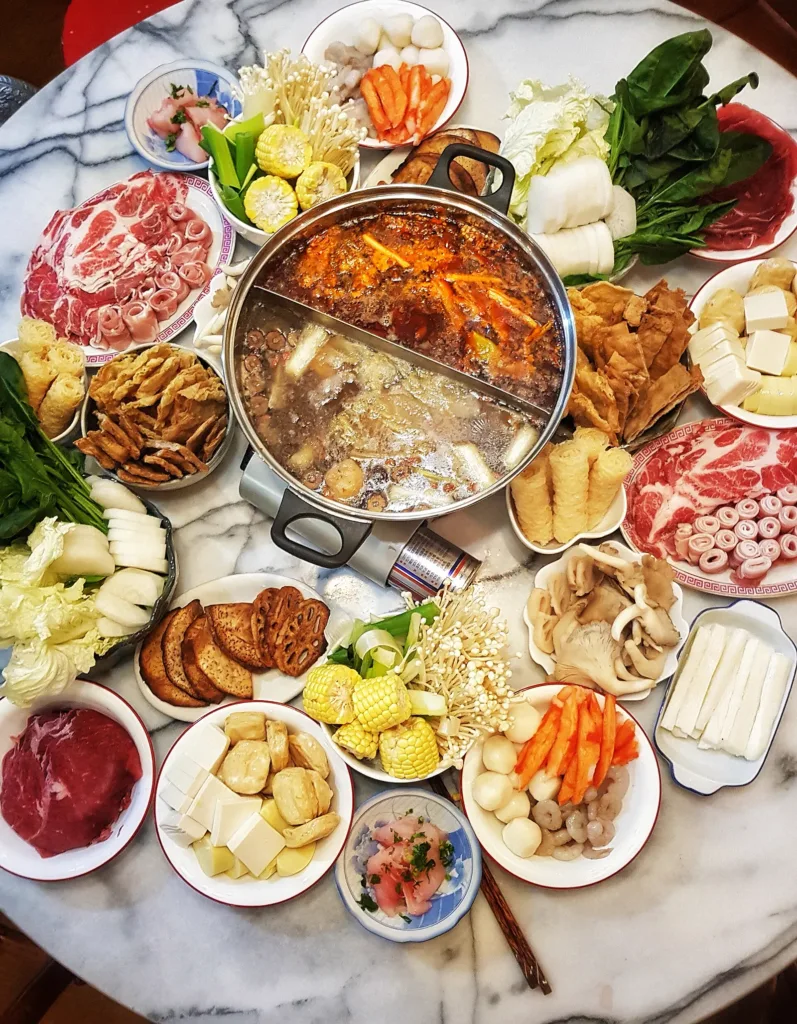
- Illustrative Chongqing hot pot photographed in Singapore (3 March 2018), showing a divided broth and assorted ingredients. This is not Medog Stone-Pot Fish and is not a Medog restaurant photograph. Photo: Jonathan Lin (jonolist)Photo: CC BY-SA 2.0