

Stir-Fried Shredded Beef with Sour Radish 酸萝卜炒牛肉丝
Stir-Fried Shredded Beef with Sour Radish is featured among the local specialties of Tibet (Xizang).
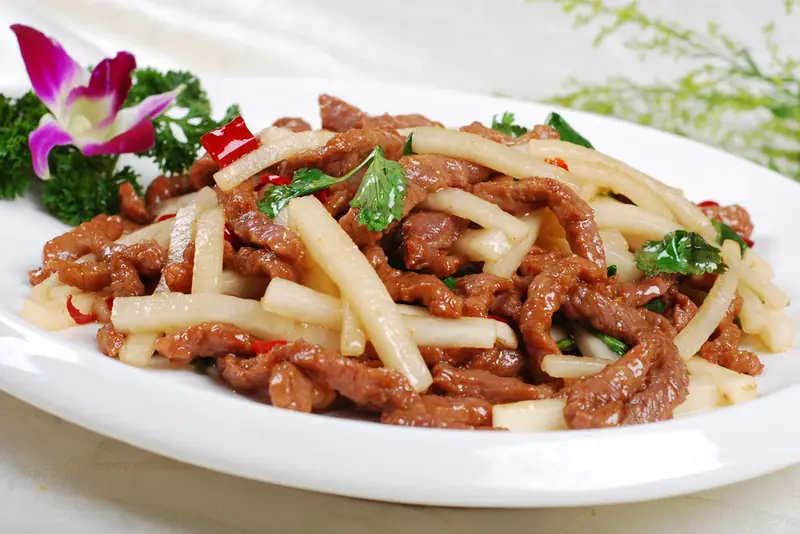
Image notes
Resized for the web; the photo itself has not been edited.
Stir-Fried Shredded Beef with Sour Radish (酸萝卜炒牛肉丝) is a stir-fry listed for Tibet (Xizang); the name reads sour radish, stir-fried, beef, shreds, so it names both the ingredients and the method.
Why everything is shredded
炒 means cooking quickly over high heat, and 丝 means the ingredients are cut into thin strips so they can take that heat. Beef is sliced across the grain into matchsticks, which shortens the muscle fibres and lets them cook through before they toughen. The radish is cut the same way so that both finish at the same moment. A hot pan, a little oil and a short cooking time are the whole technique; a crowded pan steams instead of frying.
Sour, savoury and crisp
The preserved radish supplies salt and acidity at once, so the dish tastes bright and savoury without a vinegar note on top. Beef brings the weight, and the radish keeps it from feeling heavy. Texture is the thing to judge: strips of beef should be tender with a slight spring, and the radish should still have a bite rather than collapsing into softness. If the plate looks wet, the pan was too cool and the vegetables gave up their water.
One dish, one province
This dish is a province-level one rather than a named county's, so it stands for the wider region rather than for one town. That is why the name carries no place word: the technique and the ingredients are the whole identity, and no single kitchen owns the plate.
Ingredients and dietary checks
Beef, pickled radish and cooking oil are the core, with garlic, ginger, chilli or a little sugar sometimes added to round out the sourness. Three questions pay off. Soy sauce or a fermented paste may be used, so ask 有酱油吗 (is soy sauce used) if you avoid wheat. Chilli may be present, so ask 辣不辣 (how spicy). And because the radish is preserved rather than fresh, ask 咸不咸 (how salty) if sodium matters.
How to order it
Show 酸萝卜炒牛肉丝 and ask 辣不辣 (how spicy), 咸不咸 (how salty) and 一份多少 (how big is a portion). If you want the dish to arrive quickly, say so, since a stir-fry is usually cooked to order and takes only minutes once the pan is hot. Ask 有米饭吗 (is there rice) if you want something plain to eat it with.
Serving it at the table
This is a dish built for rice. The sourness cuts through an oily meal, so it works well next to fried or braised plates, and it loses its edge if left to sit, since the radish keeps releasing liquid. Eat it first while the strips are still firm, and share it across the table rather than treating one plate as a main course.
More dishes to compare
Explore related local specialties and compare their names, preparation notes and ordering guidance.
Dried yak meat 风干牦牛肉 →
Dried yak meat (风干牦牛肉) is the neighbouring entry: beef preserved by air-drying and served cold or as a snack. 酸萝卜炒牛肉丝 goes the other way, using fresh meat and a hot pan, so the pair shows how the same animal reaches the table by two very different routes.
Questions before you order
Is the dish very sour?
The sourness comes from preserved radish rather than from vinegar, so it reads as a savoury tang rather than a sharp bite. Ask 酸不酸 (how sour is it) if you want to know before ordering.
Can it be made without chilli?
Often yes, since the chilli is added in the pan rather than built into the preserved vegetable. Ask 不放辣椒可以吗 (can it be made without chilli) and confirm the kitchen can cook it separately.
Sources & reading
The supplied food list supports this name and regional association. The culinary terms below are explained as menu vocabulary; a local recipe, origin story and venue availability have not been independently verified.