

Tibetan Fragrant Pig 藏香猪
Nyingchi’s Tibetan Fragrant Pig (藏香猪) is a local pork speciality most closely associated with roasting. Its thin skin, relatively high lean-meat ratio and tender meat are the qualities local sources highlight, but the name identifies a pig product rather than one fixed recipe or one guaranteed restaurant.
Tap any red Chinese text to hear it in Mandarin.
Why it belongs on a Nyingchi food list
Nyingchi’s local food tradition gives 烤藏香猪 Kǎo Zàngxiāngzhū a clear place: a Xizang government food feature lists roasted Tibetan Fragrant Pig among the region’s ten traditional foods and describes it as a dish enjoyed by local people. The association is not only a tourism label. A 2026 government report describes Nyingchi Tibetan-pig meat as a current local speciality industry with traceability requirements for commercial shipments.
The animal is also part of a wider Tibetan-pig tradition rather than a breed invented by a single restaurant. The Ministry of Agriculture and Rural Affairs describes Tibetan pig as a valuable local resource originating on the Qinghai–Tibet Plateau and as the pig distributed at the highest elevations, adapted to high-altitude, low-oxygen conditions. That context helps explain why the dish is worth trying in Nyingchi: the ingredient connects the meal to the region’s farming landscape, while the cooking lets you notice the meat itself.
A Milin county government account records an older pattern of household raising for home use, followed by cooperative and larger-scale development. It is useful context for the ingredient’s local agricultural identity, but its 2019 production target is not a current estimate of what visitors can buy.
What to look for in the dish
The local description is specific about texture: thin skin, a high lean-meat proportion and tender meat. When roasted, those traits are presented as a juicier result than ordinary pork. CCTV’s Nyingchi food segment likewise describes the skin and meat as fine and recommends slow-fire roasting. In practice, pay attention to the browned skin, the lean meat and the softer fatty layer together instead of judging the dish by a heavy sauce alone.
There is no single official plate or universal seasoning list. One Nyingchi travel operator describes a traditional preparation in which the pig is cleaned, rubbed with salt and Sichuan pepper, hung to dry, and then cooked; it presents the skin, fat and meat as the textures to taste in one bite. Treat that as a documented local-style variation, not a rule for every kitchen. A menu using 藏香猪 Zàngxiāngzhū may serve roast pork or another preparation of the same product, so ask how it was cooked and whether the portion is served hot, sliced or shared.
How to find and order it
Keep the Chinese name handy: 藏香猪 Zàngxiāngzhū. For the roast preparation, also try 烤藏香猪 Kǎo Zàngxiāngzhū. Search for “藏香猪” on Meituan (美团) or Amap / Gaode Maps (高德地图) to find nearby places serving this dish. Check menus, recent reviews, opening information and today’s availability before choosing. Search results are a way to locate current supply, not proof of quality or authenticity, and the dish has no single fixed address.
This is pork, so it is not suitable for vegetarian, vegan or pork-free diets. If cross-contact matters, ask about shared grills, stock, sauces and utensils; do not infer that a dish is free of an allergen or alcohol from its appearance or from a short reheating step. Claims that every Tibetan pig is fed a particular mountain ingredient should also be treated cautiously: husbandry and sourcing can vary, while the reliable reason to order the dish is the locally identified ingredient and its roast texture.
Sources & reading
Image credits & notes (1)
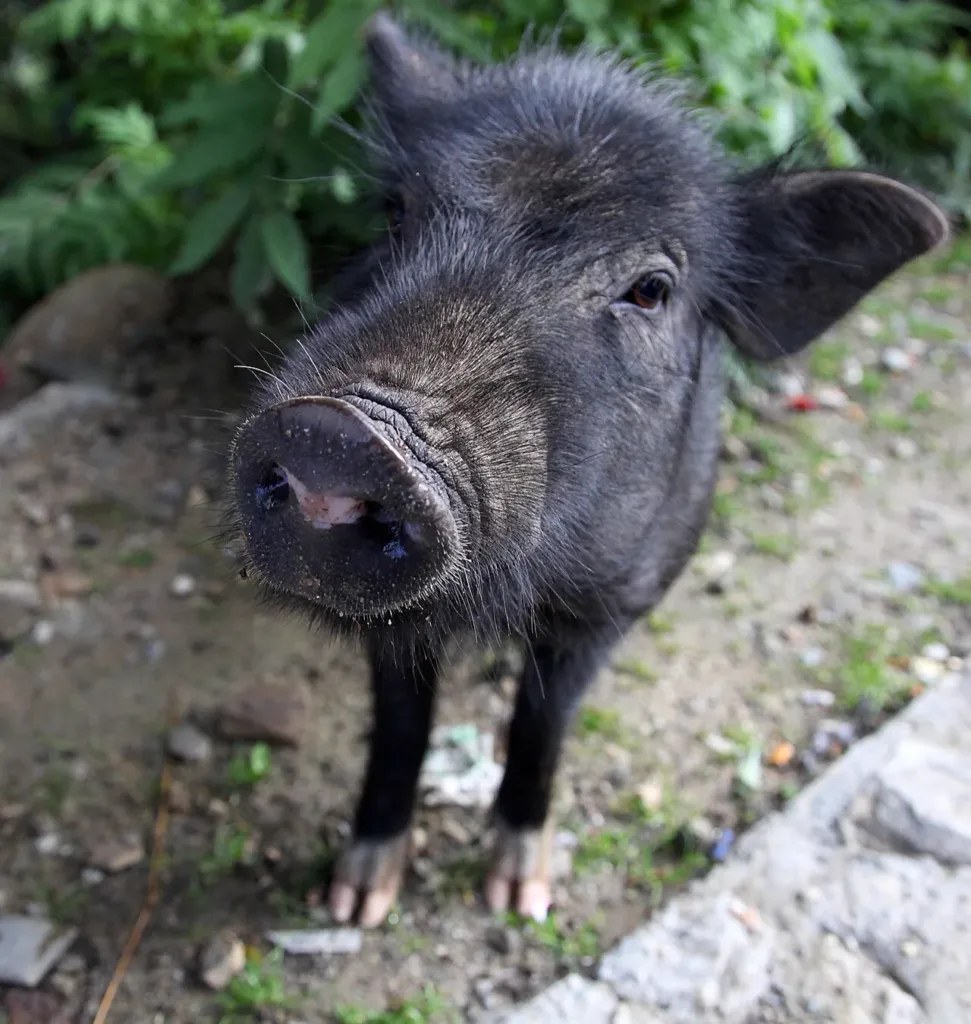
- A Tibetan pig documented in the Lhasa area, shown only as an ingredient and provenance reference for Nyingchi’s Tibetan Fragrant Pig; this is not a photograph of the roasted dish or of Nyingchi. Photo: Jolly YauPhoto: CC BY-SA 3.0