

Toasted-flour cereal 油炒面
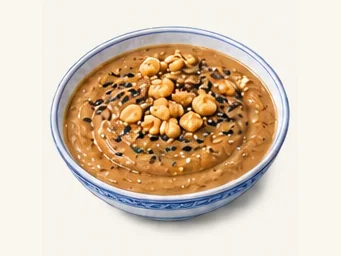
Youchaomian (油炒面) is a Beijing-associated warm snack made by slowly toasting flour, blending it with fat and often sesame or chopped nuts, then whisking a portion with boiling water into a thick, spoonable paste. Sweetened with sugar and sometimes scented with osmanthus, it tastes of roasted flour and toasted seeds; recipes differ in their fat, garnishes and degree of sweetness.
Tap any red Chinese text to hear it in Mandarin.
What the name means
In Beijing food writing, 油炒面 is also called 油茶 (yóuchá). Despite the second name, this preparation is not a tea infusion: it is a flour mixture served after hot water turns it into a thick paste. It is distinct from Beijing 面茶 (miànchá), a millet- or millet-and-rice-flour gruel commonly topped with sesame paste. The names are easy to confuse, so show 油炒面 Yóuchǎomiàn when asking for this dish.
From toasted flour to a hot bowl
A Beijing tourism account describes flour being stirred over gentle heat until it turns yellow and smells roasted. It is sifted, then combined with hot beef marrow fat; toasted sesame, chopped walnuts and melon seeds are folded through. To serve, a few spoonfuls of the dry mixture are placed in a bowl and boiling water is stirred in until smooth and thick. Sugar and osmanthus syrup are added to taste.
That is one documented traditional version, not a fixed recipe. Home recipes also use butter or other oils and vary the seed and nut mixture; some offer sugar or salt according to preference. Raisins or other dried fruit may be added. Ask what fat and toppings are in the batch if those details matter to you.
The key technique is to toast the flour without scorching it, then mix the fat through evenly. The dry mix can be kept and portioned; hot water transforms it at serving time. Whisk or stir as the water goes in: the desired texture is a cohesive, lump-free paste rather than a thin drink or dry powder.
What to expect in the bowl
The flour is toasted to a warm yellow-gold, with an aroma like roasted grain. Fat gives the mixture a rich, smooth, slightly oily feel; sesame brings a deeper toasted scent, while chopped nuts and seeds add small crunchy pieces. Sugar and osmanthus, when used, make the bowl sweet and floral. The finished consistency is thick enough to eat by spoon, with the exact density adjustable by how much boiling water is mixed in.
This is a simple, filling hot snack rather than a bowl of cereal with milk. Take a small portion of the mix, add boiling water gradually while stirring, then adjust sweetness and thickness. If ordering, 来一碗油炒面 (lái yì wǎn yóuchǎomiàn) means “one bowl of youchaomian”; ask whether it is sweet and whether it contains beef fat, butter or other ingredients you avoid.
Where to eat it
You can find Youchaomian all over Beijing, so there is no need to seek out one particular restaurant. To find one near you, search for “油炒面” in Meituan (美团) or Amap (高德地图) and check recent reviews, distance and opening hours.
More dishes to compare
Explore related local specialties and compare their names, preparation notes and ordering guidance.
Sweet sesame flatbread 糖火烧 →
Wheat dough is rolled with sesame paste and brown sugar, folded into layers and baked into a compact round bread. The filling colors the interior brown and gives the layers their characteristic fragrance. It is dense yet tender, with a toasted exterior and a deep sesame-and-sugar richness. Warm pieces make the layered structure easier to appreciate.
Walnut cream dessert 核桃酪 →
Walnuts are ground finely and cooked with water and sugar into a smooth dessert; some versions use rice to give the mixture body. Careful grinding and gentle heating keep the texture even. The result is softly nutty and spoonable, with a mellow sweetness rather than a crunchy walnut bite.
Sources & reading
Recipes and servings vary between kitchens.