

Yangzhou three-diced buns 扬州三丁包
A Yangzhou morning-tea bun made with leavened wheat dough and a filling of diced chicken, pork and bamboo shoots. The three ingredients bring savouriness, richness and a firmer bite, while the small dice keep the centre distinct rather than smooth-minced.
Tap any red Chinese text to hear it in Mandarin.
What to look for
The “three dice” are chicken, pork and bamboo shoots. Yangzhou’s official tourism guide describes the bun as a breakfast staple with a soft, fluffy wrapper and savoury filling; another local tourism feature describes the same combination as chicken for savour, pork for richness and bamboo shoot for crunch. The useful test at the table is simple: the wrapper should be light and leavened, and the filling should still have three recognisable textures instead of becoming a smooth paste.
This is a dish with a shared identity, not one universal recipe. Kitchens can change the seasoning, dice size, fat balance and amount of bamboo shoot. Local reporting often describes a three-parts-fat, seven-parts-lean balance, but that is a traditional formulation rather than a rule you can use to judge every bun. If you avoid meat, ask before ordering: 馅里有鸡肉和猪肉吗? Xiàn lǐ yǒu jīròu hé zhūròu ma? (“Does the filling contain chicken and pork?”)
Fuchun Teahouse is an important reference point for Yangzhou tea snacks. The Ministry of Culture and Tourism’s national intangible-heritage database lists “Fuchun tea-snack making technique” as a 2008 national project, with Yangzhou Fuchun Teahouse as the protecting unit. That recognition belongs to the Fuchun technique; it does not make one shop’s pleat count or shaping standard universal across Yangzhou.
A breakfast eaten with tea
Three-diced buns belong to Yangzhou’s 早茶 (zǎochá), a morning-tea meal in which steamed buns are eaten alongside tea and other small dishes. The city’s tourism material treats them as part of the local breakfast table, while a recent Yangzhou travel feature places them among the city’s classic morning-tea foods. Order the Chinese name 扬州三丁包 Yángzhōu sāndīng bāo or 三丁包子 Sāndīng bāozi and consider sharing a steamer before adding other dishes.
A 五丁包 (five-diced bun) is a richer related order that adds seafood to the chicken, pork and bamboo-shoot combination. It is not simply another English name for the three-diced bun, so check the Chinese name when ordering.
How to order
Look for the dish on a Yangzhou restaurant or teahouse menu rather than planning around one mandatory shop. Recipes, portion sizes and availability vary, and the classic three-diced filling is not automatically vegetarian or free of allergens. Ask what is in the filling if you need to avoid pork, chicken, seafood or particular seasonings. A freshly steamed bun is easiest to assess by its soft wrapper and by whether the chicken, pork and bamboo shoot remain distinct inside.
More dishes to compare
Explore related local specialties and compare their names, preparation notes and ordering guidance.
Taizhou crab-roe buns 泰州蟹黄包 →
Crab meat or roe enriches a savory filling enclosed in wheat dough and steamed. Taizhou menus may distinguish different bun and soup-bun styles, so the dish name should be read alongside the actual description. The appeal is a fragrant, rich crab center against a tender wrapper; some versions carry substantial hot broth. Size and filling ratios affect how filling one piece feels.
Wuxi soup dumplings 无锡小笼包 →
Thin wrappers enclose seasoned pork and a broth-forming filling, then are steamed in small baskets. The juices collect inside the wrapper and should be released carefully. Wuxi versions are known for a sweet-savory filling, tender meat and hot broth against a delicate, slightly elastic skin.
Sources & reading
Recipes and servings vary between kitchens.
Image credits & notes (1)
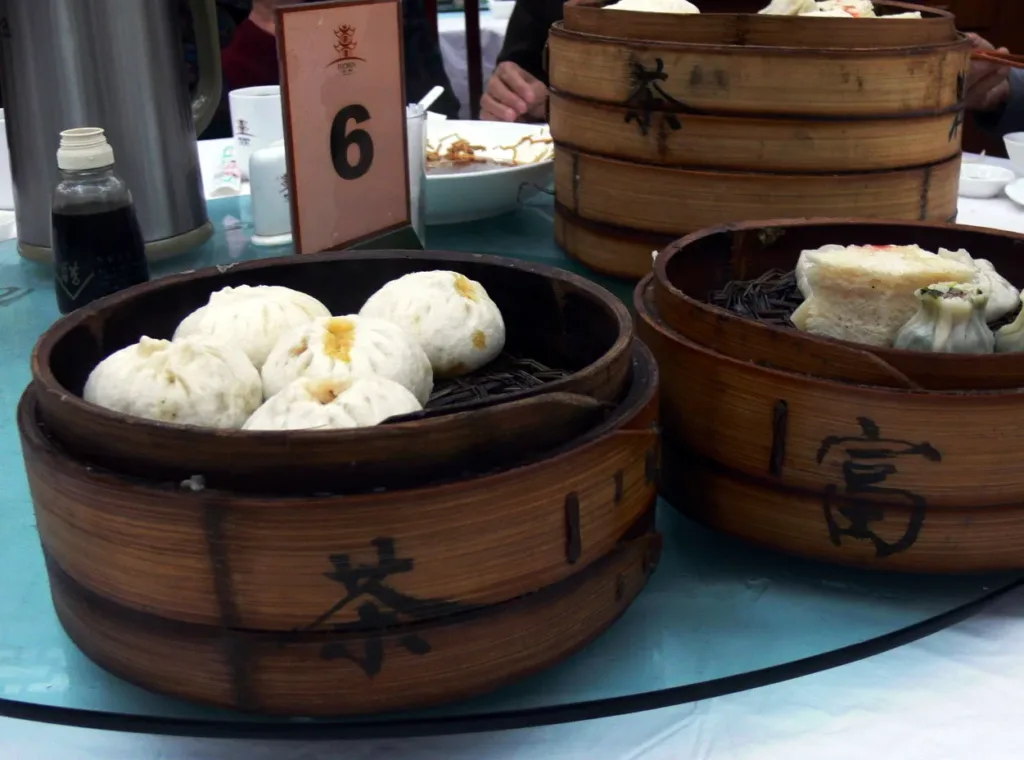
- Yangzhou Fuchun Tea House breakfast tray with steamed buns in bamboo baskets; the Commons description identifies the buns as three-diced buns. Photo: GislingPhoto: CC BY 3.0