

Soft Tofu Rice Noodles 豆花米线
Douhua mixian is a Kunming everyday bowl of thick rice noodles, soft tofu, pickled greens and sweet–savory chilli seasonings. Its identity comes from the contrast between tender tofu, springy rice noodles and the gentle tang of fermented `酸浆米线`, rather than from a single fixed recipe.
Tap any red Chinese text to hear it in Mandarin.
What to look for
Keep the Chinese name 豆花米线 Dòuhuā Mǐxiàn (dòuhuā mixian) handy when you order. The bowl is built around rice noodles and soft tofu or tofu pudding, then dressed with chopped 冬菜 (dongcai, a preserved green), garlic chives and a sweet–salty, often spicy sauce. Peanuts, chilli oil, sesame paste or minced meat sauce may appear as well. A Kunming Municipal CPPCC account of one established snack kitchen lists noodles and soft tofu as the main ingredients, with dongcai, MSG and chopped chives; local reporting also describes a bowl with meat sauce and crushed peanuts. Recipes vary between kitchens.
The noodles are usually briefly blanched or warmed before the tofu and toppings are added. Depending on the kitchen and style, the finished bowl may be warm, lukewarm or cool rather than a soup. Mix gently so the soft tofu coats the noodles without disappearing into the sauce.
Why the noodle matters
The local character is not supplied by the tofu alone. Many Kunming accounts point to thick, freshly made sour-fermented rice noodles, called 酸浆米线 (suānjiāng mǐxiàn). Rice is soaked, ground, fermented and worked before the noodle is pressed and washed; the result is springy, rice-scented and lightly sour. That tang can be unfamiliar if you have only eaten dried rice noodles. Traditional accounts also single out sweet soy sauce associated with the Tuodong pickle factory (拓东酱菜厂) as a defining local seasoning.
Some kitchens use dried or otherwise convenient noodles, and the sauce changes from shop to shop. A useful English-language comparison describes the common balance as savoury, sweet and mildly spicy, with fermented chilli-bean or wheat sauces, sweet soy, preserved greens and soft tofu. Treat that as a description of a family of Kunming bowls, not a mandatory recipe.
Meat, vegetarian and allergy questions
Do not assume that a tofu topping makes the bowl vegetarian. One local example includes red meat sauce, while modern versions may be made either with meat or as 素米线 (vegetarian rice noodles). If you need a meat-free bowl, ask 这碗是素的吗?有没有肉酱或肉汤? Zhè wǎn shì sù de ma? Yǒu méiyǒu ròujiàng huò ròutāng? (“Is this bowl vegetarian? Does it contain meat sauce or meat broth?”) and confirm at the counter. Tofu, soy-based sauces, peanuts and preserved greens are common enough that visitors with allergies should also ask what that kitchen uses.
A story, with the right amount of certainty
A frequently repeated Kunming story places the dish beside Deshengqiao (得胜桥): a woman is said to have topped her father’s noodles with soft tofu when there was no meat at home, then used sweet and salty soy sauces, chives, chilli oil and pickled vegetables. It is a local food memory rather than proof of one documented inventor. The Kunming Municipal CPPCC’s account instead documents the lineage of Liuhuan Xiaochi back to 1920s Guandu-style snacks. These stories help explain the dish’s home-style reputation, but neither turns every modern bowl into one fixed original.
Where to eat it
You can find Soft Tofu Rice Noodles all over Yunnan, so there is no need to seek out one particular restaurant. To find one near you, search for “豆花米线” in Meituan (美团) or Amap (高德地图) and check recent reviews, distance and opening hours.
Sources & reading
Image credits & notes (1)
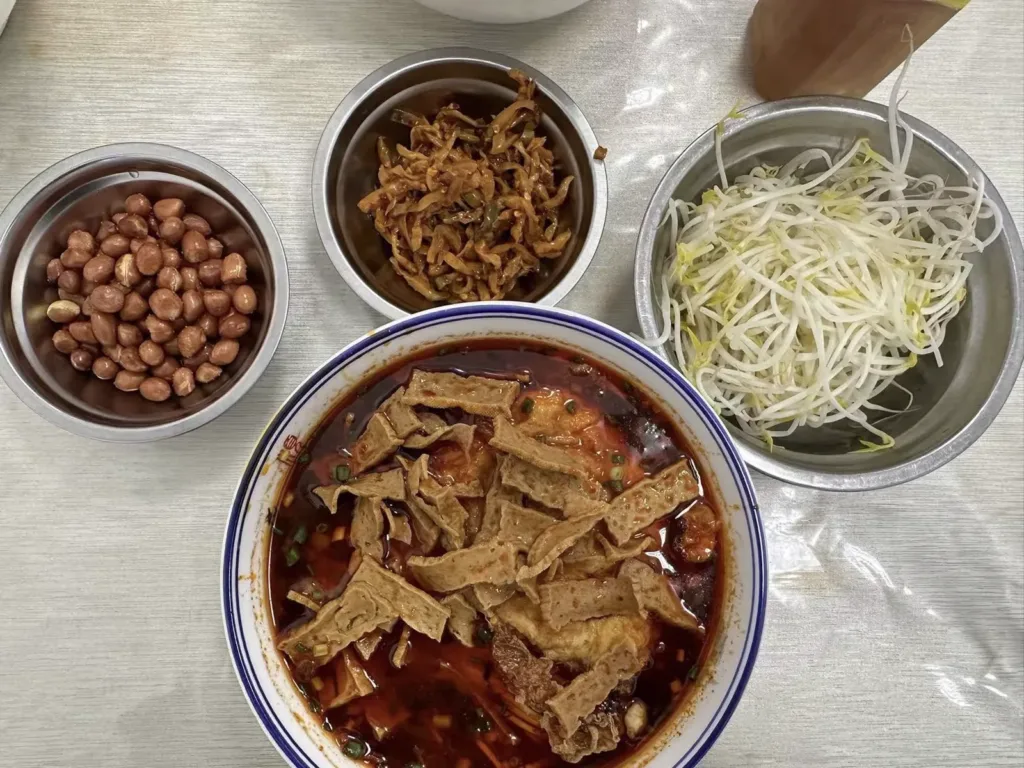
- Hunan Lengshuijiang spicy tofu rice noodles with peanuts, zha cai and bean sprouts; a disclosed regional analogue for Kunming's soft tofu rice noodles, not a Kunming bowl. Photo: Mystery6002Photo: CC0 1.0