

Kaiyuan Rolled Rice Noodles 开远小卷粉
Kaiyuan Rolled Rice Noodles are a city-associated Yunnan snack built around a freshly steamed rice wrapper, a savoury filling and a dipping sauce. The wrapper is soft and supple, while a commonly described Kaiyuan style adds an egg coating and frying for a crisp outside and tender centre. It is best understood as something to watch being made and eat while hot, not as a packaged speciality with one fixed recipe.
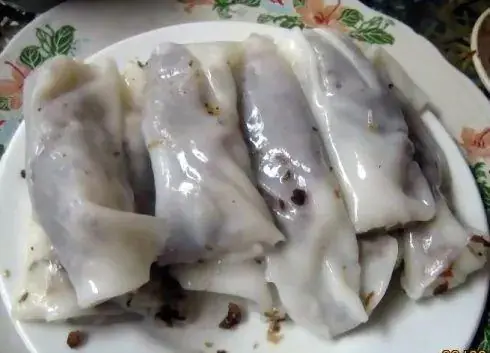
Image notes
Resized for the web; the photo itself has not been edited.
Tap any red Chinese text to hear it in Mandarin.
Kaiyuan Rolled Rice Noodles are a city-associated Yunnan snack built around a freshly steamed rice wrapper, a savoury filling and a dipping sauce. The wrapper is soft and supple, while a commonly described Kaiyuan style adds an egg coating and frying for a crisp outside and tender centre. It is best understood as something to watch being made and eat while hot, not as a packaged speciality with one fixed recipe.
What to notice
The basic wrapper starts as a rice batter. A traditional description uses a round, open-ended steaming tool: the batter is spread over a fine screen, steamed quickly, lifted onto an oiled surface and wrapped around the filling. The roll is cut into pieces; in the fried version, it is coated in a thin egg-and-starch batter and fried until lightly coloured. The result combines a slightly sticky, springy rice sheet with a savoury centre and, when fried, a crisp shell. Recipes and serving styles vary between kitchens.
Fillings commonly described for Kaiyuan include minced pork with celery, fermented or pickled vegetables such as 大头菜 and 暴腌菜, mushrooms, small bean sprouts, and pickled jiaotou (藠头). These are real variations rather than a single compulsory formula. The dipping sauce is part of the experience: dried or fried chilli, fresh chilli, fermented chilli, ginger and garlic juices, fermented tofu, peanuts, coriander, fish mint (折耳根), vinegar, soy sauce, sesame oil, garlic oil, sugar and salt may be offered in different combinations. Choose a little at first, then adjust the heat, sourness, salt and fragrance to the filling.
The snack is often linked to the movement of Vietnamese foodways along the Yunnan–Vietnam Railway and to later local adaptation in Kaiyuan. The exact origin is not settled, so treat that as a historical association rather than a proven first shop or single inventor.
How to find and eat it
Search for 开远小卷粉 Kāiyuǎn Xiǎojuǎnfěn—add 开远 Kāiyuǎn if you are searching outside the city—on Meituan (美团) or Amap / Gaode Maps (高德地图). Choose from the current nearby results only after checking the menu, recent reviews, opening information and whether the kitchen is serving it that day. Do not use a search ranking as proof of authenticity, and do not assume that every listing offers the same filling or the fried version.
This is a dish rather than a single venue, so it has no honest universal address, visitor entrance, station, exit number or fixed last-mile route. If you are already in Kaiyuan, navigate to the specific live result you selected by the city transport or taxi option shown that day. For the return, use that same listing and current map information; the return route cannot be fixed until a venue and its opening status are known. A generic railway, metro or bus route would risk sending you to the wrong place.
Pork is common, and the fried style may use egg and starch. Peanuts, fermented tofu, soy-based seasonings and several chilli preparations may appear in the sauce. Ask the vendor about the filling, batter and dipping ingredients if you have allergies or dietary restrictions; the dish should not be assumed vegetarian or allergen-free.