

Cheese Curds 奶渣
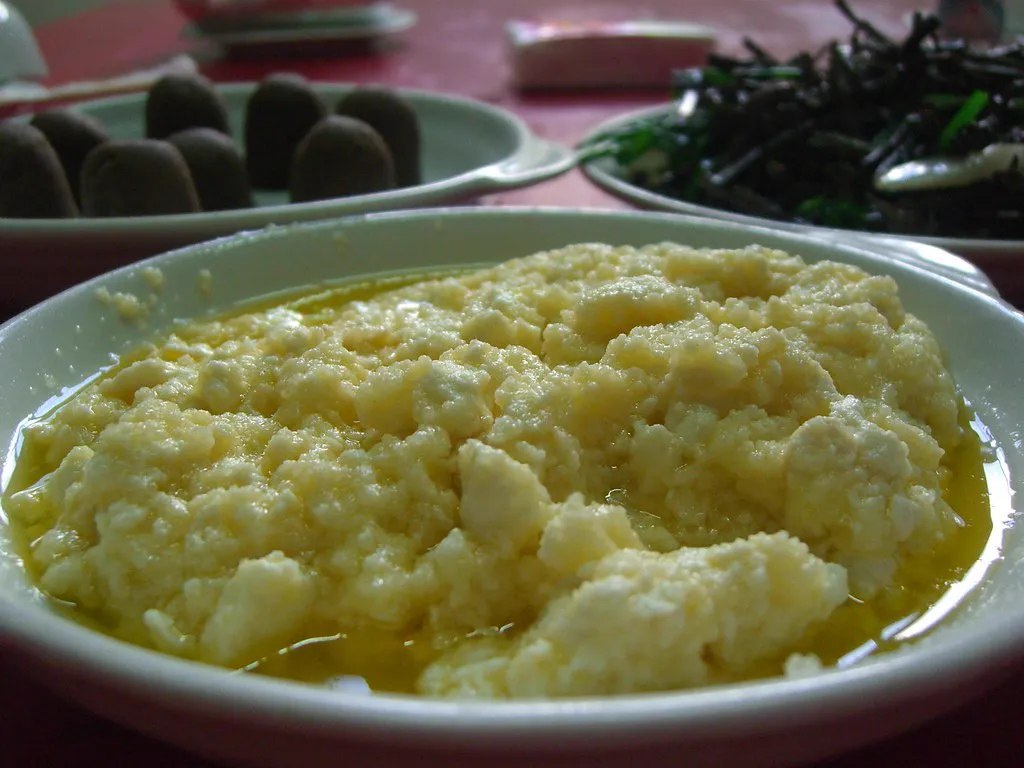
In Diqing, 奶渣 (nǎizhā) is a traditional Tibetan-area dairy food made from the solids left after milk is churned or butter is separated; the prefecture government lists it among the region’s specialty foods. Local preparations range from 酥油煎奶渣 (sūyóu jiān nǎizhā) cooked with butter and brown sugar to a Deqin-style version finished with wild honey and served with steamed buns or 粑粑 (baba).
Tap any red Chinese text to hear it in Mandarin.
What it is
奶渣 is not one standardized fresh cheese. In the basic process described in Tibetan food writing, butter is extracted from milk, then the remaining milk solids are heated so water evaporates. The result can be kept as curds, blocks or cakes. A Yunnan account describes the curds and butter as products separated from the same milk, and describes the curds as pale and slightly sour before cooking.
That distinction matters in Diqing. The prefecture government names 奶渣 as a local specialty, but the food belongs to a wider Tibetan dairy tradition rather than being a city-invented recipe. A local report links 土锅酥油煎奶渣 Tǔguō Sūyóu Jiān Nǎizhā with Nixi’s black-pot cooking and separately describes a Deqin preparation in which butter and curds meet again in a clay pot, with wild honey and breads served alongside. These are useful local associations, not a promise that every kitchen follows one formula.
How to taste it
If a menu lists 酥油煎奶渣 Sūyóu Jiān Nǎizhā, expect hot, rich curds cooked with butter. Brown sugar is one documented pairing; wild honey is another local variation. Steamed buns and 粑粑 Bāba are documented accompaniments and provide a mild, starchy counterpoint to a salty, tangy or sweet-fat bite. It may be served as curds, blocks or cakes, depending on how the kitchen prepares it, and the sweetness may be subtle or pronounced. Ask which finish the kitchen uses rather than ordering from the English label alone.
Keep these Chinese names ready: 奶渣 (Nǎizhā) and 酥油煎奶渣 (Sūyóu Jiān Nǎizhā). Search for “奶渣” or “酥油煎奶渣” on Meituan (美团) or Amap / Gaode Maps (高德地图) to find nearby places serving this dish. Check menus, recent reviews, opening information and today’s availability before choosing. Search results do not establish quality or authenticity, and this dish has no single fixed venue, address or route.
Food notes
奶渣 contains dairy, and the cooked version commonly contains butter. Do not treat its white or browned appearance as proof that it is vegetarian or safe for a milk allergy. Ask whether the kitchen uses yak milk, cow’s milk or a blend, and ask about shared utensils if cross-contact matters to you. Recipes and servings vary; the documented local versions do not justify treating one restaurant’s sweetness, pot or texture as the regional standard.
Sources & reading
Image credits & notes (1)
- Fried yak-milk curds in yak butter, photographed in a Tibetan restaurant in 2007; an illustrative dish image, not a current Diqing venue or supply claim. Photo: Alpha (avlxyz)Photo: CC BY-SA 2.0