

Matsutake with Green Chilies 青椒松茸
A Kunming-listed Yunnan dish that pairs wild matsutake with fresh green chilli. Its appeal is the contrast between the mushroom’s firm texture and forest-like aroma and the chilli’s clean heat; fresh matsutake makes it a seasonal order rather than a guaranteed year-round menu item.
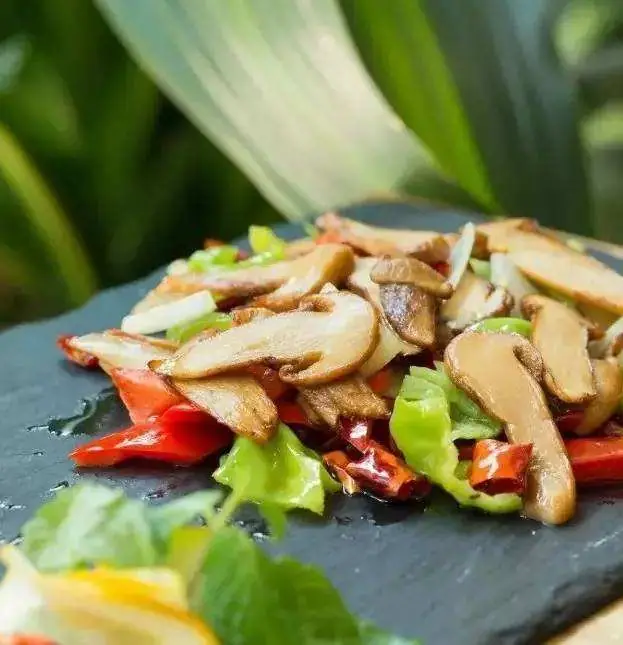
Image notes
Resized for the web; the photo itself has not been edited.
Tap any red Chinese text to hear it in Mandarin.
What the dish is
青椒松茸 (qīng jiāo sōng róng) is a Yunnan dish built around matsutake and green chilli. Kunming’s food directory lists it among the city’s local specialties, while a culinary reference identifies it as a Kunming Yunnan dish. That establishes a clear local association, but not a single fixed recipe or a claim that Kunming is the mushroom’s only home.
Matsutake is also called 松茸 or 松口蘑. A Yunnan health guide describes it as a wild mushroom that grows at roughly 2,000–4,000 metres in pine-and-oak forests and forms a relationship with pine roots. In Diqing, one of Yunnan’s major matsutake regions, a national postal report records a usual harvest season of about July to October and describes family hand-picking. This supply chain is why a plate in Kunming may connect the city’s restaurants with highland forests farther northwest.
How it is cooked
A documented version slices the matsutake and stir-fries it with green and red peppers and garlic. Salt is standard; some versions add a little stock and a thin starch glaze, while others use lard or sesame oil. Another common approach fries the mushroom briefly before adding the peppers and garlic. These are real variations, not ingredients every kitchen must use.
The useful thing to watch at the table is restraint. The mushroom should remain recognisable rather than disappear under a dark sauce. Its firm, meaty bite carries a savoury, faintly pine-like aroma; fresh green chilli adds a grassy heat and keeps the dish brighter than one made with dried chilli. Matsutake is also suitable for other methods such as frying, braising and soup, but those are different preparations, not interchangeable names for this dish.
Practical tips
Ask for 青椒松茸 (qīng jiāo sōng róng). Kunming’s broader wild-mushroom season begins around mid-June in local reporting, while the Diqing matsutake harvest is usually later and seasonal. A Kunming menu can therefore change with weather, supply and price.
Before ordering, ask whether the mushroom is fresh or rehydrated dried matsutake, and ask for the current price if it is sold by weight. If you avoid pork, ask whether the kitchen uses lard. The dish is often shared with rice and plainer food so that its aroma is easy to notice.
Wild-mushroom safety
Treat 青椒松茸 as a wild-mushroom dish, not as a promise that every mushroom called “matsutake” has been identified or handled correctly. Yunnan’s health guidance says not to collect or buy unfamiliar wild mushrooms, not to mix different mushrooms, and to cook them thoroughly; it also advises avoiding alcohol with wild mushrooms. The Chinese Academy of Sciences’ Kunming Institute of Botany likewise warns that appearance and folk tests cannot reliably identify poisonous mushrooms and that thorough cooking does not make every poisonous species safe.
For a visitor, the practical choice is a reputable, operating restaurant, a clearly identified dish, and a kitchen that cooks it through. Ask about ingredients and tell staff about allergies; do not infer that a dish is vegetarian because it looks like a simple stir-fry, and do not treat a raw or undercooked preparation as automatically safe.
Where to eat it
You can find Matsutake with Green Chilies all over Yunnan, so there is no need to seek out one particular restaurant. To find one near you, search for “青椒松茸” in Meituan (美团) or Amap (高德地图) and check recent reviews, distance and opening hours.
More dishes to compare
Explore related local specialties and compare their names, preparation notes and ordering guidance.
Lao Nai Yang Yu 老奶洋芋 →
老奶洋芋 is Yunnan mashed potato, soft and comforting and made to be eaten with rice. 青椒松茸 runs on the opposite texture, firm mushroom slices lifted by green chilli, yet both are plates where Yunnan cooking holds back on sauce and lets one ingredient speak.