

Qiubei Stir-Fried Pork with Chili 丘北辣椒炒肉
Qiubei Stir-Fried Pork with Chili is featured among the local specialties of Yunnan.

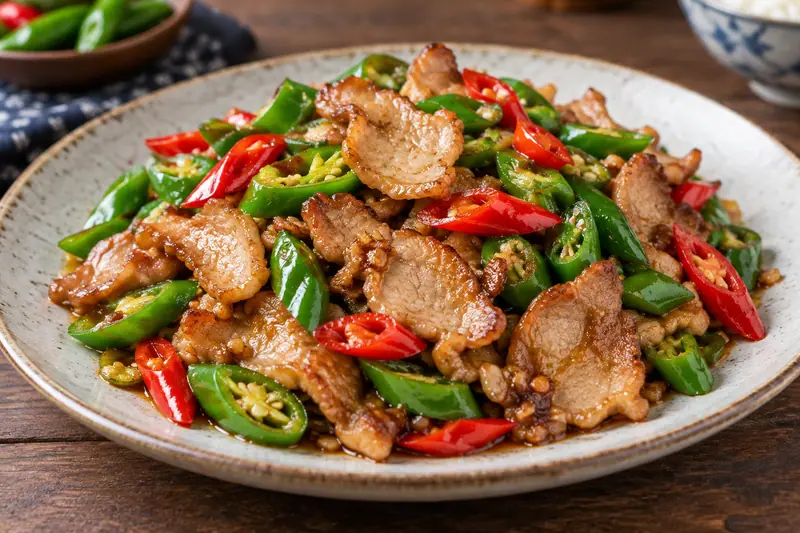
Qiubei Stir-Fried Pork with Chili (丘北辣椒炒肉) is a stir-fried meat plate catalogued for Wenshan, Yunnan, where the name stacks a county, a chili and the character for stir-frying into one menu line.
How the stir-fry is built
What makes this a 炒 rather than a stew is speed. The meat is sliced thin enough to cook through in a minute or two, the wok or pan goes on over high heat, and the ingredients are added in sequence so that nothing steams in its own juice. Aromatics such as garlic, ginger or scallion commonly go in first, the chili follows, and the meat is returned to the pan at the end so that it stays tender. Ask the kitchen how they build it if the order matters to you.
What the chili does to the plate
The chili decides how the dish reads. Fresh green or red chilies bring sharp, bright heat and a little crunch, while dried or pickled ones shift the plate towards aroma and salt. Because chilies vary from batch to batch, the same order can land mild one day and fierce the next, so 微辣 (mild) or 中辣 (medium) is worth saying out loud. Underneath the heat the taste is salty and savoury rather than sweet, and the meat carries the chili rather than the other way round.
The place in the name
丘北 is a place name inside Wenshan Zhuang and Miao Autonomous Prefecture, and 辣椒 is the ingredient that the label attaches to it. Together they make the name a pointer to a regional chili rather than a promise about the kitchen in front of you: the record catalogues the dish as a Wenshan speciality, but which chilies a given venue buys, and how much it uses, is a question for that venue. Read it as 'look for this around Wenshan' and confirm the rest on site.
Ingredients and what to ask
At its core the dish is meat, chili and cooking oil, with aromatics and a salty seasoning. A starch marinade, soy sauce, fermented bean paste, sugar or vinegar are all common ways to tune texture and flavour, and each one changes what you can safely eat: soy sauce and bean paste bring wheat, and marinades can include egg white. If you avoid meat, garlic, strong chili or wheat, say so before ordering. Ask 有肉吗 (is there meat), 有酱油吗 (is soy sauce used) and 可以少放辣椒吗 (can you use less chili).
Ordering it
Point at 丘北辣椒炒肉 on the menu, or show the characters, and settle three things first: 辣不辣 (how spicy), 一份多大 (how big the portion is) and 要不要米饭 (do you want rice with it). The dish belongs to the shared-plate style of the table, so one order usually sits alongside vegetables or a soup rather than feeding one person on its own. If you want it as a meal, add rice and treat the meat as the centre of the plate.
Eating it at the table
Eat it while it is hot: thin slices firm up and lose their edge once the plate cools, and the chili aroma fades first of all. Rice is the usual partner because it spreads the heat and mops up the seasoned oil at the bottom of the plate. In a shared meal, take a small spoonful at a time; the flavour is strong enough that the dish is normally eaten as a few bites alongside plainer plates rather than in large mouthfuls.
More dishes to compare
Explore related local specialties and compare their names, preparation notes and ordering guidance.
Xuanwei Stir-Fried Pork 宣威小炒肉 →
Xuanwei Stir-Fried Pork (宣威小炒肉) is the neighbouring catalogued entry: another Yunnan stir-fried meat plate whose name stacks a place word with 小炒肉. Both labels give you a technique and a region and leave the chili, the seasoning and the cut to the kitchen, so they are worth comparing on the plate rather than on the menu.
Questions before you order
Is the dish always very spicy?
No. 辣椒 says that chili is used, not how much, and the heat depends on the variety, the quantity and whether the seeds are kept. Ask 微辣 (mild) or 不要辣椒 (no chili), and accept that a sauce may already be mixed.
Can I eat it if I do not eat meat?
The name contains 肉 (meat), so the dish is built on meat unless the kitchen says otherwise. Ask 有牛肉的吗 (is there a beef version) or 有素的吗 (is there a vegetarian dish); you will be choosing a different plate rather than this one without the meat.
Sources & reading
The supplied food list supports this name and regional association. The culinary terms below are explained as menu vocabulary; a local recipe, origin story and venue availability have not been independently verified.