

Xichou Zhuang Leaf-Wrapped Rice Parcels 西畴壮家粽粑
Xichou Zhuang Leaf-Wrapped Rice Parcels is featured among the local specialties of Yunnan.
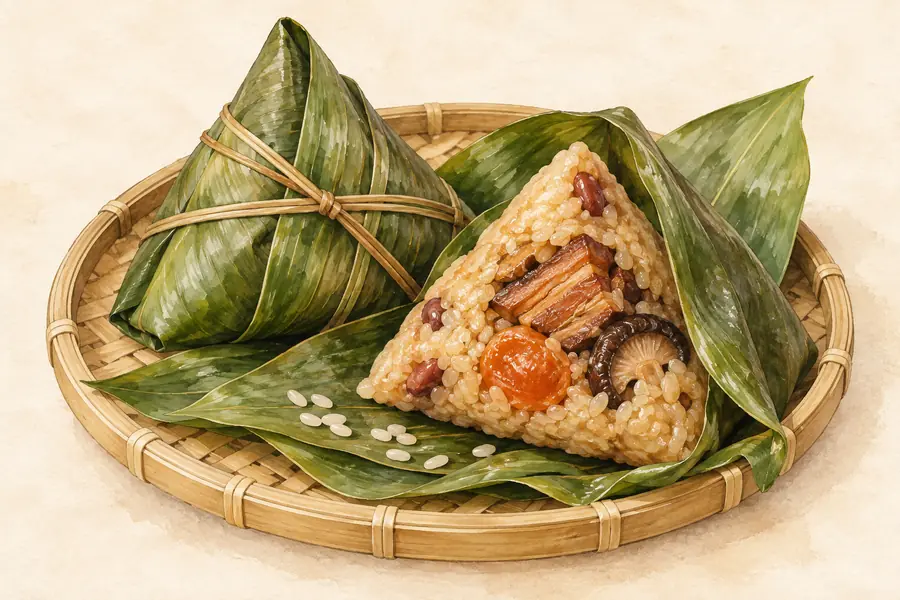
Xichou Zhuang Leaf-Wrapped Rice Parcels (西畴壮家粽粑) is a Zhuang-style leaf-wrapped rice parcel from Xichou county in Wenshan prefecture, Yunnan, where the name names a place, a household and a wrapping.
Wrapped, then cooked in the leaf
粽粑 follows the logic of the better-known 粽子. Glutinous rice, or a mix of grains, is wrapped in a broad leaf, tied with string or split cane, and then boiled or steamed until the grains set into a single dense parcel with the shape of its wrapper.
Boiling and steaming give different results. A long boil makes the rice softer and more closely packed, while steaming leaves it a little firmer, so two makers can sell parcels under the same name that eat quite differently.
Rice, leaf and filling
A plain parcel tastes of sticky rice and of the leaf that held it. Fillings split the family in two: savoury versions lean on pork, cured ham, beans or salted egg yolk, while sweet versions use bean paste, dates or nuts.
The leaf is a seasoning in its own right, and its perfume survives only while the parcel is warm. Cold 粽粑 is firmer and flatter, which is why it is worth eating where it was made rather than carrying it for a day.
The Zhuang household version
Xichou belongs to Wenshan Zhuang and Miao Autonomous Prefecture in south-east Yunnan, where Zhuang residents make up roughly 28 per cent of the prefecture population and are one of its three largest groups.
The 壮家 in the name marks a household style rather than a single shop or a single recipe. Wrapped rice parcels appear all over southern China with different wrappers and fillings, so what this entry promises is a Zhuang family version from one county, not a national standard.
Asking about the filling
Expect glutinous rice, a wrapping leaf and either a savoury or a sweet centre. Pork, cured ham, beans and bean paste all belong to the wider family, and one stall may make both kinds on the same morning.
Ask 咸的还是甜的 (savoury or sweet) before choosing, and say 不要肉 (no meat) if the parcel needs to stay vegetarian. Cured fillings bring their own salt, so it is worth asking whether ham or bacon has been included.
Buying one parcel
Show 粽粑 and ask 什么馅 (what filling) and 一个多少钱 (how much for one). They are sold singly, usually still warm from a steamer or a pot.
If you are buying several, ask 几个 (how many) and 热的吗 (are they hot). A cold parcel travels better but will not taste the same as one eaten on the spot.
Eating it on the move
Unwrap the leaf before eating and expect sticky grains on your fingers. This is a snack, a breakfast or a food for a journey rather than part of a formal meal.
One parcel is a couple of bites; two or three make a light meal with tea. Because the rice is dense and the filling is often salted, plain tea sits better alongside it than anything sweet.
More dishes to compare
Explore related local specialties and compare their names, preparation notes and ordering guidance.
Malipo Zhuang Multicolored Rice 麻栗坡壮族花米饭 →
麻栗坡壮族花米饭 is the neighbouring Wenshan entry: glutinous rice coloured with plant extracts and eaten as a dish in its own right. One is wrapped and portable, the other is served loose and coloured, but both let the rice itself carry the dish.
Questions before you order
Is 粽粑 the same as a 粽子?
It belongs to the same family of leaf-wrapped rice parcels, but the name adds a county and a Zhuang household style, so the wrapper, size and filling are local choices rather than the standard festive version.
Are the parcels always savoury?
No. Sweet fillings such as bean paste or dates sit alongside pork and bean versions, so ask 什么馅 before choosing.
Source introduction: Wikipedia contributors: 粽 · CC BY-SA 4.0. English guide adapted from the cited material, with additional preparation and ordering guidance.
Source introduction: Wikipedia contributors: 文山壮族苗族自治州 · CC BY-SA 4.0. English guide adapted from the cited material, with additional preparation and ordering guidance.