

Wild Mushroom Hot Pot 野生菌火锅
A Yunnan seasonal hot pot built around fresh wild mushrooms simmered in chicken broth; in Kunming it connects a rainy-season harvest with a social, broth-led meal. Ask for the Chinese name, and let the restaurant identify and cook the mushrooms.
Tap any red Chinese text to hear it in Mandarin.
What this dish is
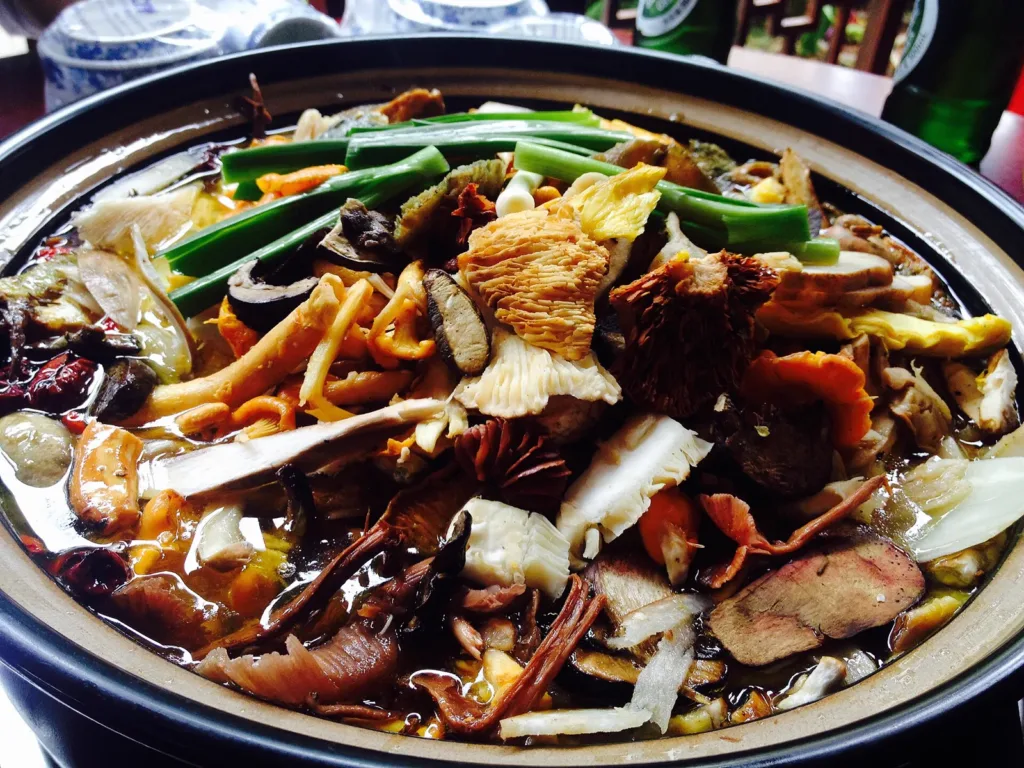
Wild Mushroom Hot Pot (野生菌火锅, yěshēng jùn huǒguō) is a Yunnan dish, not a single fixed Kunming recipe. In a Kunming restaurant report, a mixed mushroom platter is tipped into boiling local chicken broth. The same report names Kunming’s Mushuihua Wild Mushroom Trading Center (木水花野生菌交易中心) as part of the fresh-mushroom supply chain. Examples seen there include truffles, “jian shou qing” (见手青), boletes, matsutake, ganba mushrooms and chanterelles.
The dish is therefore best understood as a seasonal way of eating what is available, rather than a guaranteed list of species. Freshness, the mushroom mix, the stock and the order in which ingredients enter the pot vary between kitchens. It is normally a meat-based meal: chicken stock is central to the Kunming account, so ask before ordering if you need a vegetarian broth.
How the pot gets its flavour
The base is deliberately quiet so the mushrooms can show their aroma. A Yunnan-focused English culinary account describes chicken or silkie-chicken broth gently cooked with ginger and Sichuan pepper; it also notes that some kitchens deepen the stock with dried mushrooms while saving fresh mushrooms for the meal. That is one documented preparation, not a universal formula.
At the table, the restaurant may bring a platter of cleaned mushrooms and add them to the simmering broth. The cooking becomes part of the meal: the soup takes on a deeper mushroom scent as the pieces soften, while different fungi contribute different textures. The simple rural preparation documented by Xinhua in Eryuan, Dali, follows the same basic logic—gather, wash, cut, then make a chicken-and-mushroom hot pot—but that village setting is regional context, not a description of every Kunming restaurant.
Season and ordering
Xinhua reports that Yunnan’s wild mushrooms commonly begin appearing around May and continue until the rainy season ends in October. Rain and supply affect both the selection and the price, so a menu in Kunming can change during the season and may use dried mushrooms or a different mix outside the freshest period.
Use the Chinese name 野生菌火锅 Yěshēngjūn Huǒguō when asking about the dish. Before ordering, ask which mushrooms are available today, whether the broth contains chicken or other animal ingredients, and whether the kitchen will handle the cooking. “Wild mushroom hot pot” does not mean that every mushroom in a mixed platter is interchangeable, and the name does not promise a vegetarian or allergy-safe meal.
Safety matters
Do not forage, buy unidentified mushrooms, or use colour, worm holes, garlic or boiling as a home test. Yunnan health authorities warn people not to collect, buy, sell or eat unfamiliar or high-risk wild mushrooms. A Chinese Academy of Sciences source also notes that some toxins are not removed simply by cooking, and recommends choosing a reliable source rather than trusting folk tests.
For a visitor, the sensible choice is a restaurant that handles the mushrooms as a regular seasonal product. Eat a modest portion, follow the staff’s cooking instructions, and do not assume that a long boil makes an unknown species safe. If anyone feels unwell after eating, seek urgent medical care and keep any remaining mushrooms or a photo to help clinicians identify the meal.
Where to eat it
You can find Wild Mushroom Hot Pot all over Yunnan, so there is no need to seek out one particular restaurant. To find one near you, search for “野生菌火锅” in Meituan (美团) or Amap (高德地图) and check recent reviews, distance and opening hours.
Sources & reading
Image credits & notes (1)
- A wild mushroom hot pot crowded with assorted mushrooms and aromatics. Photo: Hyuki (Pixabay user hyuki-880087; Commons file uploaded by Kcx36)Photo: CC0 1.0