

Tsampa Roasted Barley Flour 糌粑
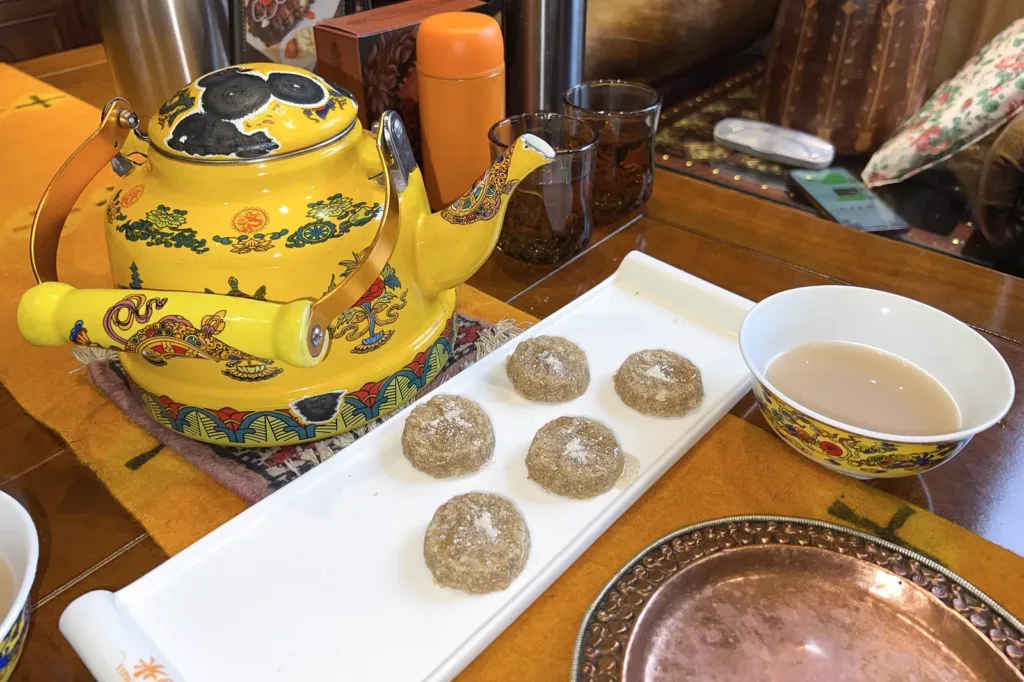
In Diqing, tsampa (糌粑) is a Tibetan staple made from roasted highland barley flour, usually worked with butter tea and sometimes dried cheese or sugar into small hand-shaped portions. It is worth trying for the contrast between toasted grain and rich tea, and for the way a simple bowl shows how local food fits high-altitude pastoral life.
Tap any red Chinese text to hear it in Mandarin.
Why it belongs in a Diqing food itinerary
Diqing’s government lists 糌粑 alongside butter tea, dried milk curd, buckwheat cakes and other local flavours. That places it within the prefecture’s Tibetan food tradition, but it does not mean Shangri-La invented the dish. Tsampa is also described as a staple across Tibetan food culture, so think of Diqing as one place to encounter a living regional tradition rather than a single city-only recipe.
Tsampa is practical food rather than a plated dish with one fixed appearance. A host or restaurant may set out the flour with tea and the other ingredients separately, leaving you to combine them at the table. The experience is as much about the mixing and shaping as it is about the final bite.
What gives the flour its taste and texture
The starting grain is qingke, or highland barley. A local Diqing-area account describes drying the barley, roasting it and then grinding it finely without sifting away the outer part. It notes both pale and purple-black barley, so the flour may differ in colour and coarseness. Roasting before grinding gives the base a toasted grain aroma; keeping the flour unsifted helps explain why it does not feel like a perfectly smooth starch.
This is why “roasted barley flour” is a better guide than “barley cake.” Before liquid is added, it is a dry, fragrant flour. Tea and fat make it workable, and the finished portion can feel compact on the outside while retaining a slightly grainy roasted character. Local descriptions do not prescribe one universal ratio of flour, tea, butter, cheese and sugar, so variation from one household or kitchen to another is normal.
How to eat it
The familiar combination is tsampa with butter tea. Put some flour in a bowl, add tea gradually, and mix it with butter; dried cheese or milk curd, often called 曲拉 (qula), and sugar may be added for a richer or sweeter version. Use your fingers to work the mixture together, then pinch or roll it into a small portion before eating. The method is simple, portable and suited to pastoral life, which helps explain why tsampa is more than a novelty snack.
Some Tibetan food descriptions also use milk tea as the liquid. The tea, butter, dairy and sugar determine whether a serving leans savoury, creamy or sweet. Treat those proportions as a real variation, not as evidence that one preparation is the only authentic one.
Barley contains gluten. Butter, butter tea and dried cheese are animal-derived or dairy ingredients, and a pale or brown flour cannot prove that a serving is vegetarian, dairy-free or safe for an allergy. Ask what was mixed into the bowl and whether the same utensils are used for other ingredients before ordering.
Finding it without turning it into a restaurant checklist
Keep the Chinese name handy: 糌粑 Zānba. Search for “糌粑” on Meituan (美团) or Amap / Gaode Maps (高德地图) to find nearby places serving this dish. Check menus, recent reviews, opening information and today’s availability before choosing. Search results and rankings do not prove quality or authenticity, and supply can change from one day to the next.
Sources & reading
Image credits & notes (1)
- Tsampa cakes served with butter tea at Makye Ame Restaurant in Xining, Qinghai; an external regional example, not a photograph taken in Diqing. Photo: N509FZPhoto: CC BY-SA 4.0