

Putuo Buddhist Vegetarian Meal 普陀素斋
Putuo Buddhist Vegetarian Meal is featured among the local specialties of Zhejiang.
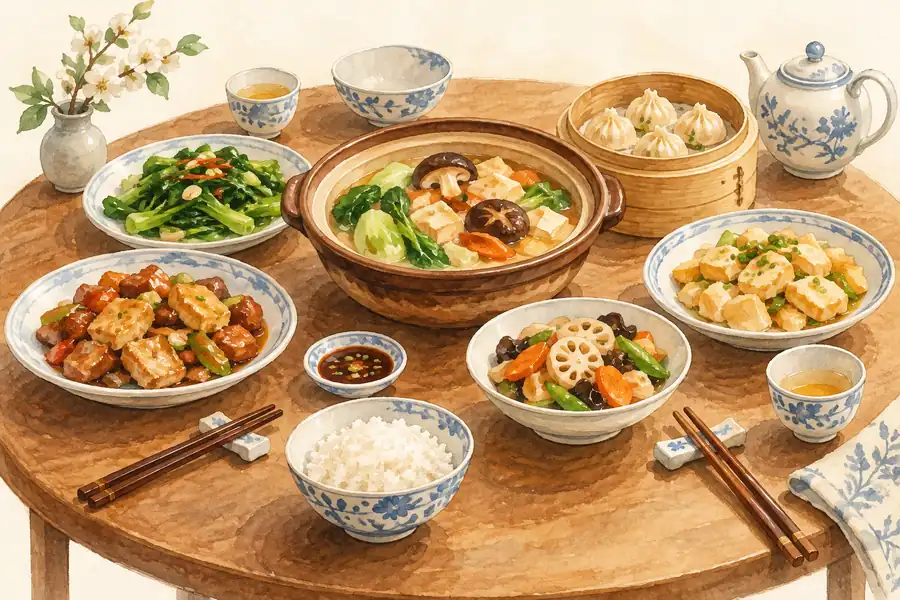
Putuo Buddhist Vegetarian Meal (普陀素斋) is a vegetarian-meal entry listed for Zhoushan, Zhejiang; 普陀 is the island place element and 素斋 is the word for a vegetarian meal of the kind served in Buddhist settings.
How the meal is built
A vegetarian meal of this kind is planned backwards from what it excludes: no meat, no fish, and in many Buddhist kitchens none of the strongly pungent vegetables such as garlic, onion, chives and leek. That removes the usual sources of savoury depth, so the kitchen builds it instead from mushroom stock, kombu or kelp, fermented bean pastes and soy sauce. Ingredients are prepared in several ways — steamed, braised, deep-fried, cold-dressed — and assembled into a sequence of small dishes rather than one large plate, so that a table can taste across textures in a single sitting.
What the food tastes like
Expect savoury, clean flavours with a lot of umami from mushroom and fermented seasoning, and less of the sweetness that comes from meat or shellfish. Textures carry more of the interest than they would in a meat-based meal: chewy wheat gluten, slippery bean-curd skin, springy konjac, crisp fried vegetables and soft steamed items in the same spread. Because nothing is heavily spiced, small differences between dishes show up clearly, and a good version is judged on how varied the courses feel rather than on any one plate.
Reading the name
The label pairs a place with a meal type. 素斋 is not a recipe but a category of cooking, and the place element tells you where the version is served. 普陀素斋 belongs to Zhoushan, Zhejiang, the island city associated with it. Because the name describes a style rather than a dish, the menu can change with the season and the kitchen, and a printed list would be wrong as soon as it was written.
Ingredients and dietary checks
The meal is built from vegetables, bean curd and bean-curd skin, wheat gluten, mushroom and other fungi, seaweed, nuts and grains. Two ingredients surprise people who assume vegetarian means free of everything: wheat gluten brings gluten, and soy sauce, bean paste and many prepared items contain wheat too. Nuts and sesame appear often. Ask 有面筋吗 (is there wheat gluten), 有大蒜洋葱吗 (is there garlic or onion), 有花生吗 (are there peanuts) and 有鸡蛋吗 (is there egg).
How to arrange the meal
Ask 怎么点 (how is it ordered), 是套餐还是单点 (is it a set menu or à la carte), and 适合几个人 (how many people is it for). If the meal is a fixed set, ask 可以不要辣吗 (can it be non-spicy) and 有没有不放蒜的菜 (are there dishes without garlic). For anyone with an allergy, it is worth confirming each course rather than the menu as a whole, since a vegetarian spread uses many prepared ingredients.
Eating it
Take the cold dishes and lighter steamed courses first and let the braised and fried items come later, which is how the textures are meant to be read. Rice or plain noodles usually anchor the table, and tea is the usual drink. Because the food is not rich, a set of this kind is easier to finish than a meat banquet, and a table of two can often manage a smaller set rather than the full spread.
More dishes to compare
Explore related local specialties and compare their names, preparation notes and ordering guidance.
Pianerchuan noodles 片儿川 →
Pianerchuan noodles (片儿川) are a single quick noodle bowl built on pork and preserved vegetable, the kind of dish a vegetarian has to interrogate before ordering. 普陀素斋 removes that problem entirely and organises a whole table around the answer, so the two show what a fixed dietary rule does to a menu.
Questions before you order
Is the meal vegan as well as vegetarian?
Not automatically. Egg is used in some dishes, and dairy appears occasionally, so ask 有鸡蛋吗 (is there egg) and 有牛奶吗 (is there milk) rather than assuming. The core of the meal is plant-based.
Does it contain garlic and onion?
In the Buddhist tradition that 素斋 refers to, the strongly pungent vegetables are often left out. Practice varies between kitchens, so ask 有大蒜洋葱吗 (is there garlic or onion) if that matters to you.
Sources & reading
The supplied food list supports this name and regional association. The culinary terms below are explained as menu vocabulary; a local recipe, origin story and venue availability have not been independently verified.