

Explore the region
Tap any red Chinese text to hear it in Mandarin.
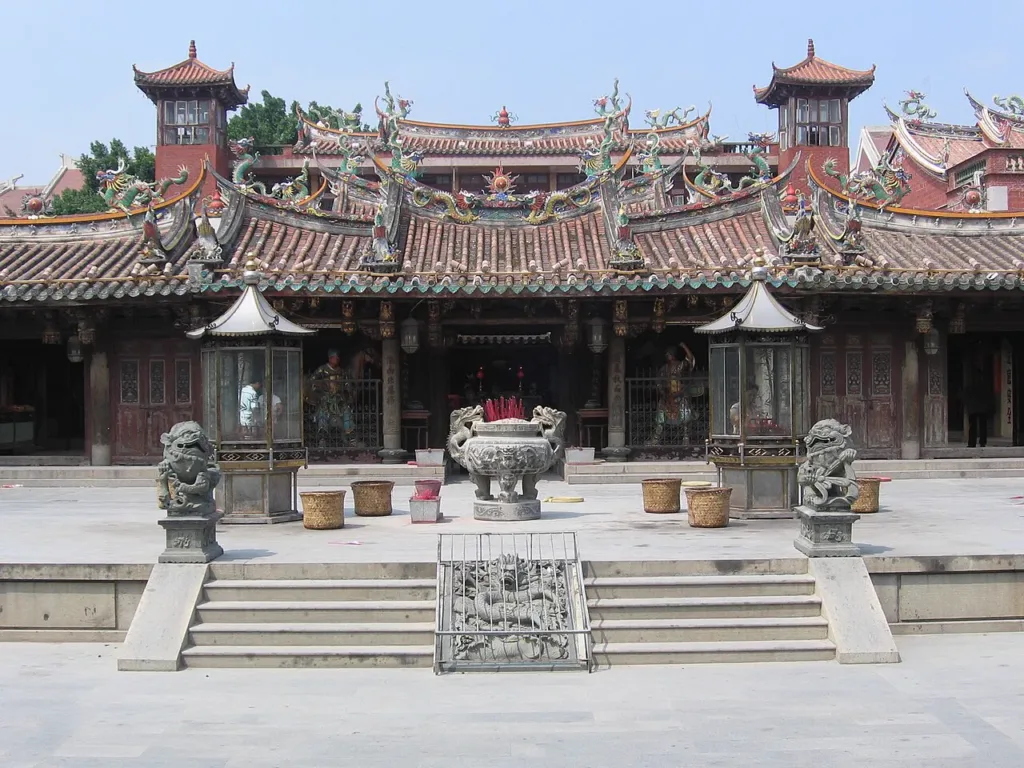
Quanzhou’s old-city streets are places where sacred buildings remain part of everyday circulation. Tonghuai Guan-Yue Temple stands directly on Tumen Street, beside Qingjing Mosque, and still functions as a place of folk worship rather than a silent display hall. The temple is a Fujian provincial cultural relic and one of the city’s best places to see how religious architecture, local craft and ordinary street life occupy the same compact block.
The name records two layers of devotion. The shrine originally centred on Guan Yu; in 1914, worship of Yue Fei was added and the name changed to Guan-Yue Temple. The present complex was repaired and rebuilt several times, including a major restoration from 1986 to 1990. Its overseas connections are part of its identity: the Licheng government describes the temple’s branch tradition across Taiwan, Hong Kong, Macao and Southeast Asia.
What to look for
Read the site as three adjoining temples rather than one undifferentiated hall. The central Wucheng Hall is dedicated to Guan Yu and Yue Fei. Sanyi Temple honours Liu Bei, Guan Yu and Zhang Fei, with associated worship of Zhuge Liang and Zhao Yun. Chongxian Hall is dedicated to Guan Yu’s ancestors. The parallel arrangement makes those different relationships visible in the plan of the building.
Look closely at the hard-ridge roofs, the chuan-dou timber frames and the Minnan decorative vocabulary: wood carving, stone carving, clay sculpture and roof-ridge porcelain decoration. Plaques attributed to Zhu Xi and Zhang Ruitu, together with historic steles and couplets, add a written layer to the architecture. The protected complex covers about 1,294 square metres, so details reward a slow look rather than a quick photograph from the street.
This is an active place of worship. Keep to the edges of courtyards, leave clear space for worshippers, and ask before photographing people, offerings or rituals. The temple is most interesting when its carved surfaces and its present-day use are observed together.
Plan your visit
The verified heritage address is No. 186 Tumen Street, Licheng District, Quanzhou (泉州市鲤城区涂门街186号). It is a street-front complex: use the Chinese name 通淮关岳庙 Tōnghuái Guān-Yuè Miào when asking for the entrance. A current visitor listing read for this guide reports free entry and opening hours of 06:00–18:00; that listing was published in 2025 rather than issued as a current temple timetable, so check the day’s arrangements if you are travelling on a major festival or expecting access to every interior.
There is no separate museum ticket or guaranteed performance included in the information reviewed here. Treat any ceremony, stage programme or temporarily closed hall as a day-specific matter, and follow signs or staff instructions inside the worship spaces.
Getting there
Quanzhou has no operating urban metro line to use for this visit; a February 2026 reply from the city’s Development and Reform Commission says the city has not met the conditions to begin metro construction.
For local public transport, Bus 33 stops at 关帝庙 (Guandimiao) and links 温陵公交首末站 (Wenling Bus Terminus) with 福厦铁路泉州站 (Fuxia Railway Quanzhou Station). The route listing places 关帝庙 in both directions. Check the vehicle destination and the stop-side signage on the day, because road works and special traffic controls can alter an urban route.
If you arrive by rail at 泉州站 (Quanzhou Railway Station), Bus 33 provides the clearest documented onward connection to the 关帝庙 stop. The city’s transport guidance treats 泉州东站 (Quanzhou East Railway Station) and 泉州南站 (Quanzhou South Railway Station) as separate high-speed stations away from the central city; from either, allow for a current taxi or bus transfer rather than assuming a direct metro connection. For the return, use the opposite-direction 关帝庙 stop for Bus 33, or request a taxi from the Chinese destination below.
For a taxi or ride-hailing car, show 通淮关岳庙,泉州市鲤城区涂门街186号. The temple is on the Tumen Street frontage, not at a separate suburban gate. If you are driving, a 2022 report identified 总站商贸城停车场,鲤城区宣武巷2号 as a nearby parking option and described a walk of about four minutes to the temple; parking availability and terms should be checked locally, and the report is not a guarantee of current capacity.
Combine your visit
A suggested sequence linking the specific features of this visit.
-
Wucheng Hall
Begin with the principal martial-deity worship space.
-
Chongxian and Sanyi halls
Compare the adjoining halls and their linked arrangement.
This order is editorial. Confirm access and any transfers between stops; it does not establish a walking route, same-day connection or common admission ticket.
Find Guan-Yue Temple
通淮关岳庙 · 泉州市
The pin marks the area, not the entrance.
More places nearby
Approximate straight-line distances between map pins, not travel distances.
Qingjing Mosque 清净寺
Less than 1 km awayQingjing Mosque preserves a monumental stone entrance on Quanzhou’s Tumen Street. Its sequence of vaulted arches leads towards the remains of the original prayer hall, where walls, niches and inscriptions give a sense of the…
View guide →Quanzhou Tianhou Temple 泉州天后宫
Less than 1 km awayQuanzhou’s Tianhou Temple honours Mazu, whose protection was sought by sailors and trading communities. The main hall’s richly decorated double-eaved roof contrasts with the broader, simpler sleeping hall behind it. Courtyards…
View guide →Kaiyuan Temple (Quanzhou) 泉州开元寺
2 km awayKaiyuan Temple’s two stone pagodas rise above a broad Buddhist precinct on Quanzhou’s West Street. Zhenguo and Renshou pagodas give the complex its unmistakable outline, while the main hall contains details that reward a slower…
View guide →Sources & visit information
Sources checked on 24 October 2026. Hours, tickets, reservations and transport can change; confirm with the operator before you go.
Image credits & notes (1)
- The central courtyard and front hall of Tonghuai Guan-Yue Temple in Quanzhou, seen from the south; the hard-ridge roof, porcelain ornament and incense burner are clearly visible. Photo: Ariel Steiner (Asteiner)Photo: CC BY-SA 2.5