

Explore the region
Tap any red Chinese text to hear it in Mandarin.
Quanzhou’s Confucian Temple is more than a single hall. It is a surviving urban institution in which worship and education were planned together. The complex began at its present site in the Northern Song period, and its main arrangement took shape in 1137. Official heritage descriptions present it as part of the cultural landscape of Quanzhou’s former maritime-trade centre: the western group is the temple for Confucian rites, while the eastern group is the prefectural school.
That relationship is still legible as you walk. Red-tiled roofs, courtyards and shaded old trees lead from a ceremonial approach to the Panchi water court and Dacheng Hall; across the complex, Yuying Gate, the study pond and Minglun Hall show that this was also a place for teaching. It is a useful stop in the old city when you want to see how Quanzhou’s public culture was built into its streets, not only how its religious buildings looked.
What to see
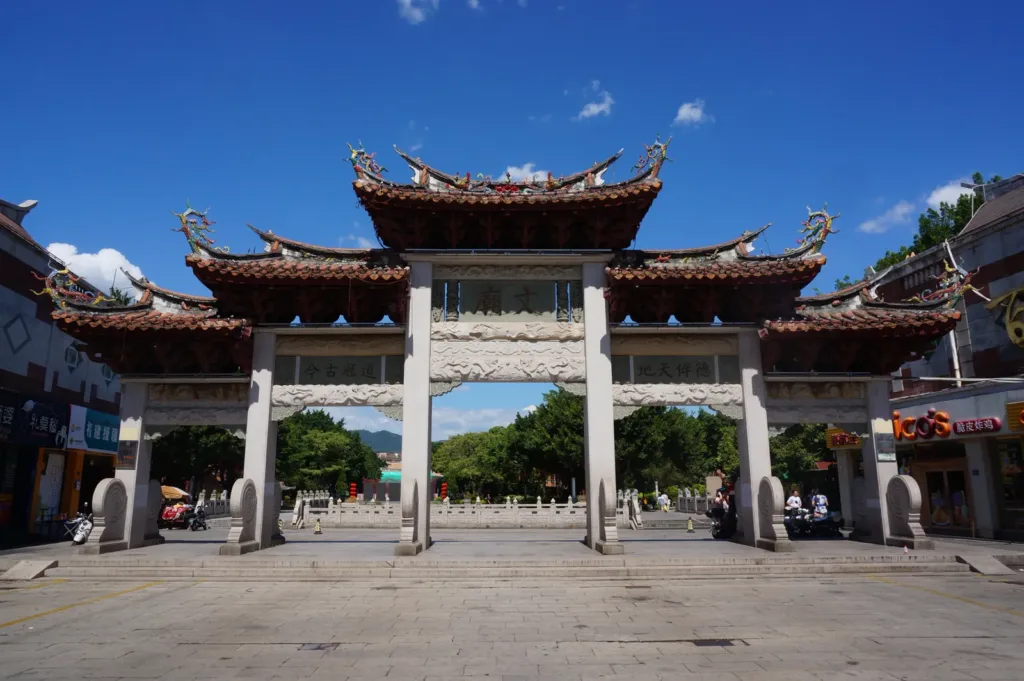
Start by looking for the former Lingxing Gate site, then follow the west, temple side towards Dacheng Gate, the Panchi pond and its stone bridge. The gate group is called Dacheng Gate and includes the central Dacheng Gate with the Jinsheng and Yuzhen side gates. The central door was traditionally reserved for major ceremonies; the side doors are the normal passage described by the heritage guide.
The main visual focus is Dacheng Hall. Its seven-bay façade carries a double-eaved hip-and-gable roof with yellow glazed tiles. Forty-eight pale stone columns support the hall, while six front columns carry carved dragons. Look also at the flower-and-scroll stone carving on the terrace base and the hall’s deep timber roof structure rather than stopping at the roofline for a photograph.
The eastern school group makes the site distinctive. Follow Yuying Gate, the study pond and bridge, the study rooms and Minglun Hall. Heritage material describes Minglun Hall as the historic prefectural school and records education-history displays in the complex. The surrounding shrines, including Cai Wenzhuang Shrine, Li Wenjie Shrine and Zhuang Jicang Shrine, add a local civic layer to the temple precinct.
Allow time to notice the water system as well as the buildings. The Panchi and study pond are linked to the old inner waterways, while the 1349 Panchi Bridge is a substantial stone bridge within the ritual approach. Treat the courtyards and halls as a protected historic and religious setting: do not cross barriers, enter closed rooms or photograph worshippers without permission.
Plan your visit
The official city description places the complex inside 泮宫 on Zhongshan Road in Licheng District: 泉州市鲤城区中山路泮宫内 Quánzhōu Shì Lǐchéng Qū Zhōngshān Lù Pàngōng nèi. For a taxi or ride-hailing car, show 泉州府文庙(鲤城区中山路泮宫). The heritage guide identifies 泮宫 as the approach into the temple grounds; once there, follow the current signs for the open visitor entrance rather than assuming that the central 大成门 will be unlocked.
A local visitor listing currently gives opening hours of 09:00–17:00 and free admission. Check the same-day notice before setting out, especially if you want to see interior displays or arrive around a ceremony; the public boundary of a protected monument can differ from the hours shown in a general listing.
For buses, the local visitor listing points to city routes 1, 3 and 18 for the temple area. Use 府文庙 Fǔ Wénmiào as the Chinese destination name, confirm the direction and live stop display in Amap or another current local map, and keep the Chinese address above for the final walk. A Fujian transport notice dated 2024-11-05 also describes tourist lines L1, 2, 30 and K502 as linking Fuwenmiao with other heritage stops and with Quanzhou Railway Station and Quanzhou East; check that the line is still operating in the displayed direction before boarding.
There is no verified metro stop included for this sight. From a ticket marked Quanzhou Railway Station 泉州站, Quanzhou East 泉州东站 or Quanzhou South 泉州南站, continue to the temple by a live bus connection or taxi rather than treating the railway station as a walkable entrance. The city’s transport briefing says Quanzhou East and Quanzhou South are away from the central urban area; for the return, book or display the exact same Chinese station name before leaving the temple.
Find Quanzhou Confucian Temple
府文庙 · 鲤城区
The pin marks the area, not the entrance.
Sources & visit information
Sources checked on 24 October 2026. Hours, tickets, reservations and transport can change; confirm with the operator before you go.
- Quanzhou Confucian Temple — Quanzhou Municipal People's Government ↗
- Quanzhou Confucius Temple and School — Quanzhou tourism recommendation ↗
- Quanzhou Confucius Temple and School — Fujian Provincial Cultural Heritage ↗
- Confucius Temple and School — Quanzhou Gastronomy ↗
- Quanzhou Confucian Temple details — Quanzhou Bendibao ↗
- Four Quanzhou bus routes adjusted as tourist lines — Fujian Provincial Department of Transport ↗
- Quanzhou's two high-speed railway stations and their bus connections — Quanzhou Municipal People's Government ↗
Image credits & notes (1)
- The rebuilt Lingxing Gate of Quanzhou Confucian Temple, viewed from Zhongshan Road. Photo: 猫猫的日记本Photo: CC BY-SA 4.0