

Explore the region
Tap any red Chinese text to hear it in Mandarin.
Why visit
Quanzhou’s maritime story is easiest to understand here as a landscape rather than a museum label. Jiuri Mountain stands above the upper Jinjiang and beside the old river approach to the port. The inscriptions connect monsoon timing, state-run overseas-trade administration, and the prayers said before ships departed or returned.
The visit is a short hill walk through wooded slopes and a temple-foot area, with the principal historical stops on the east and west peaks. It suits visitors who enjoy reading carved texts and noticing how a modest riverside site fits into the wider Quanzhou maritime network. The mountain’s name is traditionally linked to the custom of people who had migrated south from the north climbing here at the Double Ninth Festival to look towards their former homeland.
What to see
The wind-praying inscriptions
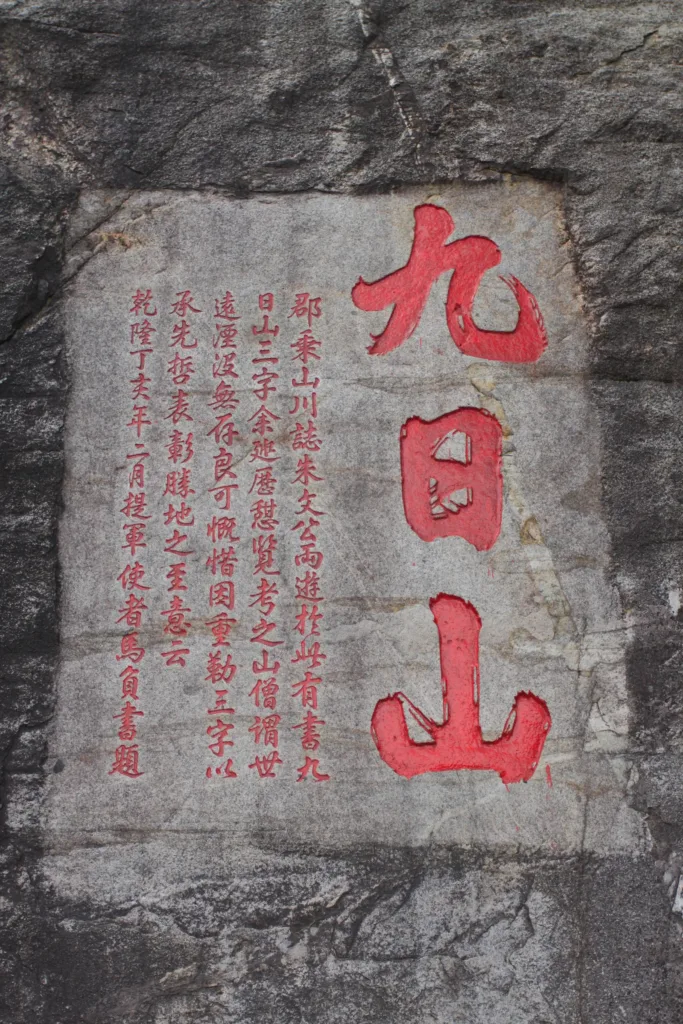
The current heritage description records 78 surviving inscriptions from the Song dynasty onwards. Ten are the famous wind-praying inscriptions: two on the east peak and eight on the west peak. They date from 1174 to 1266. Six record prayers for winter departures, three concern ships returning in summer, and one records both seasonal rites.
These are not simply scenic calligraphy. The texts name maritime-trade officials, local civil and military officials, and members of the imperial clan. They preserve the seasonal logic of sailing with the monsoon and show how the Song state linked overseas commerce with official ritual and maritime administration. Read them as compact records of people, dates, ceremonies, and shipping conditions rather than as a single monument with one legend.
Peaks, temples, and later layers
The west peak contains the Five Dynasties stone Buddha associated with Chen Hongjin; a protective stone structure shelters the seated figure. The east peak is Jiangxiang Peak, associated with the Tang chancellor Jiang Gongfu, while the west peak is also known as Gaoshi Peak through its connection with the Tang poet Qin Xi. The older temple landscape below the slopes includes Yanfu Temple, and the official approach described in a Fujian report climbs from the temple-foot area through trees towards the cliff carvings.
Look also for the inscription left after the 1991 UNESCO Maritime Silk Road expedition, signed by specialists from more than 20 countries. In 2021, the Jiuri Mountain Wind-Praying Inscriptions became one of the component sites of Quanzhou: Emporium of the World in Song-Yuan China. UNESCO lists the component separately, rather than treating the whole mountain and every nearby temple as one identical heritage unit.
Planning your visit
Where it is. Jiuri Mountain is in Xushan Village (旭山村), Fengzhou Town (丰州镇), Nan’an (南安市), Quanzhou. For a car or taxi, show 九日山景区(九日山祈风石刻),南安市丰州镇省道307线旭山小学北. The visitor approach is by the mountain-foot area near Yanfu Temple, then up the managed steps and paths. An older municipal heritage page describes the site as being behind Jinji Village; treat that as a legacy local-name clue for the same Fengzhou-side site, not as a second Jiuri Mountain.
Entry and timing. The official pages consulted for this guide do not state a current 2026 ticket price, opening schedule, or passport-specific reservation procedure. Confirm the day’s entrance arrangements with the local cultural-tourism or site operator before travelling. A 2022 city notice about reservation and capacity limits was a pandemic-era notice and should not be read as the current ticket rule.
By bus. Search for the Chinese stop name 九日山站 Jiǔrì Shān Zhàn. Quanzhou’s transport authority reported in April 2026 that Tourist Routes 1–7 and K608 form the current tourism-bus network serving key heritage sites including Jiuri Mountain. A public route listing also places 九日山 on K208 from Quanzhou Railway Station to Honglai, as well as on 6路, 旅游6路, 旅游7路, K204路, and Nan’an 161路. Route numbers and stop patterns can change, so check the current direction and the return bus in the official Quanzhou Bus channels before setting out; do not assume an older 602 label is still used.
Rail, airport, and return. If you arrive by rail, Quanzhou Railway Station (泉州站) is the clearest public-transport starting point for the K208 listing; continue to 九日山站 or take a road transfer from the station. Quanzhou East and Quanzhou South are separate newer stations, and the municipal government notes that they sit away from the central urban area, so check the exact station name on your ticket before planning the last leg. Quanzhou Jinjiang International Airport (泉州晋江国际机场) is in Jinjiang rather than at the mountain; its airport plaza has buses towards Quanzhou and Jinjiang Railway Station, after which you still need a road or bus connection to Fengzhou.
Allow time for the uphill return to the entrance, and check the last bus before climbing. There is no verified seasonal boat service or current visitor boat boarding point for Jiuri Mountain, so do not plan a water return based on the historical references to boats in the inscriptions.
Find Jiuri Mountain
九日山 · 南安市
The pin marks the area, not the entrance.
Sources & visit information
Sources checked on 24 October 2026. Hours, tickets, reservations and transport can change; confirm with the operator before you go.
- Jiuri Mountain Wind-Praying Inscriptions — Quanzhou Municipal Government ↗
- Jiuri Mountain: Sailing Thousands of Miles with the Wind — Fujian Provincial Government ↗
- Quanzhou: Emporium of the World in Song-Yuan China — component map ↗
- Jiuri Mountain Wind-Praying Inscriptions — Quanzhou UNESCO Heritage information ↗
- Quanzhou Transport Bureau 2026 proposal response ↗
- Jiuri Mountain Cliff Inscriptions — Quanzhou Tourism Bureau ↗
- Quanzhou's high-speed railway stations — Quanzhou Municipal Government ↗
- Jiuri Mountain Wind-Praying Inscriptions — China Daily Government Portal ↗
- Quanzhou A-level scenic spots reopen with reservations — Quanzhou Municipal Government ↗
- 九日山 — Chinese Wikipedia (transport stop listing) ↗
- Quanzhou Jinjiang International Airport — Fujian Provincial Government ↗
Image credits & notes (1)
- A carved inscription on the rock face at Jiuri Mountain, Quanzhou Photo: ZhangzhugangPhoto: CC BY-SA 4.0