

Explore the region
About Chanding Monastery
The county government's page records that in 1254 the Sakya leader Phagspa (八思巴), travelling through Zhuoni on his way to the court of Kublai Khan, judged the site excellent and directed his disciple the Sakya Geshe Sherab Yeshe (喜饶益西) to stay and build a monastery there, giving him a sandalwood-carved standing Buddha together with sutras and a stupa as foundation relics; Sherab Yeshe converted an existing Nyingma monastery to the Sakya school. The same page records that in 1459 Rinchen Lundrub (仁钦龙布), brother of the second Zhuoni tusi, converted the temple to Tsongkhapa's Gelug school and named it Ganden Shedrubling, and that in 1710 the Kangxi emperor granted its abbot Ngawang Trinle Gyatso (阿旺陈烈嘉措) the title of state preceptor and bestowed the name Chanding Temple, which it has used since. The prefecture government's page dates the founding differently, to 1295, with Phagspa himself choosing the site, laying the foundation, naming it and directing the building work, so the two cited pages do not agree on the date or on Phagspa's own part in it.
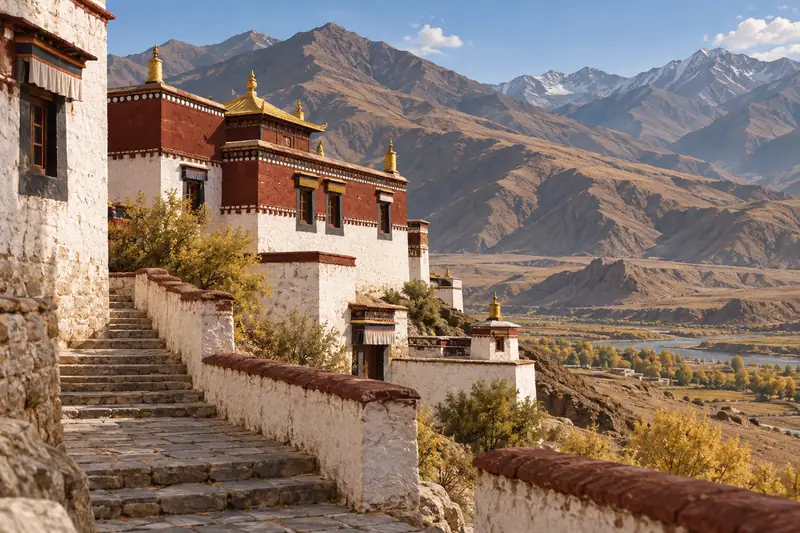
The county page calls the temple the first ancient temple of Amdo (安多第一古寺), places it on the high Baitu ridge above the town, and records that before its conversion to the Gelug school it was one of the more influential of the Sakya school's hundred and eight monasteries on the Tibetan plateau, and that together with Labrang Monastery in Xiahe it formed the two leading Gelug monastery systems of the Gannan region. It describes the buildings as ranged symmetrically about a north-south axis formed by the upper and lower great assembly halls, with glazed roof tiles and gilded ornaments, dharma wheels, victory banners and vases above and carved brackets, coffered ceilings and beam frames within; the halls, it says, are filled with images, thangkas, wall paintings and appliqué work and amount to one of the treasuries of Tibetan national culture.
The same page records that the temple published and kept the Zhuoni editions of the Kanjur and Tanjur, cutting 108 Kanjur volumes and 309 Tanjur volumes in work that ran from 1721 to 1772 over more than fifty years, and that a printing hall was built for the blocks. It adds that these volumes and the blocks were destroyed in war.
What to look for
- The upper and lower great assembly halls and the symmetric layout the county page describes about their north-south axis
- The glazed roof tiles, gilded ornaments, dharma wheels, victory banners and vases, and the carved brackets, coffered ceilings and beam frames the page lists
- The thangkas, wall paintings and appliqué work filling the halls, which the page calls one of the treasuries of Tibetan national culture
- The printing hall built for the blocks of the Zhuoni Kanjur and Tanjur, whose 108 and 309 volumes were cut between 1721 and 1772
- The site itself, which the county page records Phagspa judging excellent and directing his disciple to build on in 1254
Location & getting there
Getting to Chanding Monastery
Check which interiors and courtyards are accessible. Active places of worship and protected monuments may have different visitor rules.
- Search for 禅定寺 with 甘南藏族自治州 and 卓尼县.
Find Chanding Monastery
禅定寺 · 卓尼县
No reliable map pin yet: search by the Chinese name.
Sources & visit information
The linked sources support the identity and background described in this introduction. Opening hours, admission, activity availability and exact arrival arrangements have not been comprehensively checked. Confirm current visitor information with the venue; the original catalogue locality and editorial review flag are retained.