

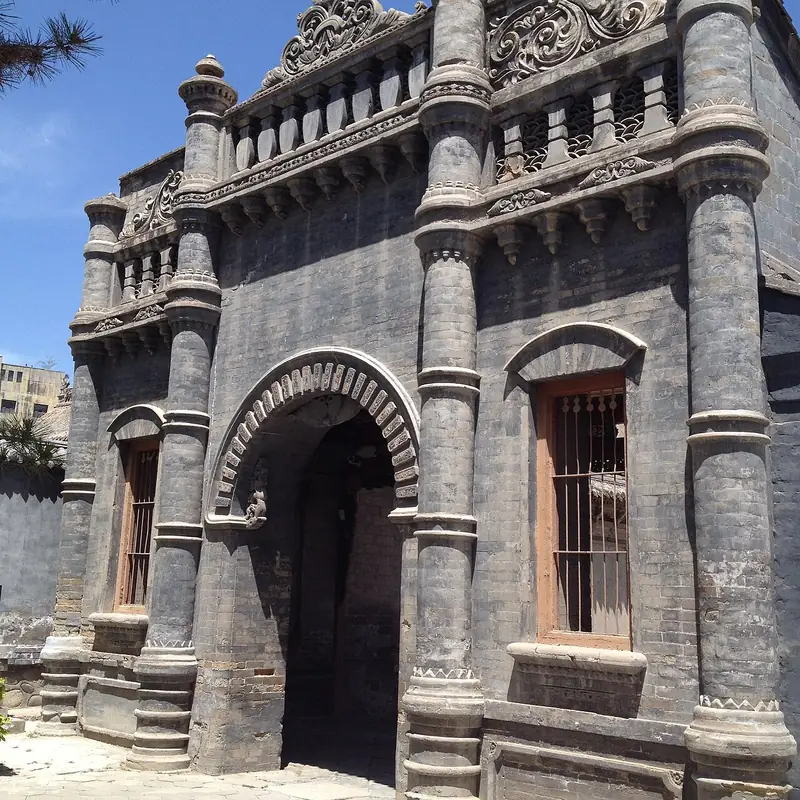
Photo adjustments
Full frame retained; EXIF orientation normalized, proportionally resized to at most 800 pixels and converted to WebP. No generated pixels or subject changes. Cards may crop the display.
Explore the region
About Donggongguan Mansion
The essay on the Linxia Prefecture Museum site opens by calling the building the most complete synthesis of Republican-era residential building in the Linxia area, and attributes its mixed courtyard layout to Han Chinese, Islamic and European eclectic architectural influences. It records that the residence faces south and is made up of four courtyards, a front courtyard, a main courtyard, a side courtyard and a garden, and that these meet at a central light well which acts as the circulation hub, a small hall-like courtyard with a large screen wall on its north side and covered galleries on the other three, with doors at the four corners leading to the four courtyards.
The main courtyard was where Ma Buqing lived, and holds a brick-and-timber main building of three storeys, five bays wide on each floor and carried on 24 full-height columns; the timber, the essay says, was fine red pine brought specially from Qinghai and the partitions are finished in rosewood, which it calls unique among the Hui residences of Bafang. The main building is flanked by two-storey secondary buildings, and the side halls and the hall opposite are seven-beam structures five bays wide on each face. The south-west and north-west courtyards are both quadrangle courtyards with seven-beam halls and side buildings, and the south-east courtyard holds a flower-viewing tower. The centre of the screen wall is a large landscape brick carving, Jiangshan Tu, made of 24 square bricks and measuring 2.8 m across by 2 m high.
The Gansu Daily feature on Linxia brick carving places the Donggongguan on the south-east side of the Bafang district and names it, with the Red Garden, as the place where Linxia brick carving is most concentrated. It records that the building has a 10 m-high grey-brick wall carved all over with pines and cranes, cypresses, plum, orchid, bamboo and chrysanthemum, among other motifs. Brick carving, it explains, is an ancient Chinese architectural decoration made by carving figures, landscapes and flowers into fired clay bricks, and Linxia work uses a fine grey brick fired in earth kilns at Beiyuan town, washed free of grit and sand, formed in wooden moulds, dried and fired, giving a dense brick of moderate hardness suited to carving.
Neither page says when the building became a protected site or a visitor attraction, and neither gives opening arrangements or ticket information or states a scenic-area grade. The essay's naming of the south-west courtyard is inconsistent between two passages, and this record does not rely on that name.
What to look for
- The 10 m grey-brick wall the Gansu Daily feature describes as carved all over with pines and cranes, cypresses, plum, orchid, bamboo and chrysanthemum
- The screen wall in the central light well, whose centre is the brick carving Jiangshan Tu, made of 24 square bricks and measuring 2.8 m by 2 m
- The three-storey brick-and-timber main building in the main courtyard, five bays wide on each floor and carried on 24 full-height columns
- The covered galleries on three sides of the central light-well courtyard and the doors at its four corners leading to the four courtyards
Location & getting there
Getting to Donggongguan Mansion
Check which interiors and courtyards are accessible. Active places of worship and protected monuments may have different visitor rules.
- Search for 东公馆 with 临夏回族自治州 and 临夏市.
Find Donggongguan Mansion
东公馆 · 临夏市
No reliable map pin yet: search by the Chinese name.
Sources & visit information
The linked sources support the identity and background described in this introduction. Opening hours, admission, activity availability and exact arrival arrangements have not been comprehensively checked. Confirm current visitor information with the venue; the original catalogue locality and editorial review flag are retained.