


Explore the region
About Faquan Temple
The Jingyuan county government's page calls Faquan Temple the largest cave temple complex surviving in the county and a famous temple of Longshang, and says it is also known as Hongshan Faquan Temple because it stands among red hills. Three springs issue below the cliff — Mochi, Yueya, also called Mozi, and Longgu — and the page says the name was taken from the words for dharma gate and clear spring. A county tourism page gives the same location as 10 km south-east of the county seat and repeats the three springs and the derivation of the name.
The temple was founded in the Northern Wei period and flourished in the Tang and Song, the county page says, making it more than 1,500 years old. After cutting and repair through the Sui, Tang, Five Dynasties, Song, Yuan, Ming and Qing, 36 caves survive, holding sculpture and murals from the Tang onwards. The page records repairs in 1102, and in 1450, 1522 and 1582 under the Ming.
The page reads two inscriptions for the temple's standing. It cites a Ming stele of 1477 by Yang Mian, the Guyuan defence official, recording that the temple was founded in an earlier age whose details cannot be checked; and a record from Jingyun Temple at Kaicheng saying that in the fifth year of Chongning in the Song, 500 ordination certificates were granted to Faquan Chan Temple at Dahongshan Cha in Huizhou. The page reads this as showing that Faquan was the upper house and Jingyun Temple, now in Haiyuan in Ningxia, its lower house. Both county pages also state that the temple shares a lineage with Famen Temple in Shaanxi and Jingyun Temple in Ningxia.
By the Kangxi period of the Qing, dozens of caves had been cut, and the page lists what then stood, among other sights: Tianwang cave, Qianfo cave, Sanjiao cave, Cangjing cave, Hongwen cave, the elders' shrine, the Jueshi pavilion, the covered bridge, the old pagoda, a Tang elm, a Song willow and a Ming bell. The temple then covered four square li with a thousand mu of temple land, divided into front and rear temples, and housed as many as 1,500 monks. In the 1960s, the page adds, it at one point stored the Siku Quanshu and other rare books that had been moved to Gansu for safekeeping.
Among the caves, the Qianfo cave was cut in the Northern Wei period and consists of front and rear caves, a chaitya-type cave with niches on all four walls holding round, high-relief and relief Buddha figures; its door has two seated Buddhas and its entrance ceiling carries a lotus panel in blue, red, green and brown. The Wufang cave, also Northern Wei, is an arched cave with Vairocana at the centre and Buddhas of the five directions on the walls, representing five kinds of wisdom. The Damo cave, again Northern Wei and flat-roofed, holds a seated Bodhidharma facing south with two attendant boys. The Guanyin hall, 7.5 m deep and 6 m wide, was cut in the Northern Wei period and its main Guanyin figure, about 1 m high, holds a green vase with a willow spray. The Tianwang cave is a flat-roofed cave 6 m deep and 5 m wide with niches on three sides, holding a roughly 2 m heavenly king and wall paintings the page calls Tang in style.
Later work is represented too. The Yufo tower holds a reclining jade Sakyamuni about 6 m long and weighing 13.5 tonnes, and the Zixuan pavilion, newly built in recent years, holds a 9 m figure of Nüwa with a mural about 15 m long showing her creating and repairing the sky. The Yanyang palace keeps a couplet attributed to Lü Dongbin, and the gate records a couplet by Zhang Daqian; the temple gate itself carries a couplet by the Gansu calligrapher He Yu, reading 法能护体,地翠千里;泉可洗心,灵映九州.
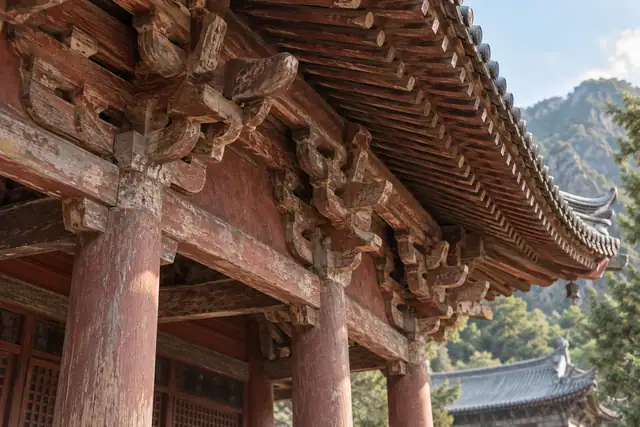
The temple was listed as a national second-class protected cultural relic in the 1950s and as a provincial protected cultural relic in the 1960s. In 1988 Jingyuan county set up a protection leading group and a repair committee, with Zhang Yuxian in charge, and the page records that 23 caves have since been repaired and, among other works, the Great Buddha hall, the five-direction and ten-direction Buddha caves, the Eight Immortals cave, the Wuliang Zushi cave, Hongwen pavilion, Yanyang palace, Sanjiao cave, Yaowang cave, Dizangwang cave, Yunfeng bridge and Jueshi pavilion restored, with the Lingxiao hall, Shuxiang pavilion, Zixuan pavilion, the bridge, the gate, Lingtai, Biyu hall, Tianfeng pagoda and the five hundred arhats hall newly built and more than a thousand statues repainted. Tang-dynasty statues of Bodhidharma and two boy attendants were unearthed at the site. In 1993 the temple was restored to provincial protected status, and in 2004 it was listed as a provincial forest park. The county page describes it as combining Confucianism, Buddhism and Daoism in one place, and as bringing together architecture, sculpture, garden design and literature.
What to look for
- The 36 caves on the cliff face, holding sculpture and murals from the Tang onwards
- The Qianfo cave's front and rear chambers, its lotus ceiling panel and the seated Buddhas at the door
- The Wufang cave's Vairocana and the Buddhas of the five directions on its walls
- The Damo cave's seated Bodhidharma and the Guanyin hall's willow-holding Guanyin
- The Tianwang cave's heavenly king and its wall paintings in the style the page calls Tang
- The reclining jade Sakyamuni in the Yufo tower, about 6 m long and 13.5 tonnes
- The Zixuan pavilion's 9 m Nüwa and its 15 m mural of her creating and repairing the sky
- The three springs below the cliff — Mochi, Yueya and Longgu
- The couplets at the gate, including He Yu's 法能护体,地翠千里;泉可洗心,灵映九州
- The temple buildings restored since 1988, among them the Great Buddha hall, Hongwen pavilion, Yanyang palace, Yunfeng bridge and Jueshi pavilion
Location & getting there
Getting to Faquan Temple
Check which interiors and courtyards are accessible. Active places of worship and protected monuments may have different visitor rules.
- Search for 法泉寺 with 白银市 and 靖远县.
Find Faquan Temple
法泉寺 · 靖远县
No reliable map pin yet: search by the Chinese name.
Sources & visit information
The linked sources support the identity and background described in this introduction. Opening hours, admission, activity availability and exact arrival arrangements have not been comprehensively checked. Confirm current visitor information with the venue; the original catalogue locality and editorial review flag are retained.