

Photo adjustments
Wikimedia thumbnail; fitted to the ranking-card frame.
Explore the region
About Labrang Monastery
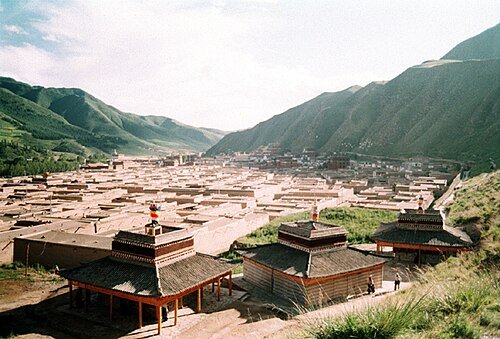
Its halls and colleges form a substantial settlement of white walls, courts and gilded roofs. The prayer-wheel route shows the monastery’s daily devotional rhythm, while the main assembly spaces and the Gongtang chorten reveal different architectural scales. A visit is best organised around the authorised hall tour and the public perimeter, leaving teaching and ritual areas to their own purposes.
Labrang Monastery was founded in 1709, during the Kangxi era (康熙), by the first Jiamuyang (嘉木样) Living Buddha, Awang Songzhe (阿旺宋哲); in 1714 its Labrang (拉章), the residence of the monastery's supreme reincarnate lama, was established, giving the monastery its name. It was listed as a Major Historical and Cultural Site Protected at the National Level (全国重点文物保护单位) in 1982. In July 2021 the monastery completed its first large-scale restoration in more than 300 years, at a cost of over 400 million yuan; fourteen halls, including the Maitreya Hall (弥勒佛殿), finished restoration.
The monastery has six great assembly halls and numerous Buddhist halls, including the Tsongkhapa Hall (宗喀巴佛殿) and the Thousand-Hand Thousand-Eye Guanyin Hall (千手千眼观音殿), plus a scripture repository, a sutra-printing house and a bronze pagoda. Its collection of Tibetan-language texts, built up since the second Jiamuyang, is described as the most extensive held by any Tibetan Buddhist monastery in the country. In 1782 it founded a Tibetan medical college, Mankang (曼康), which still produces remedies listed in the national pharmacopoeia.
Labrang is one of the six great monasteries of the Gelug school (格鲁派) and the largest monastery in the Tibetan areas of southern Gansu; it is said to have had as many as 108 subordinate monasteries and historically served as the religious and political center of the Gannan (甘南) region.
What to look for
- The prayer-wheel circuit around the monastery precinct.
- The major assembly halls and the gilded Gongtang chorten.
Location & getting there
Getting to Labrang Monastery
Travel to Labrang Town in Xiahe County and continue toward the monastery at the western end of the main settlement beside the Daxia River. Confirm the meeting point for any interior tour separately from access to the public perimeter.
Combine your visit
A suggested order for the documented features and stops.
-
Prayer-wheel perimeter
Understand the monastery’s daily devotional circuit without obstructing worshippers.
-
Authorised hall tour
Learn how the assembly spaces and colleges relate to monastic life.
-
Gongtang chorten area
Compare the stupa form with the halls, subject to its own access arrangements.
This is an editorial sequence. Check access and any road or boat transfers; it does not establish a walking route, common ticket or guaranteed same-day connection.
Find Labrang Monastery
拉卜楞寺 · 甘南州
The pin marks the area, not the entrance.
More places nearby
Approximate straight-line distances between map pins, not travel distances.
Milarepa Pavilion 米拉日巴佛阁
42 km awayMilarepa Pavilion is a tall, red-walled religious building within the Hezuo monastery precinct. Its vertically arranged shrines bring together figures associated with different Tibetan Buddhist traditions, while paintings and…
View guide →Dangzhou Grassland Scenic Area 当周草原景区
44 km awayDangzhou Grassland combines an open meadow setting with developed visitor facilities on the southern edge of Hezuo. A Tibetan-style entrance decorated with auspicious motifs introduces paths, viewpoints and white-stupa features…
View guide →Sources & visit information
The sources below support the place-specific description and arrival information. Suggested combinations are editorial planning ideas; confirm current opening, entry arrangements and transport services for your date.
- 拉卜楞寺 ↗
- Xiahe ↗
- Chinese Wikipedia: 拉卜楞寺 (revision 94244529, 2026-09-08) ↗
- English Wikipedia: Labrang Monastery (revision 1367125393, 2026-08-01) ↗
Visitor information adapted and edited from Wikipedia contributors, “拉卜楞寺” · CC BY-SA 4.0. Source revision 93621164.
Visitor information adapted and edited from Wikivoyage contributors, “Xiahe” · CC BY-SA 4.0. Source revision 5214976.
Background paragraphs translated and condensed from Wikipedia contributors, "拉卜楞寺", Chinese Wikipedia · CC BY-SA 4.0. Source revision 94244529.
Background paragraphs condensed from Wikipedia contributors, "Labrang Monastery", English Wikipedia · CC BY-SA 4.0. Source revision 1367125393.