


Photo adjustments
Full frame retained; proportionally resized and converted to WebP. No retouching or changes to the photographed subject. Card displays may crop the view.
Explore the region
About Leitai Han Tomb
Leitai Han Tomb (雷台汉墓) is a brick tomb beneath the Leitai (雷台) terrace on Beiguan Middle Road (北关中路) in Liangzhou District (凉州区), Wuwei (武威), Gansu, and the place where the bronze Galloping Horse (铜奔马), made the emblem of Chinese tourism in 1983, was dug up in 1969.
The tomb was found by accident in early autumn 1969, when members of Xinxian Commune (新鲜公社) in what was then Wuwei County were digging an air-raid shelter at Leitai and broke through the outer wall of a chamber. They handled and moved the bronze chariots and horses, which disturbed the site and made the procession hard to reconstruct. Dang Shoushan (党寿山), the Wuwei official responsible for antiquities, persuaded the production team to show him the finds and registered them, and that December they went to the provincial museum. A Taoist temple (道观) first built in the Ming dynasty stands on a terrace heaped up over the tomb's earth mound, and local people know the spot as the Zhang Family's Great Grave (张家大坟). Two tombs have now been excavated there; the one that held the horse is designated Tomb No. 1.
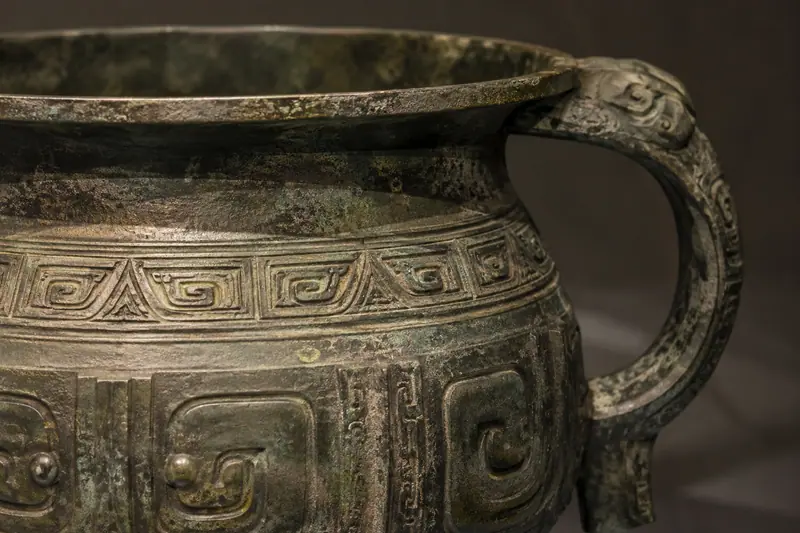
The tomb opens to the east. Its rear, middle and front chambers run in a line, with one side room off the middle chamber and a matching pair off the front one. The middle chamber held a many-branched bronze lamp, a bronze pot, a zun wine vessel and an incense burner, while its side room was filled with pottery, including a model of a towered courtyard house. The owner lay in the rear chamber with four turtle-knob silver seals bearing a general's title. Although robbed several times, the tomb still gave up more than 230 objects, among them 17 warrior figures, 28 servant figures, 39 bronze horses and 14 bronze chariots.
Inscriptions on the bronze horses use the unit title 'left cavalry thousand' (左骑千人) and the place name 'Zhangye county, Liangzhou' (凉州张掖县), both known only from Han texts, while the floor coins are wuzhu (五铢) of a Wei-Jin type. Specialists quoted by Xinhua (新华社) date the tomb to 186–219 CE, the last years of the Eastern Han; other proposals run as late as the Former Liang (前凉), and a Western Jin date has had wide support. With no epitaph, the occupant is inferred from the seals and chariot procession to be a general surnamed Zhang. The tomb became a national key protected heritage site (全国重点文物保护单位) in 2001. The Galloping Horse itself, 34.5 cm tall with one hind hoof resting on a flying bird, is kept in the Gansu Provincial Museum (甘肃省博物馆) in Lanzhou.
What to look for
- The three-chamber brick tomb with its east-facing door
- Side rooms off the middle and front chambers, where bronzes and pottery were found
- The Ming-dynasty Taoist temple on the terrace raised over the tomb mound
- Tomb No. 1, find spot of the bronze Galloping Horse (铜奔马)
Location & getting there
Getting to Leitai Han Tomb
- Search for 雷台汉墓 with 武威市 and 凉州区.
Find Leitai Han Tomb
雷台汉墓 · 凉州区
No reliable map pin yet: search by the Chinese name.
Sources & visit information
Written from the linked sources and checked sentence by sentence against quoted extracts by a separate reviewer on 2026-09-23. Opening hours, admission and access arrangements are not covered; confirm current visitor information with the site.
- 雷台汉墓 - 维基百科,自由的百科全书 ↗
- 铜奔马 - 维基百科,自由的百科全书 ↗
- Flying Horse of Gansu - Wikipedia ↗
- 【涨姿势】其实马踏飞燕踏的并不是燕子-新华网 ↗
- 甘肃省A级旅游景区名录(截至2025年12月31日) ↗
Some facts checked against Wikipedia contributors, "雷台汉墓" · CC BY-SA 4.0.
Some facts checked against Wikipedia contributors, "铜奔马" · CC BY-SA 4.0.
Some facts checked against Wikipedia contributors, "Flying Horse of Gansu" · CC BY-SA 4.0.