

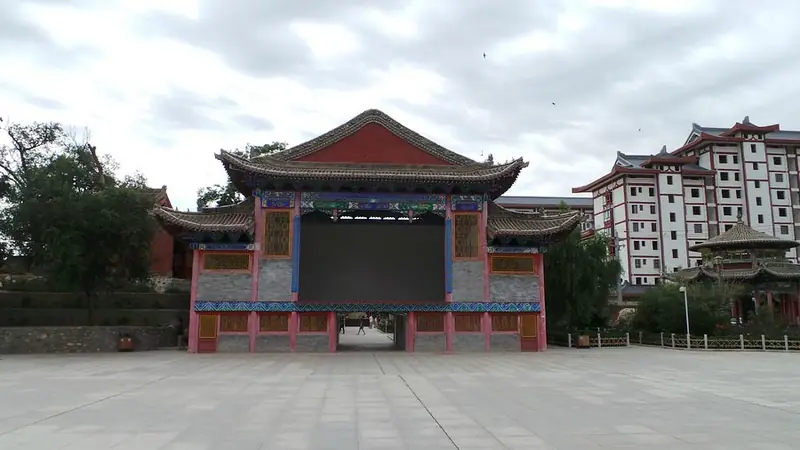
Photo adjustments
EXIF orientation normalized; resized without changing aspect ratio; converted to WebP. No subject edits.
Explore the region
About Li Family Dragon Palace
The Lanzhou Morning Post feature describes the palace as first built in the early Tang, a Tang court-style ancient building group, and the ancestral hall where Li clan members gather and make offerings; it is known at home and abroad, the feature says, because the Tang emperor Taizong wrote the name 李家龙宫 himself, and it calls the palace the only ancient building group preserved in Longxi. A People's Daily Online photo feature places it in Gongchang town, Longxi county, and gives the founding as the first year of Zhenguan, 627.
The feature gives the scale: the palace faces south and measures 600 m east to west and 440 m north to south, with 250,000 sq m of building area, which it says is a third of the whole county town. It adds that a palace is larger in scale and higher in rank than a temple, and that the buildings inside are divided into front, middle and rear groups. The first construction, it says, took several thousand craftsmen three years and three months.
The main hall, also called Xuanyuan palace or the Laozi hall, holds a statue of Laozi, Li Er, whom the feature calls the tenth-generation descendant of the Li. Its door carries a plaque reading 追本溯源 in Taizong's hand; the feature explains that the four characters use a missing stroke, a shared stroke and an added stroke, the last in the 民 of Taizong's name, meaning 济世安民, rule for the people. Nine roof figures were placed on the ridge of the main hall — dragon, phoenix, lion, heavenly horse, suanni, yayu, xiezhi, douniu and yinshi — where only imperial palaces and the Hall of Supreme Harmony were allowed ten. Li Junfu, a researcher at the Longxi Li culture institute, tells the feature that such ridge ornaments were most famous in the Qin and the Northern Song, and that the ones here are Northern Song; the main hall's are openwork, so the far side shows through and the two faces differ.
The Zushi hall holds Li Qiong, the Pure Yang patriarch, whom the feature identifies with Lü Dongbin. Two large murals flank its door, one showing the Tang building of the palace with timber carried in on yaks from the south, the other the Ming plan of the palace as it now stands, also called the Beiji palace. The feature records that in the 1960s, when relics in Longxi were badly damaged, workers plastered mud over the two murals to protect them, and that the mud later cracked and fell away, revealing the paintings intact.
The Jiulong hall, also called the Taizong hall, has nine carved dragons on its ridge, five on the main ridge with a coiled dragon at the centre and four flying dragons on the gable ridges; the side halls are called phoenix halls, with phoenixes along their ridges and a natural dragon-shaped root carving inside. Altogether, both sources give 1,899 carved dragons on the buildings, a figure the Lanzhou Morning Post feature links to 十八子李, the character 李 made of the elements for 十八子, and to the clan's prosperity. The People's Daily Online page adds halls standing now that the older feature does not name: a Li generals hall with statues of Li commanders from the Warring States to the Ming, from Li Mu to Li Guang and Li Shimin, and a dragon tree and dragon root hall.
Of the earlier fabric, the feature says the palace was at one point demolished and levelled; part was rebuilt in the Song and destroyed again by war, and of the Yuan buildings only one survives, the frontier tower, erected to commemorate the flying general Li Guang. That tower differs from every other building in having a roll-roof gable rather than a 人-shaped roof, and in its 藏头露尾 beam structure, with a dragon tail outside and a dragon head inside. The People's Daily Online page adds that the surviving ridge beasts are Northern Song brick carvings, which it calls the palace's greatest treasure.
The Longxi Tang behind the rear garden is new: the Lanzhou Morning Post feature says it was built with donations from Li clan members worldwide, its main hall standing on 18 steps under a gold plaque reading 陇西堂 and holding tablets of Li ancestors including the Three Sovereigns and Five Emperors, Gao Yao, Li Lizhen, Li Er, Li Tan, Li Si, Li Xin, Li Gao and Li Guang together with a portrait of the Tang founder Li Yuan; the annual Li ancestral ceremony is held there. The People's Daily Online page describes the same hall as in imitation Ming and Qing style, with a huge 李 character on its wall.
What to look for
- The Northern Song openwork brick carvings on the main hall's ridge, among them the 子牙楼, 登天龙 and 游龙 panels, and the surviving ridge beasts the People's Daily Online page calls the palace's greatest treasure
- The nine roof figures on the main hall's ridge, where imperial palaces were allowed ten
- The 追本溯源 plaque in Taizong's hand at the Xuanyuan hall, and its statue of Laozi
- The two murals flanking the Zushi hall, one of the Tang building and one of the Ming plan of the palace
- The frontier tower, the single surviving Yuan building, with its roll-roof gable and 藏头露尾 beams
- The 1,899 carved dragons across the buildings, the figure both sources give
- The Jiulong hall's nine dragons, and the phoenixes of the side halls with the dragon-shaped root carving
- The Longxi Tang, built with donations from Li clan members worldwide, its main hall on 18 steps
- The Li generals hall's statues of Li commanders from Li Mu to Li Guang and Li Shimin
Location & getting there
Getting to Li Family Dragon Palace
Check which interiors and courtyards are accessible. Active places of worship and protected monuments may have different visitor rules.
- Search for 李家龙宫 with 定西市 and 陇西县.
Find Li Family Dragon Palace
李家龙宫 · 陇西县
No reliable map pin yet: search by the Chinese name.
Sources & visit information
The linked sources support the identity and background described in this introduction. Opening hours, admission, activity availability and exact arrival arrangements have not been comprehensively checked. Confirm current visitor information with the venue; the original catalogue locality and editorial review flag are retained.