


Explore the region
About Qingcheng Ancient Town
The Gansu culture and tourism feature gives the town's origin and name. It says the place was a frontier garrison from the Han dynasty, and that in the Renzong years of the Northern Song, after the Western Xia ruler Li Yuanhao rebelled, the Qinzhou prefect Di Qing built a new town on the foundation of the Tang dynasty Longgou fort to guard against Western Xia incursion, relying on the Yellow River. Because it was long east to west and narrow north to south it was called 'one-street town' or 'Tiaocheng', and it was later named Qingcheng in memory of Di Qing.
The same feature describes the town's commercial history. It calls Qingcheng an oasis in a bend of the Yellow River that was once an important river shipping wharf: goods carried from Lanzhou towards Baotou went downstream by sheepskin and oxhide raft and Qingcheng was the first stopping point, so the town grew into a centre of water transport, trade and culture, and in the Ming and Qing it became known across Gansu as a water-tobacco town. It adds that historical records show Qingcheng had six academies in the Qing dynasty and produced 11 jinshi and 74 civil and military juren.
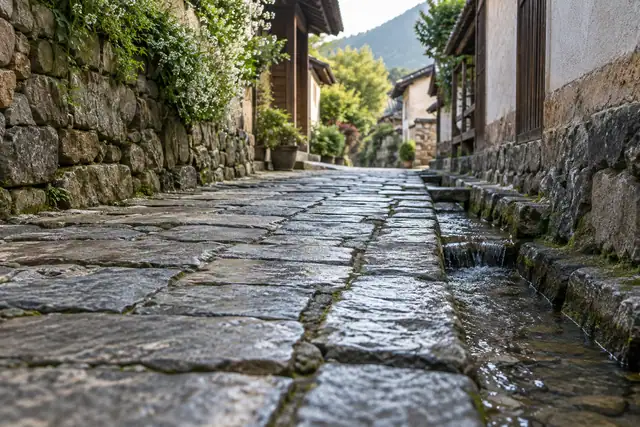
The town's plan and housing are described in the same feature. One main street runs through it with lanes off it, and the old houses include classical courtyard, three-sided and strip compounds, many with carved hanging-flower gateways, drum-shaped door stones, brick carving and spirit walls; the courtyards are built as three-hall-three-wing, three-hall-five-wing and three-hall-seven-wing forms, and because their owners were water-tobacco merchants from elsewhere the houses take in architectural features from Beijing, Tianjin, Shaanxi and Shanxi. Most date from the Kangxi, Qianlong, Jiaqing and Daoguang reigns of the Qing and stand mainly in the three villages of Chenghe, Qingcheng and Xinmin; the feature counts 1 Ming building, 33 Qing buildings and 15 Republican-era buildings, with 12 intact courtyard houses, 18 fairly intact, 14 fragmentary and 16 with only the gatehouse left, and more than 60 old courtyard houses in all.
Two monuments are described in both sources. The Gao ancestral hall was begun in the 44th year of the Qianlong reign of the Qing and initiated by the ninth-generation Gao ancestor Gao Bingxin, and the Gansu feature calls it the only surviving family shrine in the Qingcheng area; it covers more than 2,000 square metres with 400 square metres of building area and more than 20 halls and covered walkways, and the Ministry of Culture and Tourism page says it was completed in the 50th year of Qianlong, 1785, and holds the plaque 'Able in Both Letters and Arms' granted by the Daoguang emperor to Gao Minggui and the 'Jinshi' plaque granted by the Xianfeng emperor to Gao Hongru. It was listed as a county-level cultural relic protection unit in 1993, a provincial-level one in 2003 and a national key cultural relic protection unit in 2013. The two sources differ on the city god temple: the Ministry of Culture and Tourism page says it was built in the Baoyuan years of the Song, 1038 to 1039, first as the Qinzhou prefect's council hall and so also called the Di Qing residence, turned into a garrison headquarters in the early Ming, converted to a city god temple in 1724, and covering 1,000 square metres, while the Gansu feature gives its area as 3,800 square metres and lists its buildings as the gate, opera tower, covered walkways, side halls, bell and drum towers, an offering hall, a hall for the city gods of Gaolan and Jinyuan counties, and the main hall, arranged symmetrically on a north-south axis. Both give its county-level listing in 1993 and its national key listing in 2013.
The Ministry of Culture and Tourism page sets out a route through the town, running Gao ancestral hall, Qingcheng academy, Luo family compound, city god temple and the old courtyard houses, and gives driving access as 120 kilometres and about two hours from Lanzhou city centre and public transport as bus 101 from Baiyin to the Qingcheng old town stop. It also describes the Dongtan lotus pond, formed where canal irrigation made low-lying land into wetland planted with more than 100 mu of lotus, and the Erlong Mountain building group, begun in the late Ming and early Qing, built against a hill over more than 8,000 square metres and named for a hill shape likened to two dragons playing with a pearl, whose best-preserved building is a large opera tower begun in the Qianlong reign. The Gansu feature records that the town was named one of China's ten most beautiful charm towns in 2012, that the old dwellings were listed by the State Council in the seventh batch of national key cultural relic protection units in 2013 and that the town was included in the first batch of China's characteristic towns in October 2016, and that water-tobacco making, the Daotai lion dance and the Xixiang tune are on Gansu's intangible cultural heritage list.
Neither source gives opening hours, ticketing or any statement of which courtyards are private homes, so the catalogue's caution about residents' privacy stands. The two sources describe the town's status differently, one as Lanzhou's only provincial-level historic and cultural town and the other as a China historic and cultural town, and both are reported as those pages give them. The Gansu feature is a provincial promotional piece and the Ministry of Culture and Tourism page is a route promotion, so the building counts, dates and measurements in this record are those pages' own; no designation list or heritage survey was consulted in this round. The Gansu feature also calls the city god temple magnificent, and that description is not adopted.
What to look for
- The Gao ancestral hall, with the plaques the Ministry of Culture and Tourism page says were granted by the Daoguang and Xianfeng emperors
- The Qingcheng city god temple, whose buildings the Gansu feature lists from the gate and opera tower to the main hall
- The old courtyard houses along the main street and its lanes, with their carved gateways, drum-shaped door stones, brick carving and spirit walls
- The Qingcheng academy and the Luo family compound, where the Gansu feature says water-tobacco making can be seen
- The Dongtan wetland lotus and the Erlong Mountain building group, both described on the Ministry of Culture and Tourism page
Location & getting there
Getting to Qingcheng Ancient Town
Identify the main visitor approach and any separately managed houses, museums or performances. Ask before entering residential spaces or photographing residents.
- Search for 青城古镇 with 兰州市 and 榆中县.
Find Qingcheng Ancient Town
青城古镇 · 榆中县
No reliable map pin yet: search by the Chinese name.
Sources & visit information
The linked sources support the identity and background described in this introduction. Opening hours, admission, activity availability and exact arrival arrangements have not been comprehensively checked. Confirm current visitor information with the venue; the original catalogue locality and editorial review flag are retained.