

Photo adjustments
Full frame retained; proportionally resized and converted to WebP. No retouching or changes to the photographed subject. Card displays may crop the view.
Explore the region
About Yumen Pass Ruins
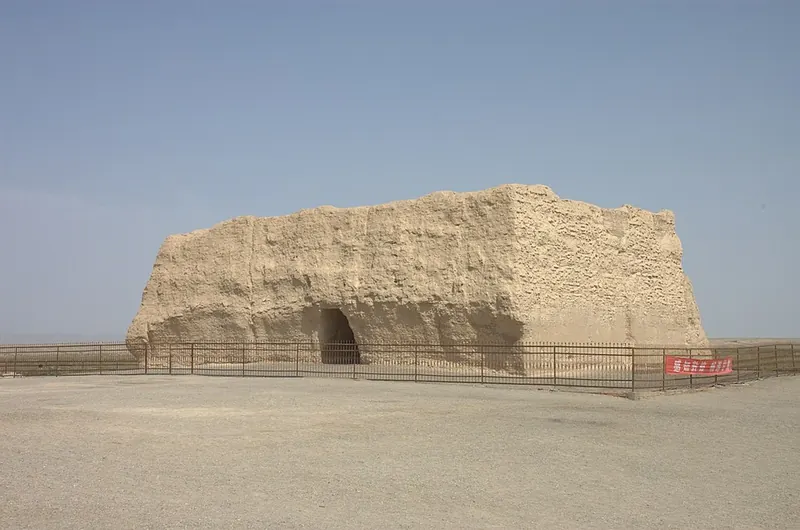
The Yumen Pass Ruins (玉门关遗址) are the remains of the Han-dynasty Jade Gate, a square earthen fort in the desert northwest of Dunhuang (敦煌), Gansu, close to the Shule River (疏勒河). Locally the fort is called Xiaofangpan Cheng (小方盘城, "Small Square Tray Fort").
Emperor Wu of Han (汉武帝) set up the pass, and its name, Yumen or "Jade Gate", comes from the jade carried from the Western Regions (西域) along this road. Together with Yangguan (阳关), which lies to its southwest, it made up the pair of frontier gates known as the "two passes" (二关): travellers leaving by Yumen took the northern road, those leaving by Yangguan the southern. In 1907 Aurel Stein found bamboo slips that named the site as Yumenguan, and Chinese archaeologists confirmed the identification in 1944.
The crossing did not stay here. In the Six Dynasties period, as the road from today's Anxi (安西) to Hami (哈密) gained importance, the pass moved east to near Shuangta (双塔); the Tang set it up again, and the ruins seen today belong to the Han site. Once the land routes westward faded after the Song, the pass fell into ruin.
The fort is square, like a tray, with gates in its north and west walls. Its mud walls stand about 10 m high and enclose more than 600 m², and the Shule River runs less than 100 m beyond the north gate. The site lies at about 1,400 m above sea level, northwest of Erdun village (二墩村) in Yangguan town. About 15 km to the northeast, in a hollow beside the old east–west bed of the Shule, stands Hecang Cheng (河仓城), known locally as Dafangpan Cheng (大方盘城, "Big Square Tray Fort"). Both are covered by the national protected-site listing Yumen Pass and Great Wall Beacon Sites (玉门关及长城烽燧遗址), made in 1988, and in 2014 Yumen Pass became one of the components of the UNESCO World Heritage site covering the Chang'an-Tianshan corridor of the Silk Roads. The pass has long been a subject for poets; the Tang poet Wang Zhihuan (王之涣) wrote that the spring wind does not pass Yumen Pass (春风不度玉门关). The site appears as the Yumen Pass Ruins Scenic Area, rated 3A, in Gansu's list of scenic areas. It should not be confused with the city of Yumen (玉门), some 400 km to the east.
What to look for
- Xiaofangpan Cheng (小方盘城), the square Han fort with mud walls about 10 m high and gates on the north and west
- The Shule River (疏勒河), less than 100 m beyond the fort's north gate
- Hecang Cheng (河仓城), or Dafangpan Cheng, about 15 km northeast beside the old course of the Shule
- Remains of Great Wall beacon towers included in the same national listing
Location & getting there
Getting to Yumen Pass Ruins
- Search for 玉门关遗址 with 酒泉市 and 敦煌市.
Find Yumen Pass Ruins
玉门关遗址 · 敦煌市
No reliable map pin yet: search by the Chinese name.
Sources & visit information
Written from the linked sources and checked sentence by sentence against quoted extracts by a separate reviewer on 2026-09-23. Opening hours, admission and access arrangements are not covered; confirm current visitor information with the site.
Some facts checked against Wikipedia contributors, "玉门关" · CC BY-SA 4.0.
Some facts checked against Wikipedia contributors, "Yumen Pass" · CC BY-SA 4.0.