

Explore the region
About Fengshan Mazu Temple
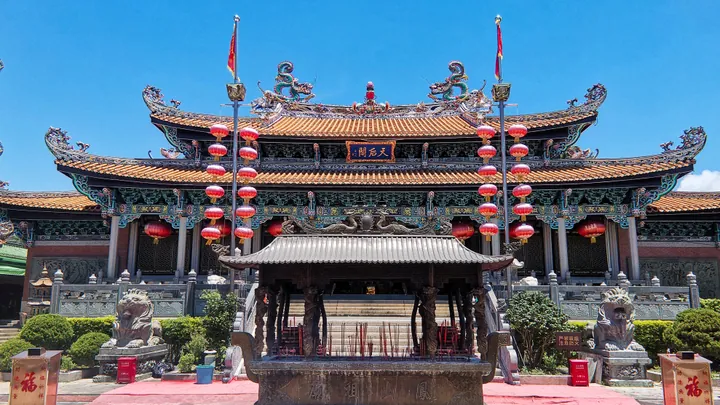
Fengshan Mazu Temple (凤山祖庙) is a temple to the sea goddess Mazu (妈祖) on Fengshan hill (凤山) in Chengqu (城区), Shanwei (汕尾), set in a temple park of about 100,000 m² on the shore of Pinqing Lake (品清湖) on the east side of the district.
The temple dates from 1636, the ninth year of the Chongzhen reign of the Ming. Fishermen from Fujian (福建) who had drifted to this stretch of coast and settled below Fengshan brought Mazu with them as their protector. When the Kangxi court lifted the ban on sea trade, Shanwei harbour grew into a busy port, and the temple was enlarged in 1742. It was rebuilt in its old form in 1934, and from the 1980s donations from local people and overseas Chinese paid for the Tianhou Pavilion (天后阁), bell and drum towers, a hilltop statue and several museums. The temple became a county-level protected site in June 1991, was restored in its original style from February 1992 and reopened in December 1994; the Fengshan Temple tourist area was approved in May 1995 and ranks among Guangdong's key sites for religious tourism.
On the Fengyi Terrace (凤仪台) at the summit of Fengshan stands a statue of Mazu 16.83 m high and weighing 1,000 tonnes, carved from 468 blocks of granite brought from Putian (莆田) in Fujian, Mazu's home region. The four characters "天后圣母" ("Holy Mother, Empress of Heaven") beside it were written by the writer Bing Xin (冰心). In the park, the Mazu Holy Deeds Museum (妈祖圣迹馆) presents her life and legends, a fishing-folk museum shows coastal working life with models and figures, and the Hailufeng Opera Mask Garden (海陆丰脸谱园) displays face paintings from three rare local opera forms: Zhengzi opera (正字戏), Baizi opera (白字戏) and Xiqin opera (西秦戏). From the top of Fengshan the whole of Shanwei city is in view, with Dinggai Hill (鼎盖山), shaped like an upturned wok, to the east.
The temple is a branch shrine that took its Mazu from the Meizhou (湄洲) temple in Fujian, and it is a centre of Mazu worship in eastern Guangdong, especially among coastal fishermen. Mazu's birthday falls on day 20 of lunar month three, and on that day townspeople, fishing families and villagers gather for a temple fair with a Mazu procession, the scramble for the "firecracker head" (争抢炮头), opera and incense offerings. The Fengshan Mazu temple fair was added to Guangdong's provincial list of intangible cultural heritage in 2009.
What to look for
- The main temple, founded in 1636 and enlarged in 1742, with the Tianhou Pavilion (天后阁) and bell and drum towers
- The 16.83 m granite Mazu statue on the Fengyi Terrace (凤仪台), inscribed by Bing Xin
- The Mazu Holy Deeds Museum (妈祖圣迹馆) on Mazu's life and legends
- The Hailufeng Opera Mask Garden (海陆丰脸谱园), with Zhengzi, Baizi and Xiqin opera face paintings
- Views over Shanwei city from the summit of Fengshan
- The Mazu birthday temple fair and procession on day 20 of the third lunar month
Location & getting there
Getting to Fengshan Mazu Temple
- Search for 凤山祖庙 with 汕尾市 and 城区.
Find Fengshan Mazu Temple
凤山祖庙 · 城区
No reliable map pin yet: search by the Chinese name.
Sources & visit information
Written from the linked sources and fact-checked against them on 2026-09-23. Opening hours, admission and access arrangements are not covered; confirm current visitor information with the site.
Some facts checked against Wikipedia contributors, "凤山祖庙" · CC BY-SA 4.0.
Image credits & notes (1)
- The Mazu Pavilion of Fengshan Ancestral Temple, Shanwei · 汕尾凤山祖庙妈祖阁Photo: HMGiovanniV · CC BY-SA 4.0 · taken 2022-08-14Resized for the web; the photo itself has not been edited. Thumbnails may show a cropped view.
