

Explore the region
Tap any red Chinese text to hear it in Mandarin.
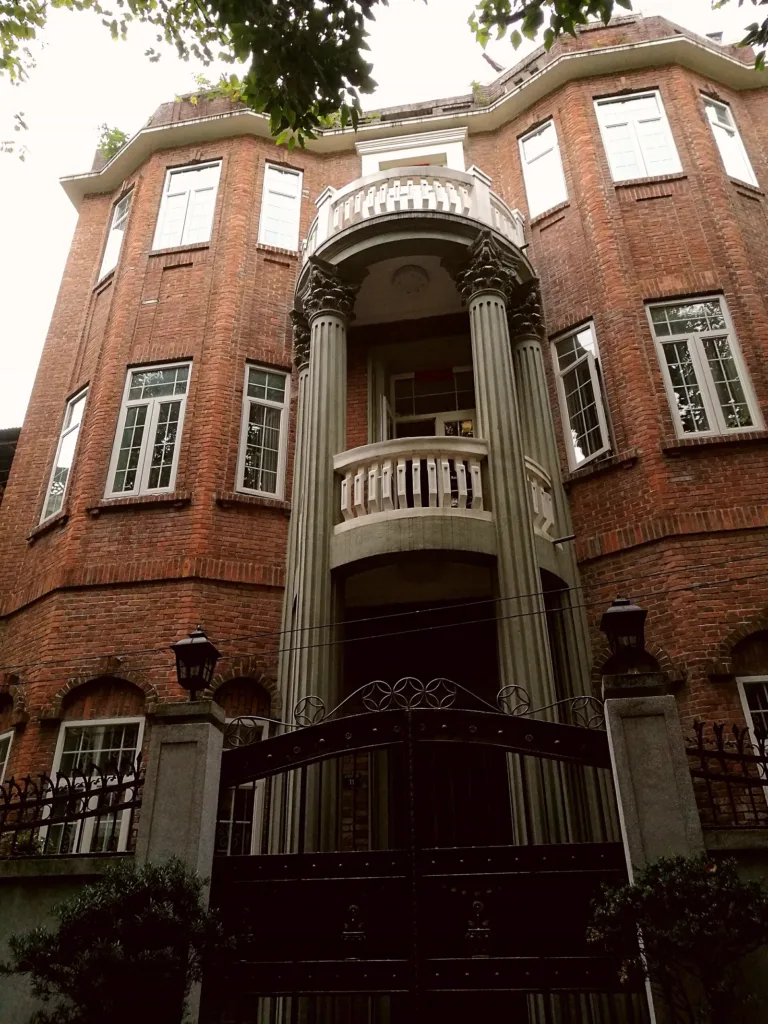
Dongshankou is better understood as a street district than as a single attraction with one gate. Its historic residential core is Xinhepu, a large protected area in Yuexiu District. More than 400 low-rise courtyard houses, many faced in red brick, make this a distinctive alternative to Guangzhou’s western-city arcades and traditional Lingnan houses.
The district took shape as Guangzhou expanded east. After the opening of the Canton–Kowloon Railway increased the area’s appeal, residential and institutional building grew here during the Republic-era peak of development. The streets preserve detached garden houses alongside religious and educational buildings; red brick is prominent, but plaster and stone finishes also appear. Look at the façades and the way the low buildings meet their lanes rather than expecting a single monumental landmark.
Xinhepu also records the city’s political history. The site of the Third National Congress of the Communist Party of China is among the protected heritage places. The municipal conservation plan organizes suggested walking themes around revolutionary history, architecture and arts, Cantonese everyday life, and historic schools. These are planning themes, not a guaranteed tour or promise that every building is open.
A practical visit is a slow walk through public streets such as Xinhepu Road, Miaoqian Straight Street and Guigang Dama Road. The municipal plan also names Qiming community, Songgang community and Xinhepu community as characteristic areas. Pause to compare brick façades, courtyard-scale houses and later street life; many properties have ordinary residential or other uses, so enter a building only where public access is clearly offered.
Getting there
Take Guangzhou Metro Line 1 or Line 6 to Dongshankou (东山口). Yuexiu District’s visitor page identifies Line 1, and a Guangzhou municipal transport report describes Dongshankou as the existing Line 1/Line 6 station. Start your walk from the station area and use the street names above to orient yourself; the historic district is not a single station exit or a single-address venue. For a taxi or ride-hail, use 东山口地铁站 Dōngshānkǒu Dìtiězhàn as a transit landmark, then confirm the drop-off point in your map app. Return to Dongshankou Station for either metro line. No exit number or precise walking time is specified here because the sources consulted do not establish one for a particular route.
The conservation area is a lived-in neighborhood. Access to streets does not imply access to individual houses, schools or memorial buildings; check the relevant institution’s current visitor information before planning an interior visit. The pages consulted do not establish current opening hours, admission or reservation rules for individual sites.
Find Dongshankou Historic District
东山口 · 越秀区
The pin marks the area, not the entrance.
Sources & visit information
Sources checked on 22 October 2026. Hours, tickets, reservations and transport can change; confirm with the operator before you go.
Image credits & notes (1)
- A red-brick historic mansion in Dongshankou, Guangzhou, with a prominent curved portico and gated entrance. Photo: Amber ZouPhoto: CC BY-SA 4.0