

Explore the region
Why visit
Guangxiao is a working temple as well as a protected historic site. Its importance is tied especially to Huineng, the sixth patriarch of Chan: local tradition says he was ordained here beneath a bodhi tree in 676. The temple is also associated with the monk Jianzhen, who stayed here for a spring in 749 during his efforts to travel to Japan. These are historical traditions recorded in local government descriptions, not a promise that every associated place or object is accessible today.
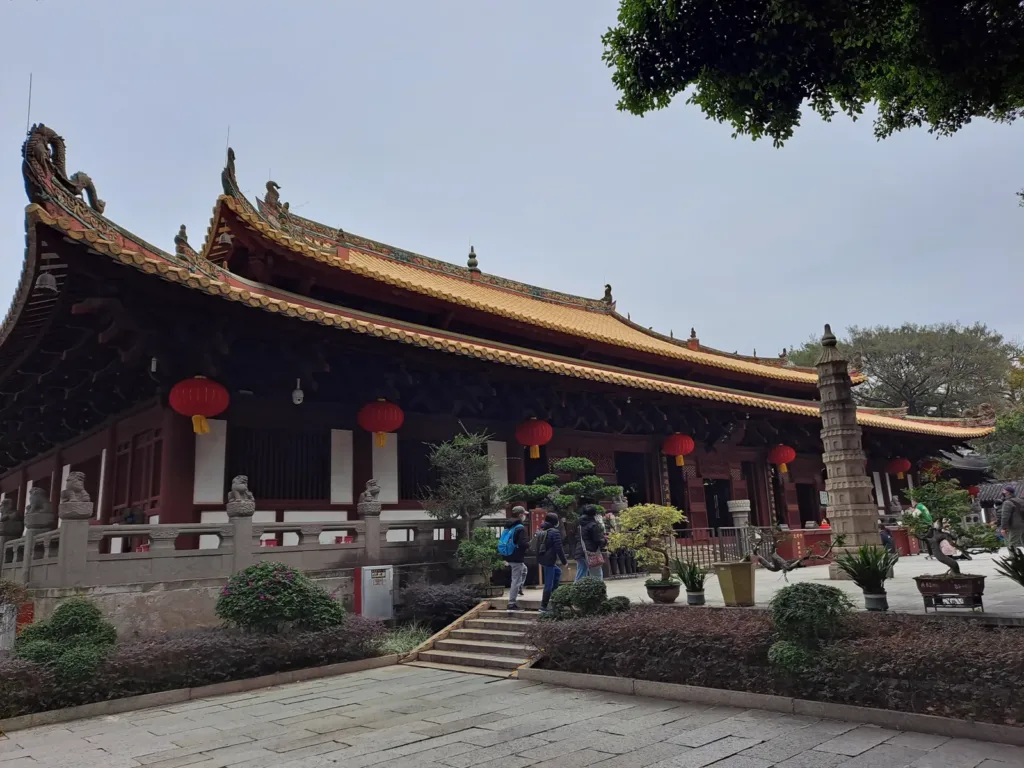
The grounds bring several periods of Buddhist architecture and practice into one visit. Guangzhou’s city profile describes the Mahavira Hall as first built in the Eastern Jin and retaining Tang- and Song-period architectural character; that description refers to the hall’s history and style, not an untouched building surviving wholly from the Eastern Jin. Other named features include the Tang-period pagoda commemorating Huineng’s shorn hair, a dharani-inscribed stone pillar, and iron pagodas cast under the Southern Han. A spring is traditionally attributed to Bodhidharma. The Yuexiu District profile also places Guangxiao among Guangzhou’s four great monasteries, alongside Liurong, Haichuang and Hualin.
What to look for
Begin with the Mahavira Hall: look at its raised setting and broad roofline, then compare its scale with the smaller halls around it. As you move through areas open to visitors, look for the hair pagoda associated with Huineng, the pair of iron pagodas, the inscribed dharani pillar, the spring attributed to Bodhidharma, stelae, images and bodhi trees. The temple’s official city profile identifies these as historic features, but does not establish which interiors or courtyards are open on a particular day. Treat them as a checklist rather than a guaranteed route.
Because this is an active place of worship, keep noise low, follow signs and staff instructions, and do not enter closed halls or interrupt religious activities. Ask before photographing worshippers or ceremonies.
Location and getting there
The listed address is 109 Guangxiao Road (光孝路109号), Yuexiu District (越秀区), Guangzhou. For a taxi or ride-hailing car, enter 光孝寺,广州市越秀区光孝路109号 as the destination.
By metro, take Guangzhou Metro Line 1 to Ximenkou (西门口) Station; the district government lists it as the metro stop for the temple. Continue on foot toward Guangxiao Road and follow local signs. The sources reviewed do not establish a best station exit or a reliable walking time, so no exit number or minute estimate is given. For the return trip, retrace your route to Ximenkou and check the station signs for the direction you need.
A Yuexiu District government visitor page, published in November 2022, lists free admission and hours of 08:00–16:30. The English travel guide consulted lists a ¥5 charge and hours of 08:30–16:30 instead. These published details conflict, and neither source establishes the temple’s current rules; check a current on-site notice before planning around admission or opening time.
Find Guangxiao Temple
光孝寺 · 越秀区
The pin marks the area, not the entrance.
Sources & visit information
Sources checked on 22 October 2026. Hours, tickets, reservations and transport can change; confirm with the operator before you go.
Image credits & notes (1)
- Mahavira Hall at Guangxiao Temple, Guangzhou, photographed on 28 December 2021. Photo: 钉钉Photo: CC BY-SA 4.0