

Explore the region
About Maba Man Site
The Maba Man Site (马坝人遗址) is a prehistoric site at Lion Rock (狮子岩), 3 km southwest of Maba town (马坝镇) in Qujiang District (曲江区), Shaoguan (韶关), northern Guangdong. It takes in both the cave where the Maba Man skull turned up and the Neolithic Shixia site (石峡遗址) between the same two hills.
Lion Rock is a pair of isolated limestone peaks that, seen from afar, look like a lion crouching on the ground: the northern hill is the head, the southern one the tail. Caves criss-cross the inside of both. In 1958 members of the Maba commune (马坝公社) were digging out cave deposits for use as fertiliser in a second-level cave on the north side of the head hill when they found a human skull and other vertebrate fossils in a crack in the rock.
The skull, named Maba Man (马坝人), is a skull cap with parts of the right upper face and nose, possibly from a middle-aged man. Heavy brow ridges and a low, thick braincase recall Homo erectus, but the brain was larger, and many authorities group the fossil with archaic Homo sapiens; Chinese Wikipedia lists it as the only early Homo sapiens fossil yet found in South China. The age is hard to fix because the crevice cannot be dated directly: estimates run from about 300,000 to 130,000 years, and a 2014 revision gave 237,000. When researchers cleared the cave entrance in 1984 they recovered two stone tools made of gravel, and the Lion Cave has yielded fossils of animals including giant panda, Stegodon, hyena and giant tapir.
In 1973 a Neolithic site, the Shixia site, came to light between the lion's head and tail. It holds four layers. The oldest is Neolithic, from about 6,000 years ago. Next comes a late Neolithic layer of about 5,000 to 4,000 years ago that gave its name to the Shixia culture (石峡文化), then an early Bronze Age layer of about 3,800 to 3,100 years ago and a late Bronze Age layer spanning the late Western Zhou and the Spring and Autumn period. Digs exposed pottery kilns, ash pits and post holes, emptied 136 graves and produced stone tools, pottery and jade, among them jade cong, stepped adzes and three-legged dishes. Shixia was listed as a Major Historical and Cultural Site Protected at the National Level (全国重点文物保护单位) in 2001, and the Maba Man site was merged into that listing in 2006.
What to look for
- Lion Rock (狮子岩), twin limestone peaks shaped like a crouching lion and riddled with caves
- The second-level cave on the lion's head hill where the Maba Man skull was found in 1958
- The Shixia site (石峡遗址) between the head and tail hills, with four layers from the Neolithic to the Spring and Autumn period
Location & getting there
Getting to Maba Man Site
- Search for 马坝人遗址 with 韶关市 and 曲江区.
Find Maba Man Site
马坝人遗址 · 曲江区
No reliable map pin yet: search by the Chinese name.
Sources & visit information
Written from the linked sources and fact-checked against them on 2026-09-23. Opening hours, admission and access arrangements are not covered; confirm current visitor information with the site.
Some facts checked against Wikipedia contributors, "马坝人遗址" · CC BY-SA 4.0.
Some facts checked against Wikipedia contributors, "石峡遗址" · CC BY-SA 4.0.
Some facts checked against Wikipedia contributors, "Maba Man" · CC BY-SA 4.0.
Image credits & notes (1)
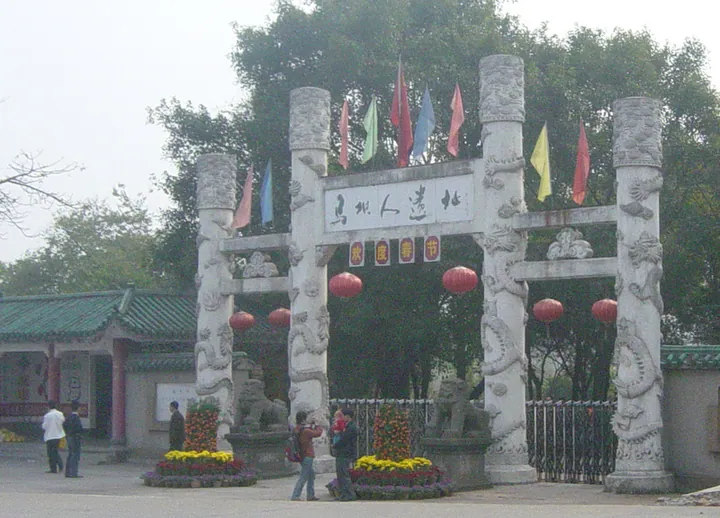
- Main entrance gate of the Maba Man Site Park in Qujiang District, Shaoguan · 韶关市曲江区马坝人遗址公园大门 Source-recorded photograph date: 2 February 2006 (original upload date).Photo: The original uploader was Zhuwq at Chinese Wikipedia. · CC BY-SA 3.0Resized for the web; the photo itself has not been edited. Thumbnails may show a cropped view.
