


Explore the region
About Naozhou Island
Naozhou Island (硇洲岛) lies some 35 km southeast of the city centre of Zhanjiang (湛江) in the South China Sea, facing Donghai Island (东海岛) across the water to the northwest. It forms Naozhou Town (硇洲镇) in Mazhang District (麻章区) and is described as China's largest volcanic island.
The island rose from a seabed eruption 200,000 to 500,000 years ago, as basalt lava welling from fissures chilled in the sea and piled up until it broke the surface. Roughly rectangular, about 10 km by 6 km and 53 square kilometres in area, it runs northeast to southwest. Wind and waves have carved a cliff about 2 km long and 10 to 20 m high along the eastern shore; the western shore has wide beaches and serves as a natural harbour. The name comes from 'naosha' (硇砂), a mineral produced by the eruption.
By the Song dynasty the island had a market town that was an important staging point for sea trade. Legend holds that the Song emperor Zhao Shi (赵昰) fled here from the Yuan armies at the end of the Southern Song, and that his brother Zhao Bing (赵昺), who succeeded him, raised the island to Xianglong County (翔龙县). The Ming set up a coastal patrol station, the Qing emptied the island under the 1662 sea ban and stationed a garrison from 1704, and in 1899 France took it into its leased territory of Guangzhouwan (广州湾). Japan occupied the territory in 1943 and it returned to China in 1945.
The French lighthouse on Ma'an Hill (马鞍山), the highest point, at the island's southeast corner, replaced a Yuan-dynasty stone tower and entered service in 1904. Built of local volcanic stone, its 19.2 m conical tower has 68 steps spiralling round a central column, and the light is 103 m above the sea. It is on the national list of major protected historical sites. Farming of bananas, sugar cane and peanuts and fishing for abalone, lobster and sea urchin support the islanders.
What to look for
- Naozhou Lighthouse (硇洲灯塔), completed in 1904 in local volcanic stone, with a French-inscribed stone at its base, dated 1899, marking a level 16.05 m above lowest tide
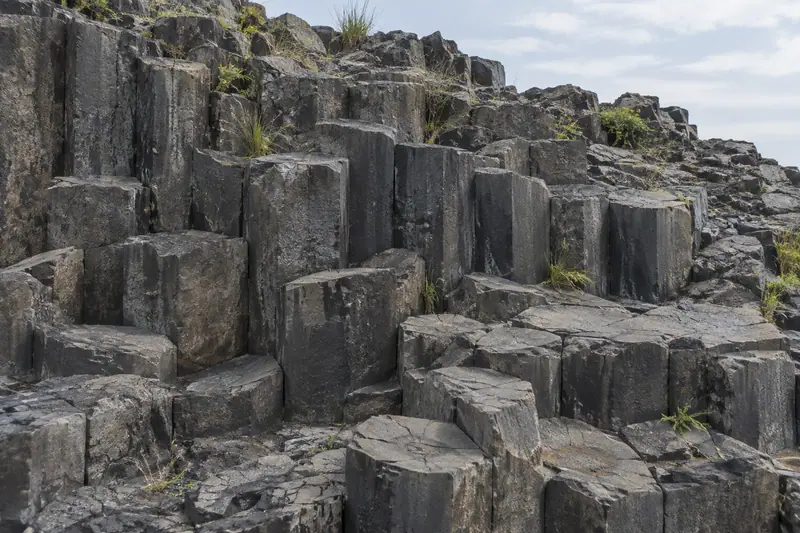
- Nayanshi Beach (那宴石海滩) in the southeast, lined with columnar-jointed basalt and black volcanic gravel
- The east-coast sea cliff, about 2 km long and 10 to 20 m high
- Jinqian Tianhou Palace (津前天后宫), a temple to the sea goddess founded in 1506 and also the site of the Naozhou command post for the Hainan Island campaign
- Song Emperor's Well (宋皇井), which legend says the fleeing emperor's horses pawed open
- Turtle City (海龟城), a rescue centre opened in 2009 for sea turtles, horseshoe crabs and Chinese white dolphins
Location & getting there
Getting to Naozhou Island
- Search for 硇洲岛 with 湛江市 and 麻章区(硇洲岛).
Find Naozhou Island
硇洲岛 · 麻章区(硇洲岛)
No reliable map pin yet: search by the Chinese name.
Sources & visit information
Written from the linked sources and fact-checked against them on 2026-09-23. Opening hours, admission and access arrangements are not covered; confirm current visitor information with the site.
Some facts checked against Wikipedia contributors, "硇洲岛" · CC BY-SA 4.0.
Some facts checked against Wikipedia contributors, "Naozhou Island" · CC BY-SA 4.0.
Some facts checked against Wikipedia contributors, "硇洲灯塔" · CC BY-SA 4.0.
Image credits & notes (1)
- Naozhou Island (硇洲岛), Zhanjiang. Photograph: "Naozhou - P1570755 - Naozhou vehicle ferry dock".Photo: User:Vmenkov · CC BY-SA 3.0Resized for the web; the photo itself has not been edited. Thumbnails may show a cropped view.
