


Explore the region
About Tangwei Old Village
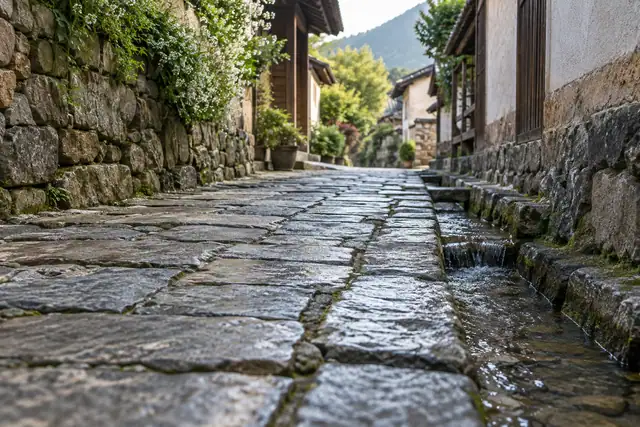
The Dongguan municipal government's own account, sourced to Guangdong Chorography, records that the sixth-generation Li ancestor Dong'an settled the site at the end of the Southern Song for its scenery, and that the village was later renamed Tangwei, 'end of the lotus pond', after a pond in front of the settlement. The architectural complex faces south, covers about 40,000 square metres, and includes walls, watchtowers, lanes, ancestral halls, study halls, residences, old wells, ponds and old banyan trees in a grid layout around the village-entrance pond; the most representative of its 21 ancestral halls are the Li Clan Ancestral Hall, Mei'an Gong Ancestral Hall and Jingtong Gong Ancestral Hall. The perimeter wall runs 860 metres with a red-sandstone base and blue-brick walls, 108 watch holes and 17 attached watchtowers, which together with 4 gates and a freestanding watchtower form 28 defensive structures.
The complex was listed as a Guangdong provincial protected cultural relic in 2002, a Major Historical and Cultural Site Protected at the National Level in 2006, a Chinese Historic and Cultural Village in 2007 and a national AAAA tourist area in 2016. The village also keeps the folk festival Kangwang Baodan, held from the first to the seventh day of the seventh lunar month to mark the birthday of the Northern Song general Kang Baoyi, with a sequence of rites including a procession, offerings, Cantonese opera and a communal banquet; the Dongguan municipal government describes it as a living record of Ming-Qing Lingnan folk custom, and it was listed on the Guangdong provincial intangible cultural heritage register in November 2007.
What to look for
- The Li Clan Ancestral Hall, Mei'an Gong Ancestral Hall and Jingtong Gong Ancestral Hall, the most representative of the village's 21 ancestral halls.
- The 860-metre perimeter wall with its 108 watch holes and 17 watchtowers, together with the village's 4 gates and freestanding watchtower.
- The village-entrance pond around which the grid of lanes is arranged.
- The Kangwang Baodan festival procession and rites, held each year from the first to the seventh day of the seventh lunar month and listed as Guangdong provincial intangible heritage.
Location & getting there
Getting to Tangwei Old Village
Identify the main visitor approach and any separately managed houses, museums or performances. Ask before entering residential spaces or photographing residents.
- Search for 塘尾古村落 with 东莞市 and 石排镇.
Find Tangwei Old Village
塘尾古村落 · 石排镇
No reliable map pin yet: search by the Chinese name.
Sources & visit information
The linked sources support the identity and background described in this introduction. Opening hours, admission, activity availability and exact arrival arrangements have not been comprehensively checked. Confirm current visitor information with the venue; the original catalogue locality and editorial review flag are retained.