


Explore the region
About Xuanwu Mountain
The Lufeng municipal government's own page places the site on the northern edge of Jieshi, a designated historic and cultural town, and records it as a national AAAA tourist area and a provincial-level scenic area. It describes Yuanshan Temple, originally called Xuanwu Miao and first built in the first year of the Southern Song Jianyan reign (1127), as enlarged over the Ming and Qing into a palace-style complex of 99 rooms, and as one of the largest and best-preserved religious temple complexes in eastern Guangdong on the government's own description; the temple was listed as a Major Historical and Cultural Site Protected at the National Level on 25 June 2001. Its main hall holds both a statue of Xuantian Shangdi and a statue of Sakyamuni Buddha, making it a temple where Buddhist and Daoist worship converge.
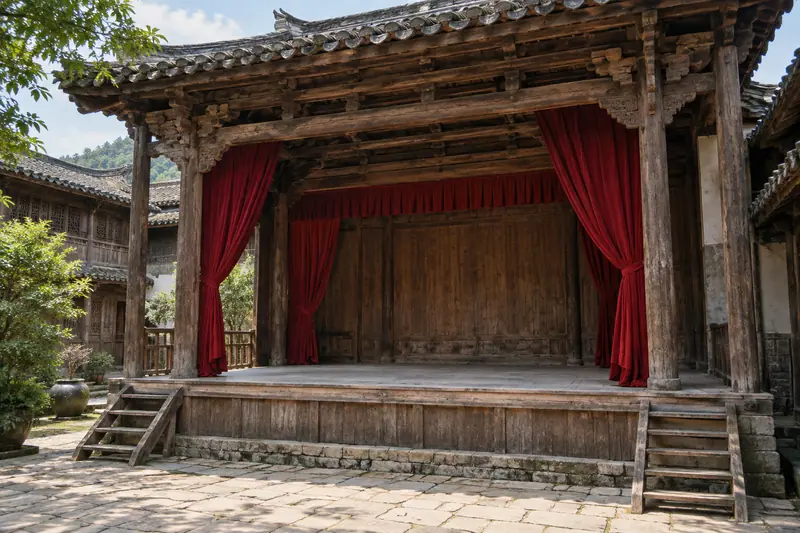
The Lufeng municipal government records more than 40 plaques from court officials hanging in the main hall, including one by Lin Zexu, imperial commissioner and governor-general of Guangdong and Guangxi, reading 水德灵长, one by Liu Yongfu, Black Flag Army commander and twice commandant of Jieshi, reading 灵声满道, and one bestowed by the Qing Tongzhi emperor and written by Empress Dowager Cixi, reading 威宣岭表. It also describes the Fuxing Leita pagoda, first built in 1578 and rebuilt as an octagonal three-storey stone pagoda in 1865, destroyed in 1969 and restored in 1981 to a height of 18.8 metres from 5,340 interlocking granite blocks, and an ancient stage first built in the Ming Wanli reign and rebuilt in the fifteenth year of the Qing Qianlong reign, which began in 1736, which the Lufeng municipal government describes as the oldest and largest temple stage in Guangdong.
What to look for
- Yuanshan Temple's main hall, holding both a statue of Xuantian Shangdi and a statue of Sakyamuni Buddha.
- The Lin Zexu plaque (水德灵长) and the Liu Yongfu plaque (灵声满道), among more than 40 court-official inscriptions in the main hall.
- Fuxing Leita pagoda, an 18.8-metre octagonal stone pagoda rebuilt in 1865, destroyed in 1969 and restored in 1981.
- The ancient stage (古戏台), first built in the Ming Wanli reign and rebuilt in the fifteenth year of the Qing Qianlong reign (which began in 1736), which the Lufeng municipal government describes as Guangdong's oldest and largest temple stage.
Location & getting there
Getting to Xuanwu Mountain
Check which interiors and courtyards are accessible. Active places of worship and protected monuments may have different visitor rules.
- Search for 玄武山 with 汕尾市 and 陆丰市.
Find Xuanwu Mountain
玄武山 · 陆丰市
No reliable map pin yet: search by the Chinese name.
Sources & visit information
The linked sources support the identity and background described in this introduction. Opening hours, admission, activity availability and exact arrival arrangements have not been comprehensively checked. Confirm current visitor information with the venue; the original catalogue locality and editorial review flag are retained.
Image credits & notes (1)
- The ornate stone memorial archway at the entrance to the Xuanwu Mountain temple complex in Jieshi, Lufeng · 汕尾市陆丰市碣石镇玄武山牌坊Photo: 林维岳 · Public domain · taken 2014-06-23Resized for the web; the photo itself has not been edited. Thumbnails may show a cropped view.
