

Explore the region
About Zhuji Ancient Lane
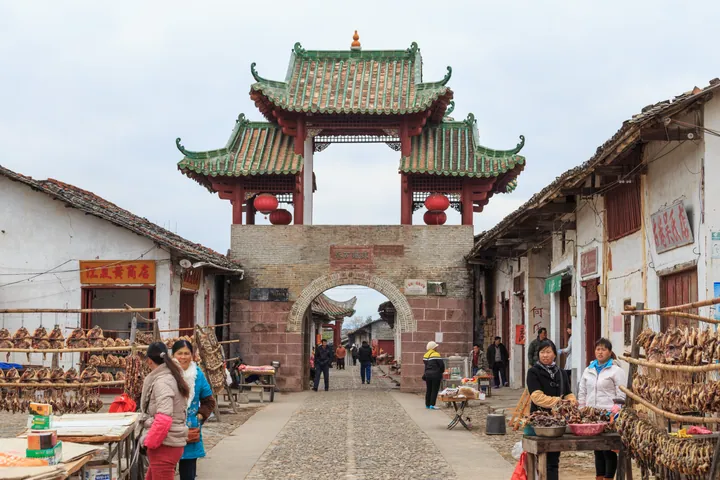
The lane was once called Jingzong Lane, and before that the village was known as Shashui. In the Tang it was home to the Zhang family, whose head Zhang Chang was celebrated for keeping seven generations under one roof; in 825 the emperor rewarded the family with a pearl sash ring, and the lane took the name Zhuji, partly to avoid using the emperor Jingzong's own name. It runs more than 1,500 metres from Sima Bridge at the south end to Fenghuang Bridge at the north, is about four metres wide and is paved throughout with cobbles, with houses, ancestral halls and shopfronts along both sides and old buildings, a pagoda, old banyans and old bridges among them.
Its importance came from the road. After Zhang Jiuling cut the Dayuling road in 716 the Meiguan crossing became the main way into Lingnan from the north, and Zhuji Lane was the first commercial town travellers reached after coming over the ridge; Han Yu, Su Dongpo and Wen Tianxiang all passed through on their way into southern exile. Many who came stopped for a while and then moved on. One large departure was organised by a lane leader named Luo Gui, when over a thousand people of dozens of surnames cut bamboo for rafts and went down the Shashui river into the Zhen river and on to the delta. Descendants of Zhuji migrants are counted at 186 surnames and many millions of people, which is why the lane is treated as a meeting point of Guangfu and Hakka traditions and why families return to it. The folk literature known as the legend of the southward migration of the Zhuji people entered the national intangible cultural heritage list in 2021.
What to look for
- The cobbled lane itself, more than 1,500 metres from Sima Bridge to Fenghuang Bridge and about four metres wide
- The 22 major clan ancestral halls along the street, including the Qing-dynasty Liu clan hall in the middle section, 4.3 metres wide and 30.4 metres deep
- The Lei family ancestral residence in the northern section, another Qing building protected at county level since 1982
- The stone pagoda raised in the Yuan over the well of the consort Hu, known as the Guifei Pagoda and a Guangdong provincial protected monument
- The old banyans and old bridges recorded among the lane's surviving features
Location & getting there
Getting to Zhuji Ancient Lane
Identify the main visitor approach and any separately managed houses, museums or performances. Ask before entering residential spaces or photographing residents.
- Search for 珠玑古巷 with 韶关市 and 南雄市.
Find Zhuji Ancient Lane
珠玑古巷 · 南雄市
No reliable map pin yet: search by the Chinese name.
Sources & visit information
The linked sources support the identity and background described in this introduction. Opening hours, admission, activity availability and exact arrival arrangements have not been comprehensively checked. Confirm current visitor information with the venue; the original catalogue locality and editorial review flag are retained.
Image credits & notes (1)
- The gate tower of Zhuji Ancient Lane (Zhu Ji Gu Xiang), Nanxiong, over the historic street lined with vendors · 韶关市南雄市珠玑古巷门楼及老街Photo: Zhangzhugang · CC BY-SA 4.0 · taken 2014-01-12Resized for the web; the photo itself has not been edited. Thumbnails may show a cropped view.
