

Explore the region
Tap any red Chinese text to hear it in Mandarin.
Read the name carefully
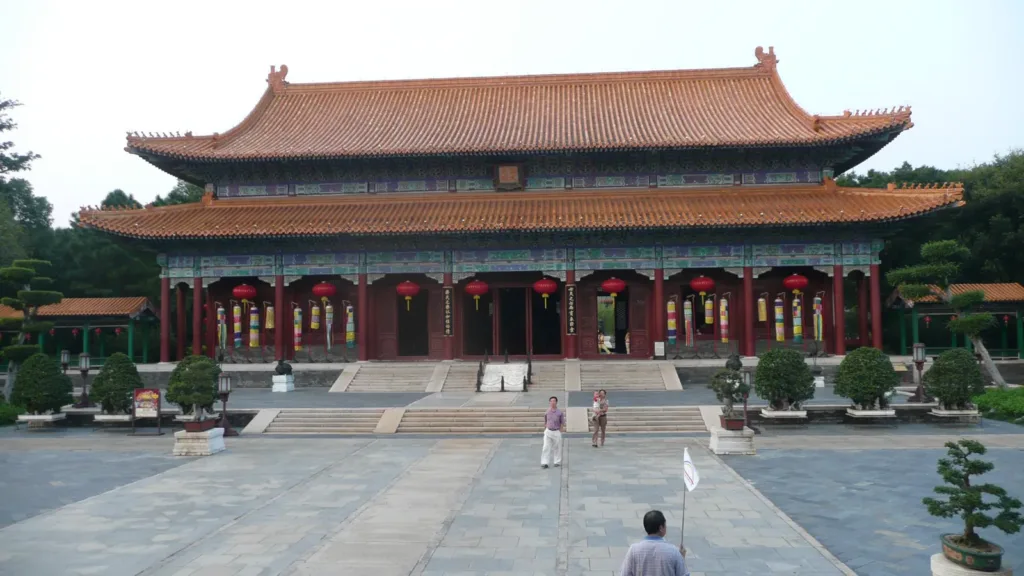
The word “New” is the important part of New Yuanming Palace. The park was built and opened in Zhuhai in 1997 as a reproduction of selected Old Summer Palace scenes; it is not a group of Qing buildings moved south from Beijing. That modern reconstruction is the subject worth visiting: the park shows how a famous imperial garden was packaged for later tourism and public interpretation.
The park’s setting also makes the comparison legible. The visitor descriptions place Fuhai Lake at the centre, with palace and garden structures around it and Stone Forest Mountain at the edge of the site. Read the architecture as a designed composition around water and slopes, not as evidence that the destroyed Beijing garden survives here.
What to look for
Start with the large-scale views across Fuhai Lake. The lake gives the reconstructed halls and garden structures distance from one another, so their rooflines and coloured surfaces can be read as a landscape rather than as a row of isolated façades.
Then compare the park’s three visual languages. The Zhuhai visitor page describes palace buildings, gardens in the style of Jiangnan south of the Yangtze, and Western structures; the English guide likewise separates the imperial-style garden, lake-side classical garden and Western section. Look for where the materials, roof forms and decorative vocabulary change, and keep the modern setting in mind.
A practical circuit is to read the entrance as an introduction to the reconstruction, cross or follow the central-lake viewpoints, and finish with the smaller pavilions and the sections whose style interests you most. This is an editorial order, not a promise that every internal route or building is open. Leave room to stop for the changing view back towards the lake and the mountain edge.
Entry and current checks
A Trip.com listing read on 24 October 2026 presents free entry and hours of 09:00–22:00, with last entry at 20:30. These are third-party listing details, not a guarantee from the operator, so confirm the opening gate and any special programme before travelling.
A Zhuhai Media report quoting the park’s 28 August 2024 announcement said that ordinary weekdays and weekends no longer required a reservation, while major holidays could be treated differently and capacity controls could be introduced. The same notice retained telephone and group-booking services and gave 0756-8610388 for enquiries. Do not assume that a rule written for 2024 covers your holiday or passport-based booking today.
Older visitor material describes performances and optional boat or cable-car products, but those schedules and prices are not evidence of a current programme. Ask at the venue if a show or paid add-on is the reason for your visit.
Getting there and back
The address used by the park’s English visitor information is Lanpu, by Jiuzhou Avenue; a current Trip.com listing gives the more specific form 164 Lanpu Road, Xiangzhou District, Zhuhai. Keep the Chinese name 圆明新园 Yuánmíng Xīnyuán and this road name ready for a driver, and ask to be taken to the visitor entrance rather than to a general map pin.
Bus is the clearest public-transport option in the sources checked. The Zhuhai Transport Wiki distinguishes 圆明新园总站 Yuánmíng Xīnyuán Zǒngzhàn on Lanpu Road, beside the east side of the park, from a separate 圆明新园 Yuánmíng Xīnyuán stop on Baishi Road. At the terminal, routes 13, 62 and 69 are listed with the park as one end of the line; route 69 connects with 城轨唐家湾站 (Tangjiawan Intercity Railway Station), while route 62 connects with 横琴客运码头 (Hengqin Passenger Terminal).
Do not board by name alone: check whether the bus is at the Lanpu Road terminal or the Baishi Road roadside stop, and confirm the direction on the day. For the return, the terminal listings show the reverse destinations—体育中心南 Tǐyù Zhōngxīn Nán for route 13, 横琴客运码头 Héngqín Kèyùn Mǎtóu for route 62 and 城轨唐家湾站 Chéngguǐ Tángjiāwān Zhàn for route 69—but live service and last departures still need checking before an evening visit.
Combine your visit
Suggested order for the visit:
-
Entrance architecture
Read the park’s reconstruction theme.
-
Central lake shore
See the buildings against the hills.
-
Garden pavilions
Continue with closer views of the smaller structures.
This is an editorial sequence of named spaces or places. It does not imply a verified walking connection or promise opening, ticket availability or a journey time.
Find New Yuanming Palace
圆明新园 · 珠海市
The pin marks the area, not the entrance.
More places nearby
Approximate straight-line distances between map pins, not travel distances.
Zhuhai Museum 珠海市博物馆
7 km awayZhuhai Museum’s current home is on Haihong Road, where its permanent exhibitions connect the city’s maritime setting, local history and community traditions. The Zhuhai History displays include both a chronological history and…
View guide →Zhuhai Opera House 珠海大剧院日月贝
7 km awayZhuhai Opera House stands on Yeli Island and is recognised by its shell-like architectural forms. The building’s relationship with the sea is central to its appearance: the curved outline reads differently from the island…
View guide →Chimelong Ocean Kingdom 长隆海洋王国
16 km awayChimelong Ocean Kingdom is an ocean-themed amusement park in Fuxiang Bay on Hengqin. The layout is divided into named areas, combining aquariums and animal habitats with rides and entertainment. Ocean Avenue forms the entrance…
View guide →Sources & visit information
Sources checked on 24 October 2026. Hours, tickets, reservations and transport can change; confirm with the operator before you go.
Image credits & notes (1)
- A front palace-style hall and paved forecourt at New Yuanming Palace in Zhuhai. Photo: Brücke-Osteuropa (Wikimedia Commons file author)Photo: Public domain