

Photo adjustments
Proportionally resized and converted to WebP without cropping, retouching or changing the photographed subject.
Explore the region
About Maotai Town
From 1915 Square, steps lead towards Yangliuwan’s liquor-themed commercial street. China Liquor Culture City provides a separate museum-style introduction to brewing, while the riverside memorial area tells a different part of the town’s story. A town visit does not automatically include entry to working distilleries, so distinguish public streets, museums and production facilities.
The name 'Maotai' comes from a sacrificial platform covered in thatch grass by the ancient Liao people (古獠人), called the 'thatch sacrificial platform' and shortened to 'Maotai.' In the Yuan dynasty the settlement was recorded as Maotai Village. In 1745, during the Qianlong era (乾隆), Guizhou governor-general Zhang Guangsi (张广泗) opened the Chishui River to shipping and established the Ren'an Wharf (仁岸码头) at Maotai; the resulting trade led to a brief renaming as 'Yishang Zhen,' but the older name persisted and the settlement became known as Maotai Town.
Liquor production had already reached a substantial scale by the Jiaqing and Daoguang eras, according to the Zunyi Prefecture Gazetteer, which recorded Maotai's wine as the province's finest and counted at least twenty distilleries there; by the Guangxu era its liquors were sold well beyond Guizhou. The old brewing houses were destroyed when Taiping rebel forces under Shi Dakai (石达开) attacked Guizhou. The town was formally established in 1930, and after several administrative reorganizations the Renhuai county government relocated to Maotai in 1954; the present boundaries of Maotai town date from a 2015 administrative adjustment.
What to look for
- 1915 Square and Yangliuwan street reveal the town’s modern liquor-themed visitor district.
- The Maotai crossing memorial and riverside Red Army memorial area connect the town with Long March history.
Background & history
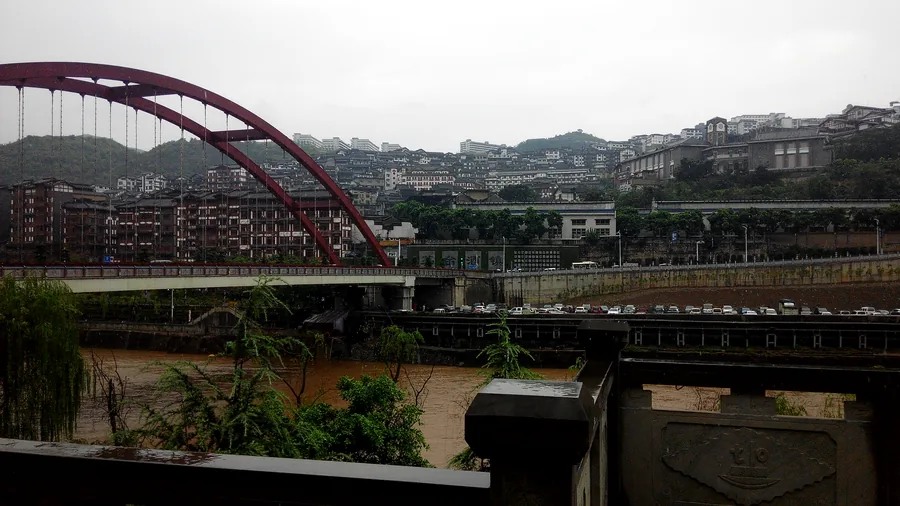
Maotai (simplified Chinese: 茅台; traditional Chinese: 茅台 or 茅臺; pinyin: Máotái) is a town in the north of Guizhou province, located on the southeast (right) bank of the Chishui River (赤水河). It is under the administration of Renhuai City. The village is most famous as the origin of the eponymous brand of baijiu. The liquor is very popular in China. Maotai is the only alcoholic beverage presented as an official gift by Chinese embassies in foreign countries and regions, and it received worldwide exposure when Zhou Enlai used the liquor to entertain Richard Nixon during the state banquet for the U.S. presidential visit to China in 1972.
Excerpt from Wikipedia: Maotai, Guizhou · Wikipedia contributors · CC BY-SA 4.0. Selected introductory sentences; formatting simplified. Background information, not current visitor-service advice.
Location & getting there
Getting to Maotai Town
The official directory locates the Maotai tourist-area approach beside the archway on Zhongmao Express Road in Maotai town, Renhuai. Arrange the final transfer specifically to 1915 Square, the riverfront or China Liquor Culture City according to your first stop.
Combine your visit
Suggested order for the visit:
-
1915 Square and Yangliuwan
Explore the public commercial district.
-
China Liquor Culture City
Add the brewing-history displays if open.
-
Maotai crossing memorial area
Finish with the river and its memorial landscape.
This is an editorial sequence of named spaces or places. It does not imply a verified walking connection or promise opening, ticket availability or a journey time.
Find Maotai Town
茅台镇 · 遵义
The pin marks the area, not the entrance.
More places nearby
Approximate straight-line distances between map pins, not travel distances.
Hailongtun 海龙屯
44 km awayHailongtun is a ruined mountain fortress whose defences use the steep terrain of Longyan Mountain. A sequence of passes controlled the approach, including Feihu and Feilong, while the summit preserves the remains of the Bozhou…
View guide →Loushan Pass Scenic Area 娄山关景区
50 km awayLoushan Pass combines a steep mountain setting with memorials to the Red Army battles fought here during the Long March. The large poetry inscription, Xifeng Terrace and the Xiaojian Mountain battlefield provide different ways…
View guide →Loushan Pass Battle Site Exhibition Hall 娄山关红军战斗遗址陈列馆
52 km awayThe Loushan Pass Battle Site Exhibition Hall places the mountain battlefield in context through photographs, documents and objects. Its exhibition follows the first capture of the pass, the later fighting and the history of the…
View guide →Sources & visit information
The sources below support the place-specific description and arrival information. Suggested combinations are editorial planning ideas; confirm current opening, entry arrangements and transport services for your date.
- Maotai, Guizhou ↗
- Guizhou Tax Bureau: Maotai town report ↗
- Guizhou tourism report: Zunyi and Maotai ↗
- Guizhou scenic-area directory ↗
- Chinese Wikipedia: 茅台镇 (revision 92544894, 2026-05-05) ↗
Visitor information adapted and edited from Wikipedia contributors, “Maotai, Guizhou” · CC BY-SA 4.0. Source revision 1370807592.
Background paragraphs translated and condensed from Wikipedia contributors, "茅台镇", Chinese Wikipedia · CC BY-SA 4.0. Source revision 92544894.