

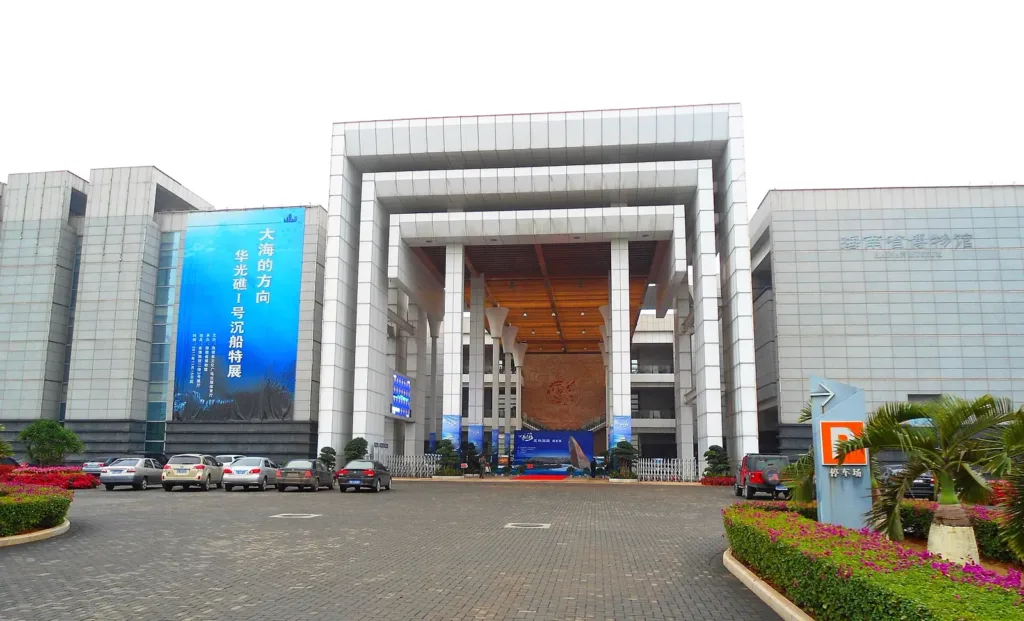
Explore the region
Why visit
Hainan Museum is best read as an island story rather than as a general collection. The museum’s exhibition system follows the idea of Nanming Qidian (南溟奇甸), a phrase associated with the Ming scholar Qiu Jun’s description of Hainan. Its three main displays give the visit a clear sequence: Sailing the Southern Seas (南溟泛舸) looks at sea routes, fishing, salt-making and the South China Sea; Frontier Beyond the Seas (方外封疆) follows Hainan’s history from prehistory through the Republican period; and Between the Immortal and the Mortal (仙凡之间) explores the island’s regional customs and cultural diversity.
The maritime galleries are a good first stop if you want to understand why Hainan’s history is inseparable from water. The museum uses shipwreck archaeology and objects recovered from the sea to explain trade and seafaring, with the Huaguangjiao I shipwreck as a particularly useful reference point. The history galleries then give that maritime setting a longer timeline. Rather than trying to read every label, compare the island’s archaeological evidence with the later stories of migration, administration and overseas links.
The smaller specialist galleries make the museum recognisably Hainanese. The huanghuali display follows the wood from the island’s tree and everyday tools to furniture and carving. The agarwood display explains how a fragrant material is formed and worked, and includes a reconstructed setting for its use. Four intangible-heritage galleries add a more social dimension: Qiong Workshop presents craft, Qiong Food Street presents food culture, Qiongya Village presents minority traditions, and Qiong Stage combines objects with performances and other local arts. The museum’s current notice places these galleries in halls 3–9, while the three main displays occupy halls 10–19.
Plan the visit
Allow time to move between the history and art buildings, and choose one main thread rather than treating the museum as a checklist. A useful first circuit is the maritime display, then the history display, followed by huanghuali or agarwood. If you prefer everyday culture, start with the intangible-heritage galleries and finish with the historical rooms. Temporary exhibitions change, so check the museum’s current announcement before setting out. The official site’s current homepage displays 09:00 opening, 16:30 last entry and 17:00 closing; Monday closure and holiday exceptions should be checked against the date-specific notice.
The address is 76 Guoxing Avenue, Qiongshan District, Haikou (海口市琼山区国兴大道76号). The museum’s transport page lists buses 27, 56, 76, 619, G43 and G51 to Sheng Bowuguan Station (省博物馆站). Keep the Chinese name and address ready for a taxi or ride-hailing driver. The same page lists a free outdoor car park; the museum’s 2026 holiday notice warns that spaces can be tight on busy days and says that nearby car parks may be a better fallback.
For entry, follow the museum’s latest notice rather than relying on an old listing. Its 2026 holiday announcement says individual visitors could enter without advance reservation by presenting valid identification at the gate, and expressly includes a passport among the accepted documents; groups still needed to reserve through the museum website or WeChat account. That announcement applied to the stated holiday dates, so check the museum’s current service notice for your own travel day.
Combine your visit
Suggested order for the visit:
-
History gallery
Begin with the island’s archaeological and historical context.
-
Maritime civilization gallery
Continue with ports, fishing and sea connections.
-
Traditional crafts or huanghuali collection
Finish with close observation of materials and workmanship.
This is an editorial sequence of named spaces or places. It does not imply a verified walking connection or promise opening, ticket availability or a journey time.
Find Hainan Museum
海南省博物馆 · 海口
The pin marks the area, not the entrance.
More places nearby
Approximate straight-line distances between map pins, not travel distances.
Temple of the Five Lords 五公祠
2 km awayThe Temple of the Five Lords is a memorial complex in Haikou dedicated to officials exiled to Hainan during the Tang and Song periods. Statues of the five men give the principal hall its focus, while the surrounding palms, lily…
View guide →Qiongtai Academy 琼台书院
3 km awayQiongtai Academy is a historic educational site in Haikou’s Fucheng area, associated with the scholar Qiu Jun. Its principal two-storey building combines brick and timber, giving the academy a smaller and more intimate scale…
View guide →Haikou People's Park 海口人民公园
4 km awayHaikou People’s Park is built around a wooded hill in the otherwise largely flat centre of the city. Narrow winding paths rise beneath a tree canopy towards a broad upper area. This shaded, enclosed landscape feels different…
View guide →Sources & visit information
Sources checked on 23 October 2026. Hours, tickets, reservations and transport can change; confirm with the operator before you go.
Image credits & notes (1)
- Hainan Museum's main entrance in Haikou, photographed on 7 January 2012. Photo: Anna FrodesiakPhoto: CC0 1.0