

Explore the region
Tap any red Chinese text to hear it in Mandarin.
Why visit
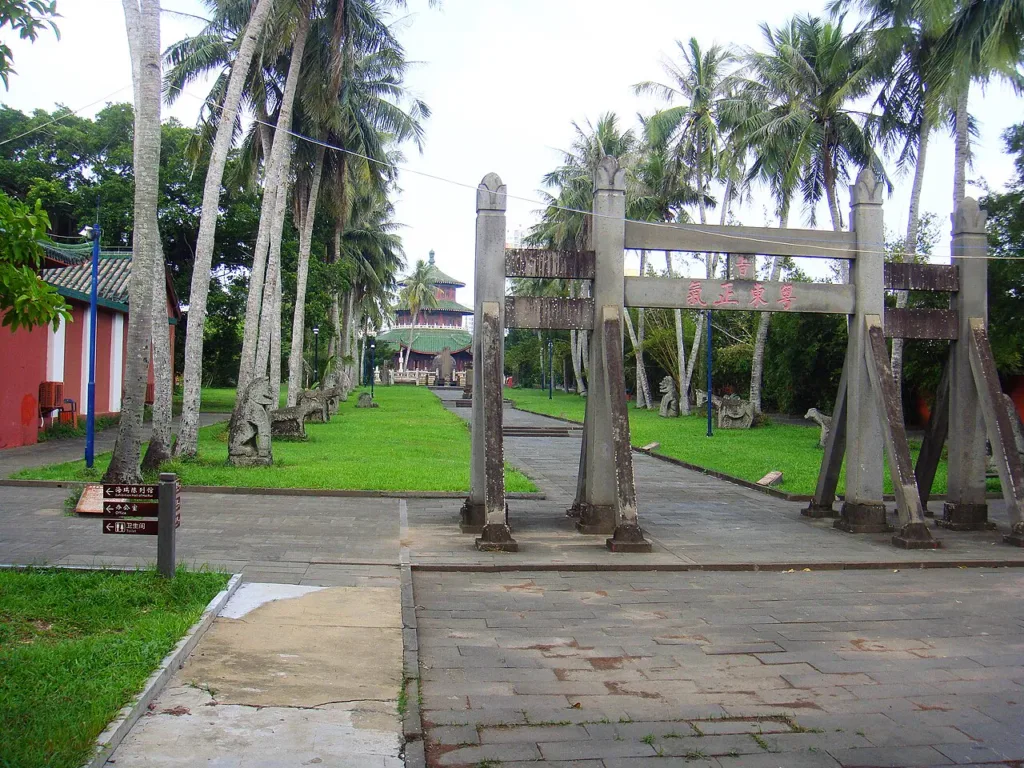
Hai Rui Cultural Park (海瑞文化公园) is in Longhua District, Haikou. It is built around the tomb precinct of Hai Rui, the Ming official remembered for uncompromising integrity and outspoken public service. The park is not simply a planted city park: its purpose is to let visitors read a historical figure, a memorial site and a modern public-education project together.
The provincial government describes three connected areas: the tomb garden, a historical display area and an integrity-culture education area. The exhibition programme includes a Hai Rui Life and Deeds Exhibition and a South Seas Breeze — Integrity Culture Exhibition, using Hai Rui’s story as the organising thread. The site was designated a national 4A tourist attraction in 2025.
The physical setting makes the distinction between old and new especially important. The tomb and commemorative landscape belong to the memorial layer; the exhibition hall, audiovisual displays and education facilities are later interpretation. A construction report records landscape renewal and a new Hai Rui exhibition hall, while local visitor guidance identifies the exhibition hall, Qingfeng Pavilion (清风阁), the tomb, the Hai Gong statue and Yanglian Pavilion (扬廉轩) as points within the visitor experience.
What to look for
Start with the exhibition if it is open, so the names and episodes in Hai Rui’s life have a framework. Then move through the tomb garden and read the inscriptions and commemorative architecture as later acts of remembrance rather than assuming every structure is a Ming-period survival. Look for the entrance approach, the tomb precinct, Qingfeng Pavilion and the outdoor symbols associated with clean government, including the lotus planting around the “No Stain Pond” described in local visitor material.
Leave time for the outdoor sequence as well as the display cases. The park’s appeal is the contrast between a quiet memorial setting and a very explicit contemporary message about integrity; it is more useful to read the labels and observe how the site is arranged than to treat it as a generic sightseeing garden. If a guided talk is available, it can help with the historical context, but the public booking instructions currently available online ask for an identity document and an electronic verification code. Ask the operator whether a passport can be used before relying on that service.
A practical visit
A detailed local visitor guide dated 12 August 2026 lists the grounds as free and distinguishes the park from its staffed visitor areas: the exhibition hall and core tomb area are listed as open Tuesday–Sunday, 09:00–17:00, with last entry at 16:30, and closed on Mondays. The same guide also describes the wider park as open around the clock. Treat those as separate claims: plan a museum-and-tomb visit in the daytime, and confirm any holiday, maintenance or event changes with the park before travelling.
Free guided talks are listed for Tuesday–Sunday at 10:00–10:45 and 15:00–15:45, with 50 places per session. The listing says registration closes 30 minutes before a talk and gives the Hai Rui Cultural Park Management Office’s WeChat route and telephone number (0898-68966823). These arrangements are useful planning leads, not a substitute for confirming current booking access or passport handling.
Location and getting there
The park’s own website gives the address as No. 39, Ruxian Road off Qiuhai Avenue, Longhua District, Haikou (海口市龙华区丘海大道汝贤路39号). Use the Chinese name 海瑞文化公园 Hǎi Ruì Wénhuà Gōngyuán or 海瑞墓 Hǎi Ruì Mù in Amap and show the full address to a taxi or ride-hailing driver.
No metro stop at the park was established by the sources used for this edit. A July 2026 local transport guide lists bus 91 to 市资规秀英分局 Shì Zīguī Xiùyīng Fēnjú and a walk of about 333 metres, or bus 61 to 海口供电公司 Hǎikǒu Gōngdiàn Gōngsī and a walk of about 606 metres. Verify the live direction, stop position and return bus before setting out; if the stop information has changed, a taxi or ride-hailing trip using the Chinese destination is the more straightforward fallback.
The park and exhibition are free according to the published visitor guidance, but current opening arrangements, the entrance used for the tomb and exhibition areas, and identity-document requirements for any booking should be checked before departure.
Find Hai Rui Cultural Park
海瑞文化公园 · 龙华区
The pin marks the area, not the entrance.
Sources & visit information
Sources checked on 23 October 2026. Hours, tickets, reservations and transport can change; confirm with the operator before you go.
- 海口上下联动打造清廉阵地 — Hainan Provincial Government ↗
- 海瑞文化公园打造海南特色廉洁文化品牌 — China News Hainan ↗
- 海口海瑞文化公园游玩指南(开放时间+门票) — Haikou Local Guide ↗
- 海口海瑞文化公园免费讲解预约指南 — Haikou Local Guide ↗
- 海瑞文化公园 — official website ↗
- 海口海瑞墓交通指南 — Haikou Local Guide ↗
- 中建二局承建的海南海瑞文化公园项目正式开园 — China State Construction Engineering Corporation ↗
- 海瑞文化公园国家4A级旅游景区揭牌 — China News Hainan ↗
Image credits & notes (1)
- Ceremonial stone gateway and coconut-lined path in the Hai Rui tomb precinct, within Hai Rui Cultural Park, Haikou. Photo: Anna FrodesiakPhoto: CC0 1.0