

Explore the region
Tap any red Chinese text to hear it in Mandarin.
Why visit
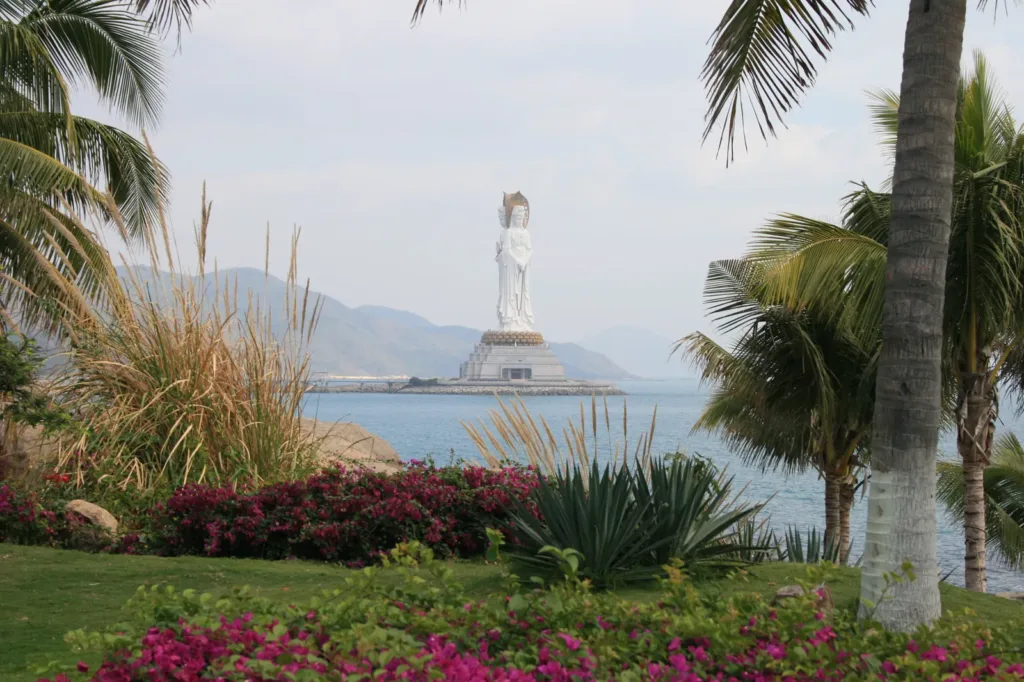
Nanshan is not simply a single old temple. It is a large, purpose-built cultural and leisure complex where Buddhist imagery, tropical coastal scenery and ideas of longevity and good fortune are presented together. The sea is part of the experience: the route repeatedly shifts between enclosed courtyards and open views toward the South China Sea. The Yazhou District government describes the area as combining tropical marine scenery, Chinese Buddhist culture, longevity culture and historical references.
The visual anchor is the 108-metre Nanshan Guanyin facing the sea. Other named highlights include Nanshan Buddhist Temple, the Three-Three Guanyin garden, the Bu’er Dharma Gate, the Nanshan International Intangible Cultural Heritage Centre and Longevity Valley. These are different kinds of spaces, so the visit works better when you compare them rather than treating every gate, hall and garden as an item to tick off.
What to look for
Start with the change in atmosphere from the entrance gateway to the temple courtyards, then continue to the more open coastal setting around Guanyin. Notice how the park uses gateways, courtyards, terraces and planted paths to frame religious symbols. The district government attributes different architectural references to different areas, including Tang-style references at Nanshan Temple, Northern and Southern Dynasties references at the Bu’er Dharma Gate and Nepalese influences at the international heritage centre. Treat those as design references, not automatic proof that each building is an ancient surviving structure.
The temple and gardens are also active religious and cultural spaces. Keep voices low near worshippers, leave room for devotional activity and ask before entering an interior or photographing a ritual. A few focused stops—Nanshan Temple, the sea-facing Guanyin area and one garden or cultural centre—will usually give a clearer sense of the place than trying to cover the whole park at speed.
Tickets and timing
The official English ticket instructions divide same-day check-in into a morning window of 08:00–13:00 and an afternoon window of 13:00–17:00. They list adult admission at CNY 129 in the peak season (1 October–30 April) and CNY 108 in the off-season (1 May–30 September). The same page says a single-ticket booking uses the buyer’s second-generation Chinese resident ID-card scan, one ticket is limited per person per day, and the purchaser must enter for the order to take effect.
Those ID-card instructions do not establish how every passport holder should book or pass the gate. If you are travelling on a passport, use the venue’s current official booking channel or tourist-centre ticket office and confirm the accepted document before paying. Do not assume that a domestic ID-based product is automatically valid for an international visitor. Opening arrangements, access to individual interiors and any bundled sightseeing-vehicle ticket should also be checked close to the visit.
Getting there
The venue’s official English transport page lists these routes to the Nanshan entrance:
- From Sanya Phoenix International Airport, take Bus 108 or 127 and transfer to Bus 5, 30, 116, 125 or 157.
- From Sanya Railway Station, Bus 55 is listed as a direct option.
- From Yazhou Railway Station, Bus 301 is listed as a direct option.
- From Sanya city, Bus 5, 30, 116, 125 or 157 are listed as direct options.
- From Nanshan North Railway Station, the same page describes a transfer to Bus 466.
The page does not give current departure intervals, last buses or a return timetable. Check the route in Amap or with the operator on the day, and ask at the tourist centre about the return connection before you begin a long visit. The district government lists sightseeing vehicles among the area’s services, but the route, operating hours and ticket bundle can change.
For a taxi or ride-hailing car, use the Chinese destination 南山文化旅游区 Nánshān Wénhuà Lǚyóuqū and the district 三亚市崖州区 Sānyà Shì Yázhōu Qū. The venue’s driving directions describe reaching the entrance after taking the Nanshan exit from the Sanya Ring Expressway and continuing about 5 km, or taking the Yacheng exit from the West Ring Expressway and continuing about 3 km. Confirm that the driver is taking you to the visitor entrance, not a nearby Nanshan-named business or the separate temple listing.
Find Nanshan Cultural Tourism Area
南山文化旅游区 · 崖州区
The pin marks the area, not the entrance.
Sources & visit information
Sources checked on 23 October 2026. Hours, tickets, reservations and transport can change; confirm with the operator before you go.
Image credits & notes (1)
- Nanshan Guanyin statue in Nanshan Guanyin Park, viewed across the landscaped coastal grounds. Photo: Gary ToddPhoto: CC0 1.0