

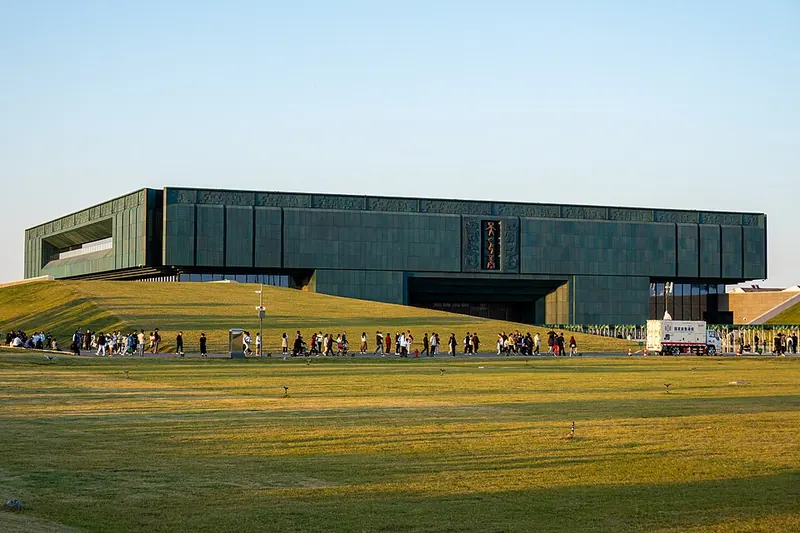
Photo adjustments
Full frame retained; proportionally resized and converted to WebP. No retouching or changes to the photographed subject. Card displays may crop the view.
Explore the region
About Yinxu Ruins
Rammed-earth palace and ancestral-temple foundations show the scale of the former city, while Fu Hao’s tomb gives the royal world a more individual focus. Oracle-bone inscriptions connect material remains with named people and recorded events. The palace area, royal cemetery and modern museum are distinct parts of a much larger site, so decide which components your visit includes.
The confirmed area of Yinxu measures about six kilometres from east to west and from north to south, covering roughly 36 square kilometres, with the Huan River (洹河) running through its middle. Centred on the palace and ancestral-temple site at Xiaotun (小屯) on the river's south bank, remains are arranged in a ring along both banks and include the royal cemetery, the Shang city site, family cemeteries, oracle-bone pits and a bronze-casting site. Since 1928, when formal excavation began under Cai Yuanpei (蔡元培), president of the then Academia Sinica, archaeologists have found more than eighty palace and temple foundations, built on tall rammed-earth platforms in symmetrical courtyard layouts.
In March 1961 Yinxu was included in the first batch of Major Historical and Cultural Sites Protected at the National Level (全国重点文物保护单位). In 1976 the tomb of Fu Hao (妇好), consort of the Shang king Wu Ding (武丁), was found north of Xiaotun; it is the only intact Shang royal tomb yet discovered, containing 1,928 objects, including 468 bronzes and 755 jade items. Nearby, the Houmuwu ding (后母戊大方鼎), unearthed east of the royal cemetery, is the heaviest bronze vessel yet found.
What to look for
- The palace and ancestral-temple foundations around Xiaotun on the south side of the Huan River.
- Fu Hao’s tomb and the archaeological context linking royal burials with Shang ritual culture.
Background & history
Yinxu (Mandarin pronunciation: [ín.ɕý]; Chinese: 殷墟; lit. 'Ruins of Yin') is a Chinese archeological site corresponding to Yin, the final capital of the Shang dynasty (c. 1600 – c. 1046 BCE). Located in present-day Anyang, Henan, Yin served as the capital during the Late Shang period (c. 1250 – c. 1046 BCE) which spanned the reigns of 12 Shang kings and saw the emergence of oracle bone script, the earliest known Chinese writing. Along with oracle bone script and other material evidence for the Shang's existence, the site was forgotten for millennia. Its rediscovery in 1899 resulted from an investigation into oracle bones that were discovered being sold nearby. The rediscovery of Yinxu marked the beginning of decades of intensive excavation and study. It is one of China's oldest and largest archeological sites, and was selected by UNESCO as a World Heritage Site in 2006. Yinxu is located in northern Henan, near modern Anyang and the borders Henan shares with Hebei and Shanxi. Public access to the site is permitted.
Excerpt from Wikipedia: Yinxu · Wikipedia contributors · CC BY-SA 4.0. Selected introductory sentences; formatting simplified. Background information, not current visitor-service advice.
The surrounding area
Northern provincial base for the Yinxu Ruins archaeological landscape and nearby regional food traditions.
Location & getting there
Getting to Yinxu Ruins
For the palace and ancestral-temple site, travel to the Xiaotun area of Yindu District in Anyang. Specify this entrance when arranging transport: the newer museum and the royal cemetery use different locations, and a general Yinxu map result may lead to another component.
Combine your visit
A suggested sequence linking the specific features of this visit.
-
Palace and ancestral-temple foundations
Start with the layout of the capital’s ceremonial and residential core.
-
Fu Hao’s tomb
Compare the large public structures with an individual royal burial.
-
Oracle-bone interpretation
Use the site’s displays to connect the remains with early written records.
This order is editorial. Confirm access and any transfers between stops; it does not establish a walking route, same-day connection or common admission ticket.

Find Yinxu Ruins
殷墟 · 安阳市
The pin marks the area, not the entrance.
More places nearby
Approximate straight-line distances between map pins, not travel distances.
National Museum of Chinese Writing 中国文字博物馆
6 km awayThe National Museum of Chinese Writing makes scripts its central subject, beginning with early evidence such as oracle bones and following changes in written form. The architecture extends that theme outdoors: the…
View guide →Mausoleum of Cao Cao 曹操高陵遗址博物馆
14 km awayCao Cao’s mausoleum museum at Xigaoxue centres on a large brick tomb approached by a sloping passage. The burial has front and rear chambers with side rooms, allowing visitors to understand its layout as a designed underground…
View guide →Youli 羑里城
18 km awayYouli combines a much older archaeological site with later buildings commemorating King Wen of Zhou. The traditional account of his imprisonment and work on the Book of Changes gives the place its meaning, but the visible…
View guide →Sources & visit information
The sources below support the place-specific description and arrival information. Suggested combinations are editorial planning ideas; confirm current opening, entry arrangements and transport services for your date.
Visitor information adapted and edited from Wikipedia contributors, “殷墟” · CC BY-SA 4.0. Source revision 93759122.
Visitor information adapted and edited from Wikivoyage contributors, listing “Yin Ruins” · CC BY-SA 4.0.
Background paragraphs translated and condensed from Wikipedia contributors, "殷墟", Chinese Wikipedia · CC BY-SA 4.0. Source revision 94255757.