

Explore the region
Tap any red Chinese text to hear it in Mandarin.
A Qing merchants’ courtyard in old Kaifeng
On Xufu Street in Kaifeng’s old city, the Shanxi-Shaanxi-Gansu Guild Hall is a surviving Qing merchants’ guild hall whose buildings make commercial history visible. Merchants from Shanxi, Shaanxi and Gansu who lived and traded in Kaifeng funded the hall in the forty-first year of the Qianlong reign (1776). It served as a place to conduct business, meet fellow provincials and worship Guan Yu; it was not simply a private residence or a conventional temple.
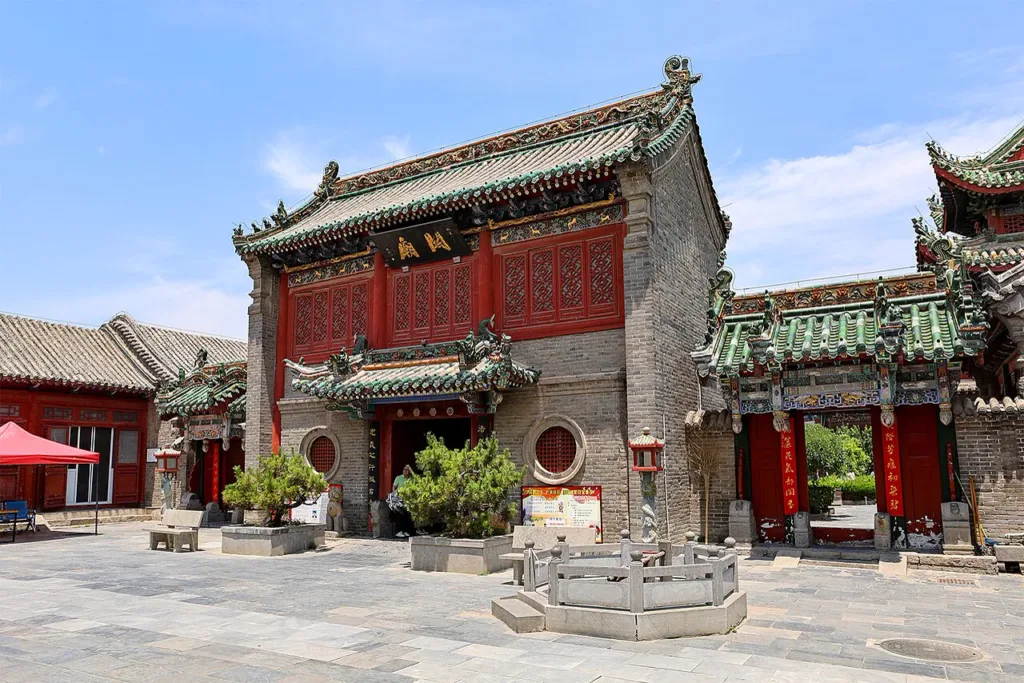
What visitors see today is the surviving Guandi Temple section of the larger historical complex. Its south-facing courtyard is arranged on a clear north–south axis: a street-side screen wall, an opera stage, a memorial archway and the main hall, with bell and drum towers, side rooms and two side courtyards alongside. The site was listed in 2001 as a fifth-batch National Key Cultural Relics Protection Unit.
The hall is especially useful for understanding how merchant identity was expressed through architecture. The inscriptions and carved decoration repeatedly connect moral conduct with trade, while the surviving buildings preserve a sequence of thresholds rather than a single monumental façade. The most rewarding visit is slow and close: follow the axis from the screen wall to the main hall, then look sideways into the smaller courts.
What to look for
- The screen wall (照壁): Face the courtyard side and look for the stone Two Dragons Playing with a Pearl (二龙戏珠), then walk around to see the four large characters “loyalty, righteousness, benevolence, courage” (忠、义、仁、勇) on the reverse. The wall is built of carefully finished grey brick; published architectural documentation gives it as about 8.6 metres high and 16.5 metres long.
- The opera stage (戏楼): Its lower level forms a passage between the front and rear courts. Above it, a carved dragon screen separates the performance area from the dressing and rest space. This is the surviving historic theatre building for which Kaifeng is particularly noted, so pause to read the stage as part of the circulation route, not only as a façade.
- The memorial archway (牌楼): The green-glazed structure carries the large plaques “Dayi Cantian” (大义参天) and “Liufang Qiangu” (流芳千古). Its painted stories and carved details reward viewing from both sides rather than taking a single entrance photograph.
- The main hall (大殿): The Guan Yu hall joins a worship hall, a middle hall and a rear hall. Look up under the front eaves for layers of wood carving and read the gable inscriptions “fair trade” (公平交易) and “seek wealth through righteousness” (义中求财).
- The side courts: The east and west cross-courts were arranged for private opera performances and each has a smaller stage. They explain why the complex feels like a working association compound, not a single-purpose shrine.
Treat the carvings as protected fabric: observe details from the visitor path and do not touch painted wood, brick reliefs or stone sculpture.
Visiting and getting there
The official Kaifeng cultural-heritage register gives the address as 105 Xufu Street (徐府街105号), while the Longting District government introduction gives 85 Xufu Street (徐府街85号). A Trip.com listing read on 31 October 2026 also uses No. 85. Because the published numbers conflict, search for 山陕甘会馆 Shān Shǎn Gān Huìguǎn together with 徐府街 Xú Fǔ Jiē in Amap/Gaode Maps and confirm the pin and street entrance on the day; do not rely on the number alone.
The official heritage and district-government pages I read do not publish a current admission price, opening calendar or reservation procedure. A third-party Trip.com listing displays daylight-saving hours of 08:00–18:00 and standard-time hours of 08:00–17:30, but treat those as provisional rather than as a guarantee. No official passport-specific booking or entry rule was found, so do not infer that a domestic-ID reservation process applies to foreign visitors. Confirm current opening, ticketing, identification and entrance arrangements before setting out.
For rail arrivals, the Kaifeng government’s transport-hub page records these city connections: at Kaifeng Railway Station (开封站), routes 10, 29 and 46 start there and routes 3, 4, 12 and 35 pass through; at Kaifeng North Railway Station (开封北站), routes 8, 21, 35 and 53 start there and routes 38 and 52 pass through. That official page does not identify a current direct stop at the guild hall. The dependable last-mile option is therefore a taxi or ride-hailing car using the Chinese destination 山陕甘会馆(徐府街); check the live Amap pin before boarding and set the return trip back to your rail station before leaving.
If you are already in the central old city, a 2025 Qunar field guide places the hall beside the north end of Bookstore Street and describes walking or cycling as practical. Use that as a route clue, not as proof of a fixed entrance or unchanged street access.
Find Shanxi-Shaanxi-Gansu Guild Hall
山陕甘会馆 · 龙亭区
The pin marks the area, not the entrance.
Sources & visit information
Sources checked on 31 October 2026. Hours, tickets, reservations and transport can change; confirm with the operator before you go.
Image credits & notes (1)
- An inner courtyard of Kaifeng’s Shanxi-Shaanxi-Gansu Guild Hall, showing the historic brick-and-wood hall and an adjoining gateway. Photo: WindmemoriesPhoto: CC BY-SA 4.0