

Explore the region
Tap any red Chinese text to hear it in Mandarin.
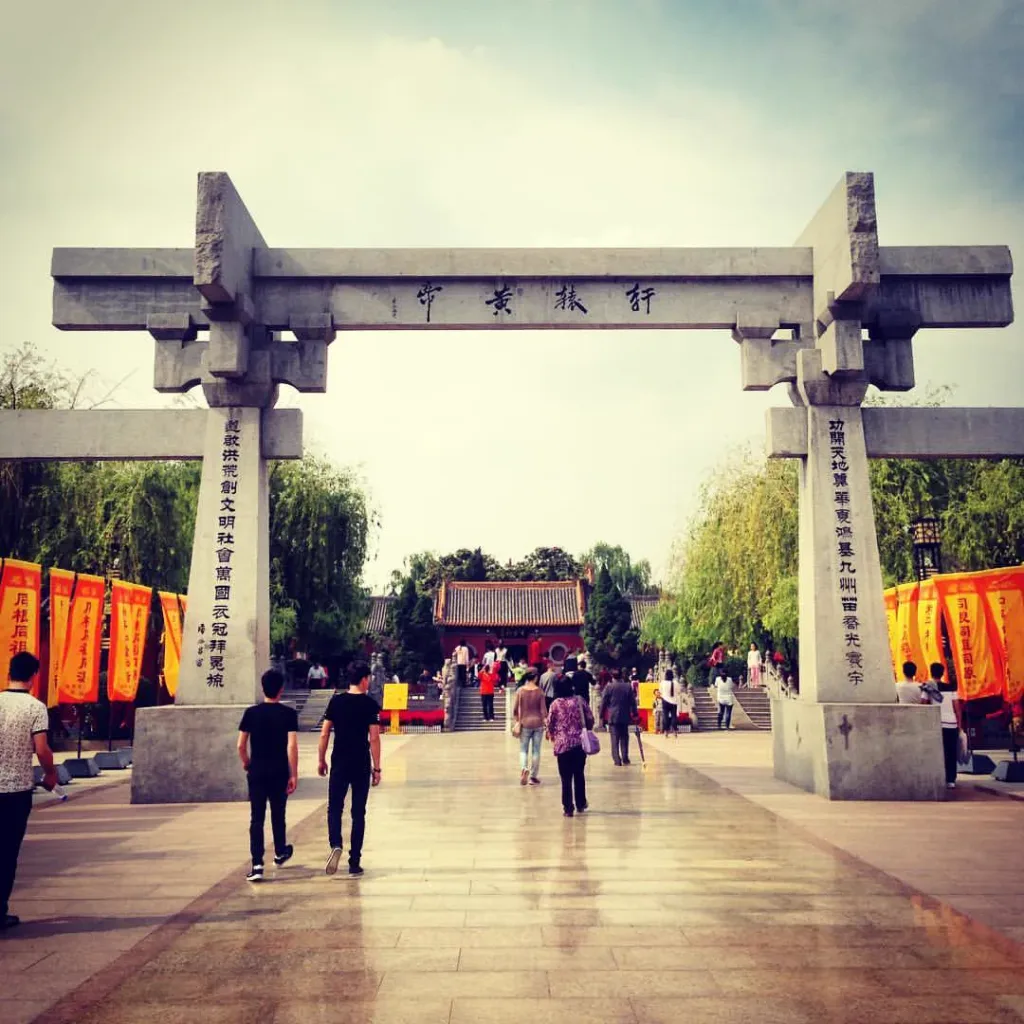
Hometown of the Yellow Emperor (黄帝故里, Huangdi Guli) is in Xinzheng rather than in central Zhengzhou. The site presents a long-standing local tradition that the Yellow Emperor Xuanyuan was born at Xuanyuan Hill and ruled from Youxiong; the tradition is the reason for the complex’s name and ritual importance, not a claim that every feature visible today is an untouched prehistoric remain. The Zhengzhou government lists it as a national 4A scenic area and a national key cultural heritage site, at Xuanyuan Road in Xinzheng.
The visitor experience is a compact ceremonial and memorial complex rather than an archaeological city. The city description gives the present layout as three broad north-to-south blocks—Xuanyuan Hill and the ancestor-worship square, the shrine area, and the Chinese Surname Square—while the provincial tourism description divides the enlarged site into five functional areas. Walk it as a sequence: start with the entrance and open squares, slow down at the shrine and Xuanyuan Bridge, then look closely at the ritual objects and the memorial landscape instead of treating the grounds as a generic park.
What to look for
The core is Huangdi Guli Shrine (黄帝故里祠), whose origin is traditionally placed in the Han dynasty. The official city account records a Ming repair in 1570 and the re-erection of the “Xuanyuan’s Native Place” stele in 1715. The shrine’s present buildings are the result of repeated rebuilding and repair, so read the site as a layered place of memory: an old ritual foundation presented through a modern expanded complex.
In front of the shrine, look for Xuanyuan Bridge (轩辕桥) and the stele associated with the site. The provincial description also identifies a large Huangdi Treasure Tripod (黄帝宝鼎) on the tripod platform, stated as 6.99 metres high and weighing 24 tonnes, with eight other tripods arranged around it. Jade columns carrying the totems of China’s 56 ethnic groups stand beside the platform. These are best understood as modern ceremonial symbols: notice the scale, axial placement and repeated ritual imagery rather than expecting excavated bronze-age objects.
Continue towards Xuanyuan Hill (轩辕丘) and the memorial hall built into its earth-covered form. At the southern end, the Chinese Surname Square turns the idea of ancestry into a public landscape of names. The complex is therefore most rewarding when you observe how shrine, bridge, mound, tripod and surname wall build a route from a specific local tradition to a much broader idea of shared ancestry.
The annual Huangdi Ancestor-Worship Ceremony is a special event, not a daily performance. The Xinzheng government reported that the 2026 ceremony took place on 19 April, the third day of the third lunar month, and followed a nine-part ritual programme. If you plan around the lunar date in a later year, confirm the announced date, access controls and any temporary closures before travelling; do not assume that an event schedule repeats unchanged.
Visit and entry
The Zhengzhou government’s attraction listing gives the address as Xuanyuan Road middle section, Xinzheng City, lists admission as free, and publishes the visitor telephone number 0371-69902555. The listing does not state a current daily opening timetable or a passport-specific reservation procedure. Call ahead, especially if you are travelling on a non-Chinese passport, want to enter interior halls, or are visiting near a ceremony or construction period. Do not treat a domestic ID-based reservation, if one appears in a third-party system, as proof that a passport booking is accepted.
Temporary closures have occurred. A notice dated 17 October 2026 announced a short closure from 08:30 to 10:30 on 18 October for repairs after rainy weather; it is evidence that conditions can change, not evidence of a continuing closure. Check the venue or current map listing on the day of travel.
Allow time to walk the full axis and to pause at the shrine, bridge, tripod platform and Xuanyuan Hill. The grounds are a place of worship and remembrance as well as a tourist attraction: keep voices low inside ritual spaces, follow staff instructions, and do not photograph people at prayer without permission.
Getting there
Use Amap/Gaode Maps (高德地图) with the Chinese destination 黄帝故里景区 Huáng Dì Gù Lǐ Jǐngqū and the city 新郑市 Xīn Zhèng Shì, then confirm the selected pin and the currently open gate. Amap’s route planner supports driving, bus, walking and cycling, combines bus and metro legs where relevant, and warns that routes can change with operations or construction.
For public transport, a Zhengzhou travel guide updated on 8 August 2025 describes this practical connection: take a coach from Zhengzhou Long-distance Bus Terminal or Zhengzhou South Long-distance Bus Station to Xinzheng Xiguan Long-distance Bus Station, then take Xinzheng bus line 1 and get off at Huangdi Hometown Station (黄帝故里站). The same source does not establish a current timetable, so check the line and stop in Amap before boarding and confirm the return route before leaving the site.
For a taxi or ride-hailing car, show 黄帝故里景区,郑州市新郑市轩辕路中段 Huáng Dì Gù Lǐ Jǐngqū, Zhèng Zhōu Shì Xīn Zhèng Shì Xuān Yuán Lù Zhōngduàn rather than relying on the English name alone. Ask the driver to follow the current map pin and the open visitor entrance; event traffic controls can change the final drop-off. No fixed fare, travel time or metro-stop transfer is claimed here because those details were not confirmed for the current day.
There is no verified direct metro stop at the complex in the sources used for this guide. If you arrive by rail or aircraft, plan the final coach, bus or taxi leg in Amap rather than assuming that a Zhengzhou Metro station is walkable from the shrine. Reverse the route in Amap before departure so that you have a current way back to Xinzheng Xiguan or your starting station.
Find Hometown of the Yellow Emperor
黄帝故里 · 新郑市
No reliable map pin yet: search by the Chinese name.
Sources & visit information
Sources checked on 31 October 2026. Hours, tickets, reservations and transport can change; confirm with the operator before you go.
Image credits & notes (1)
- An entrance arch in the Xuanyuan Huangdi temple complex at the Hometown of the Yellow Emperor in Xinzheng, with the inner shrine roof visible beyond. Photo: Blowing Puffer FishPhoto: CC BY 2.0