

Explore the region
Tap any red Chinese text to hear it in Mandarin.
In brief: A large archaeological cityscape in Xinzheng, where the states of Zheng and Han successively kept their capitals for 539 years. Its surviving rammed-earth walls, palace-city remains, cemeteries and museum displays are spread through the modern city rather than gathered behind one single gate.
Why this site matters
Zheng-Han Ancient City is in Xinzheng, a county-level city administered by Zhengzhou—not in central Zhengzhou. The ruins occupy the area around the meeting of the Shuangji River (双洎河, the ancient Wei River) and the Huangshui River (黄水河, the ancient Zhen River). Zheng moved its capital here in the late Western Zhou period; after Han conquered Zheng, Han used the same capital. Together, the two states made this their capital for 539 years.
This is not a reconstructed walled town. It is a broad archaeological landscape embedded in Xinzheng’s streets, riverbanks and parks. The ancient city covered roughly 16 square kilometres and had about 20 kilometres of walls. A dividing wall separated a western palace city from a larger eastern outer city. The western side held palaces and elite residences; the eastern side contained areas associated with residents, workshops, ritual activity and Zheng aristocratic cemeteries.
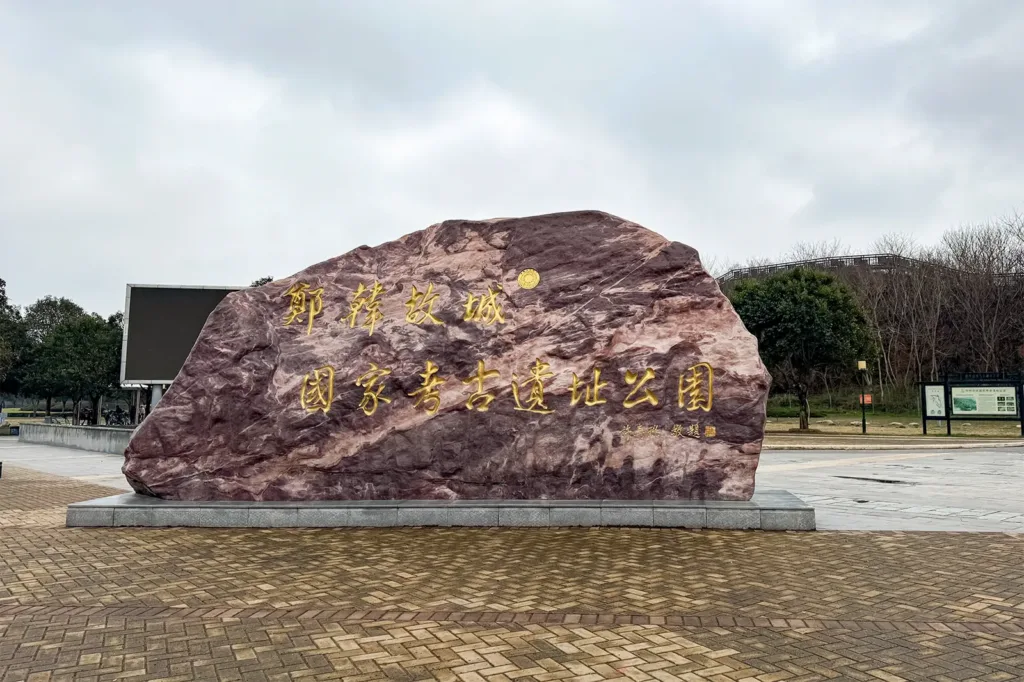
The scale is the point. From a surviving earthen wall or a protected excavation, you are looking at the outline of a working Eastern Zhou capital: defensive earthworks above ground, and much of the evidence for government, craft production, burial and ritual below it. The site was listed as a Major Historical and Cultural Site Protected at the National Level in 1961 and became a National Archaeological Site Park in 2017.
What to look for
Start with a city-wall park or another clearly signed public section rather than treating every mound or wall fragment on the map as an open attraction. The north and east walls are among the better-preserved stretches. A 2024 field report describes a protected display at the northern gate, where excavated rammed-earth layers, ancient road traces and a later wengcheng (瓮城, barbican) make the defensive design easier to read than a bare wall line.
In the western city, look for the earth platform known as 梳妆台 (Dressing Table). Archaeological research identifies it as a large rammed-earth building platform, about 135 metres long, 80 metres wide and originally about 8 metres high. It is an earthwork, not a restored palace: the useful question is what its size and position say about the palace area, not whether a palace will appear on top.
For the clearest indoor interpretation, add 郑国车马坑遗址博物馆 (Zheng Chariot and Horse Pit Site Museum). It is an important area of the Zheng-Han site, but it is not the whole ancient city and should be navigated as a separate destination. The museum’s reported displays include a Zheng duke’s tomb shaped like the character 中, the No. 1 chariot-and-horse pit, the No. 3 excavation area and finds from the Zheng aristocratic cemetery. The cemetery contains more than 3,000 Spring and Autumn burials and 23 large and medium chariot pits.
The famous 莲鹤方壶 (Lotus-and-Crane Square Hu) was excavated from the 1923 Lijialou tomb in the ancient-city area, but the original vessels are now held in museums elsewhere. Do not expect to find the original pair at the wall park or assume that a modern replica is the excavated object.
Planning a visit
Allow time to move between nodes. The National Archaeological Site Park is organised as four separate components—city wall, palace city, Dawo Lou handicraft site and Houduanwan burial area—rather than a compact single attraction. The latest Zhengzhou municipal account (20 October 2026) says these four park components are free to enter. That is a park-level statement; it does not by itself establish the current hours, ticket procedure or passport arrangements for every museum, excavation display or controlled area.
Use the exact Chinese name in a map app: 郑韩故城国家考古遗址公园 Zhèng Hán Gù Chéng Guójiā Kǎo Gǔ Yí Zhǐ Gōng Yuán for the park or wall section, and 郑国车马坑遗址博物馆 Zhèng Guó Chēmǎ Kēng Yí Zhǐ Bó Wù Guǎn for the chariot-and-horse museum. Amap (高德地图) is the practical choice for the final local leg. Because the ruins are dispersed, keep the return route for the same named node rather than assuming that a taxi or bus can pick you up from any wall fragment.
I could not verify a current metro stop, bus number, stop name or exit that serves the whole site from the public pages checked, so none is presented here as a fact. In practice, arrange the Zhengzhou–Xinzheng leg first, then use a taxi or ride-hailing car to the exact Chinese destination shown above. Before setting out, confirm the displayed entrance and the return connection in Amap; if you plan to enter an indoor museum with a non-mainland passport, confirm its current identity, booking and entry requirements with the operator rather than assuming that free park access covers it.
Treat excavation areas, cemetery grounds and earth walls as protected heritage. Stay on marked paths, do not climb or walk across exposed archaeological surfaces, and do not enter a gate, campus or dig area simply because it appears close to a map pin. The site is interesting precisely because the modern city and the ancient capital overlap; that also means that “郑韩故城遗址” is a search term for a landscape, not a promise of one universal entrance.
Find Zheng-Han Ancient City Site
郑韩故城遗址 · 新郑市
No reliable map pin yet: search by the Chinese name.
Sources & visit information
Sources checked on 31 October 2026. Hours, tickets, reservations and transport can change; confirm with the operator before you go.
Image credits & notes (1)
- The entrance marker for Zheng-Han Ancient City National Archaeological Site Park in Xinzheng. Photo: WindmemoriesPhoto: CC BY-SA 4.0