


Explore the region
About Zhoukou Guandi Temple
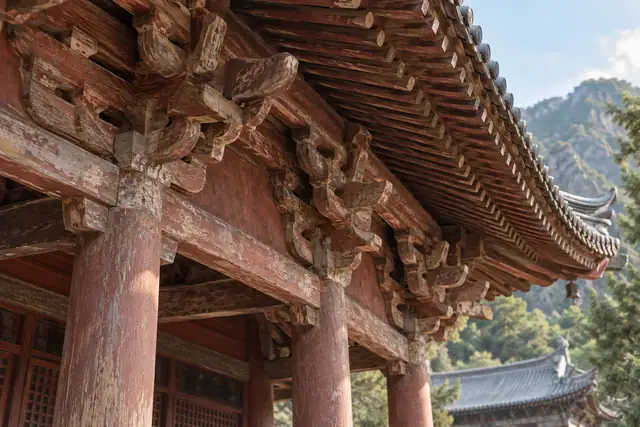
The carved gates, stone archways and richly decorated halls reflect the river port’s commercial connections. Its courts bring together spaces for devotion, business-community identity and performance, with a theatre among the principal buildings. The carved wood and stone deserve close attention: they carry much of the detail that makes this merchant-funded compound distinctive.
Zhoukou lies in southeastern Henan at the point where the Sha (沙河), Ying (颖河) and Jialu (贾鲁河) rivers converge, and was formerly an important hub for grain transport by water, known as “Little Wuhan”. During the Ming and Qing dynasties, when boats and carts converged there and merchants gathered in numbers, merchants from Xinjiang and Changzhi in Shanxi and from Puzhou, Dali and Chengcheng in Shaanxi pooled funds to build the Guandi Temple; it was formerly known as the Shanxi-Shaanxi Guild Hall (山陕会馆).
The temple was listed as a Major Historical and Cultural Site Protected at the National Level (全国重点文物保护单位) in the fourth such designation round, in 1996. Among China's surviving Guandi temples it is described as the best preserved and largest in scale, with wood and stone carvings of particularly high artistic value.
What to look for
- The carved stone archways and decorated halls along the main axis.
- The theatre and courtyard arrangement, linking worship with the activities of the merchant community.
Location & getting there
Getting to Zhoukou Guandi Temple
Go to 111 Fuqiang Street in Zhoukou’s Chuanhui District, north of the Shaying River. Ask for Zhoukou Guandi Temple or the historic Shanshan Guildhall rather than another local shrine to Guan Yu.
Combine your visit
A suggested sequence linking the specific features of this visit.
-
Gate and stone archways
Begin with the merchants’ formal entrance and its carved decoration.
-
Principal halls
Examine the worship spaces and their wood and stone details.
-
Theatre courtyard
Consider how performance fitted into the guildhall’s shared social life.
This order is editorial. Confirm access and any transfers between stops; it does not establish a walking route, same-day connection or common admission ticket.
Find Zhoukou Guandi Temple
周口关帝庙 · 周口市
The pin marks the area, not the entrance.
More places nearby
Approximate straight-line distances between map pins, not travel distances.
Taihao Mausoleum 太昊陵
26 km awayTaihao Mausoleum in Huaiyang is a temple-and-tomb complex dedicated to the cultural ancestor Fuxi. The surviving layout follows a plan established in the Ming period and repaired under the Qing.
View guide →Pingliangtai Ancient City Ruins 平粮台古城遗址
27 km awayPingliangtai preserves evidence of a compact, planned settlement from the late Neolithic Longshan period. Rammed-earth walls enclosed a roughly square space, with gates, house platforms and an organised drainage system. The…
View guide →Xu Shen Cultural Park 许慎文化园
51 km awayXu Shen’s tomb lies near Xuzhuang village in Luohe’s Shaoling district. It commemorates the Eastern Han scholar associated with the study of Chinese characters.
View guide →Sources & visit information
The sources below support the place-specific description and arrival information. Suggested combinations are editorial planning ideas; confirm current opening, entry arrangements and transport services for your date.
Visitor information adapted and edited from Wikipedia contributors, “周口关帝庙” · CC BY-SA 4.0. Source revision 92247307.
Visitor information adapted and edited from Wikivoyage contributors, listing “Zhoukou Guandi Temple” · CC BY-SA 4.0.
Background paragraphs translated and condensed from Wikipedia contributors, "周口关帝庙", Chinese Wikipedia · CC BY-SA 4.0. Source revision 92247307.