

Photo adjustments
Wikimedia thumbnail; fitted to the ranking-card frame.
Explore the region
About Tian Tan Buddha
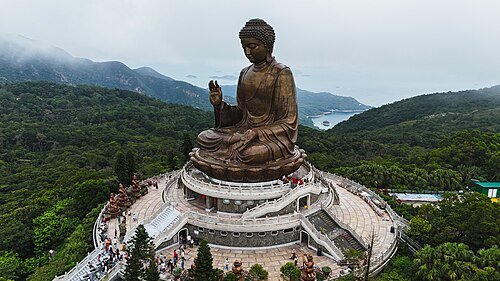
The raised right hand represents fearlessness, while the left rests palm-up in the lap. Looking from the approach towards the statue makes those gestures and the flowing robe easier to read. The circular platform takes its inspiration from Beijing’s Temple of Heaven. Combine this hilltop monument with Po Lin Monastery below, allowing for the ascending approach and separate visitor access arrangements.
In 1974 the government granted Po Lin Monastery a 6,567-square-metre plot on Mok Yu Peak (木鱼峰) at a nominal price for the statue. The monastery formally established a construction committee on 26 December 1981, and a groundbreaking ceremony followed on 29 December, led by the District Secretary for New Territories. The estimated cost rose from an initial HK$20 million to more than HK$60 million over the project's twelve years.
The statue's design was created by Master Hung Wan (宏勋法师) of Chi Lin Nunnery, and a Guangzhou sculptor's plaster model went through eight revisions before a scale model was finished in 1984. Casting and installation were carried out by the China Aerospace Nanjing Chenguang Machine Factory (中国航天南京晨光机器厂); the finished bronze was shipped from Nanjing to Hong Kong by sea in 1989, and the Big Buddha was consecrated on 29 December 1993.
The bronze figure is reached by 268 stone steps and assembled from 207 bronze plates: 165 for the body, 36 for the lotus and 6 for the cloud motifs. It stands 26.4 metres tall, about 34 metres including the lotus throne and pedestal, and weighs 250 metric tons, seated on a three-tiered altar with a museum at its base.
What to look for
- The Buddha’s raised right hand and upward-facing left palm form contrasting symbolic gestures.
- The lotus throne and circular, Temple of Heaven-inspired platform frame the bronze figure.
Location & getting there
Getting to Tian Tan Buddha
Travel from Tung Chung MTR station to Ngong Ping by the cable car or a Ngong Ping-bound Lantau bus, then follow the signed approach to Po Lin Monastery and the Buddha. The monastery identifies its address as Ngong Ping, Lantau Island; the Buddha is the elevated monument nearby.
Combine your visit
Suggested order for the visit:
-
Ngong Ping approach
See the statue’s position above the plateau.
-
Buddha platform
Study the hands, robe and lotus throne from permitted visitor areas.
-
Po Lin Monastery宝莲禅寺
Continue with the neighbouring religious complex.
This is an editorial sequence of named spaces or places. It does not imply a verified walking connection or promise opening, ticket availability or a journey time.
Find Tian Tan Buddha
天坛大佛 · 离岛区
The pin marks the area, not the entrance.
More places nearby
Approximate straight-line distances between map pins, not travel distances.
Po Lin Monastery 宝莲禅寺
Less than 1 km awayPo Lin Monastery stands on the Ngong Ping plateau of Lantau Island. Its main shrine contains three bronze Buddha images representing past, present and future, while the Hall of Bodhisattva Skanda introduces another part of the…
View guide →Ngong Ping 360 · Ngong Ping terminal 昂坪360·昂坪端站
Less than 1 km awayNgong Ping 360 turns the ascent from Tung Chung into a view across water, airport infrastructure and the wooded hills of northern Lantau. The cable route crosses Tung Chung Bay, changes direction near Airport Island and climbs…
View guide →Tung Chung Fort 东涌炮台
4 km awayTung Chung Fort preserves a compact granite enclosure beside Sheung Ling Pei village. Chinese inscriptions mark its three arched gateways, and six old cannon stand along the north wall. The main entrance inscription supplies…
View guide →Sources & visit information
The sources below support the place-specific description and arrival information. Suggested combinations are editorial planning ideas; confirm current opening, entry arrangements and transport services for your date.
- Po Lin Monastery: Tian Tan Buddha ↗
- Po Lin Monastery: visitor information ↗
- Chinese Wikipedia: 天坛大佛 (revision 93752356, 2026-08-03) ↗
Background paragraphs translated and condensed from Wikipedia contributors, "天坛大佛", Chinese Wikipedia · CC BY-SA 4.0. Source revision 93752356.