

Photo adjustments
EXIF orientation normalized; resized without changing aspect ratio; converted to WebP. No subject edits.
Explore the region
About Dashuijing Ancient Architectural Complex
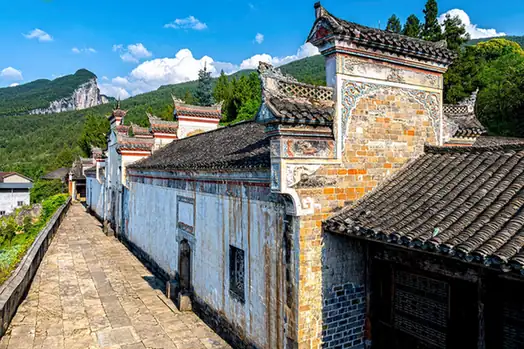
Dashuijing Ancient Architectural Complex (大水井古建筑群) is a group of Li family compounds in Dashuijing village (大水井村), Baiyangba town (柏杨坝镇), 45 km from the urban area of Lichuan (利川) in Enshi prefecture (恩施), Hubei.
Baiyangba is the home of the song "Longchuan Diao" (龙船调, "Dragon Boat Tune"). The site began as the house of the Huang family, hereditary tusi (土司) chieftains. In the Qianlong reign a Huang chieftain gave refuge to Li Tinglong (李廷龙), who had fled from the Dongting Lake (洞庭湖) region, and the Li family later took the Huang estate for themselves. Successive Li generations rebuilt and enlarged it, and building on the site spans more than 300 years, from the late Ming to 1949.
The Enshi culture and tourism bureau describes three parts. The Li Liangqing Manor (李亮清庄园) has 174 rooms; its southwest corner keeps the late-Ming Huang house of timber frames and plank walls, while the northeast part, reworked by the Lis after the Qianlong era, mixes brick with timber and Chinese with Western forms. The clan ancestral hall (李氏宗祠), built from 1846 to 1849, is a palace-style brick-and-timber building of three halls and two wings, with tall firewalls and walls inlaid with coloured porcelain. The third part is the house of Li Gaiwu (李盖五), a courtyard home facing west, built from 1942 to 1948.
Across the complex there are 24 courtyards and more than 200 rooms, and Western-style colonnades stand beside stilt houses (吊脚楼). The Hubei provincial government listed the ancestral hall and manor as a protected site on 16 December 1992, and the State Council made the whole group a national key cultural relics protection unit on 25 June 2001, in the fifth batch. It is also a national AAAA-grade scenic area.
What to look for
- Li Liangqing Manor (李亮清庄园), with the late-Ming Huang house in its southwest corner
- The Young Ladies' Tower (小姐楼) and Embroidery Tower (绣花楼) at the east and west ends of the manor
- The Li clan ancestral hall (李氏宗祠) of 1846-1849, with porcelain inlays of flowers, birds, insects and fish on its walls and firewall ends
- Li Gaiwu's house (李盖五旧宅), a 1940s courtyard residence north-east of the manor
- The old flagstone road (古石板道) that forms part of the protected site
- Dragon Bridge (龙桥), protected with the stele inscribed "魁山二公入川故里" ("old home of the two Kuishan forebears on entering Sichuan")
Location & getting there
Getting to Dashuijing Ancient Architectural Complex
- Search for 大水井古建筑群 with 恩施土家族苗族自治州 and 利川市.
Find Dashuijing Ancient Architectural Complex
大水井古建筑群 · 利川市
No reliable map pin yet: search by the Chinese name.
Sources & visit information
Written from the linked sources and checked sentence by sentence against quoted extracts by a separate reviewer on 2026-09-23. Opening hours, admission and access arrangements are not covered; confirm current visitor information with the site.
Some facts checked against Wikipedia contributors, "大水井古建筑群" · CC BY-SA 4.0.