

Explore the region
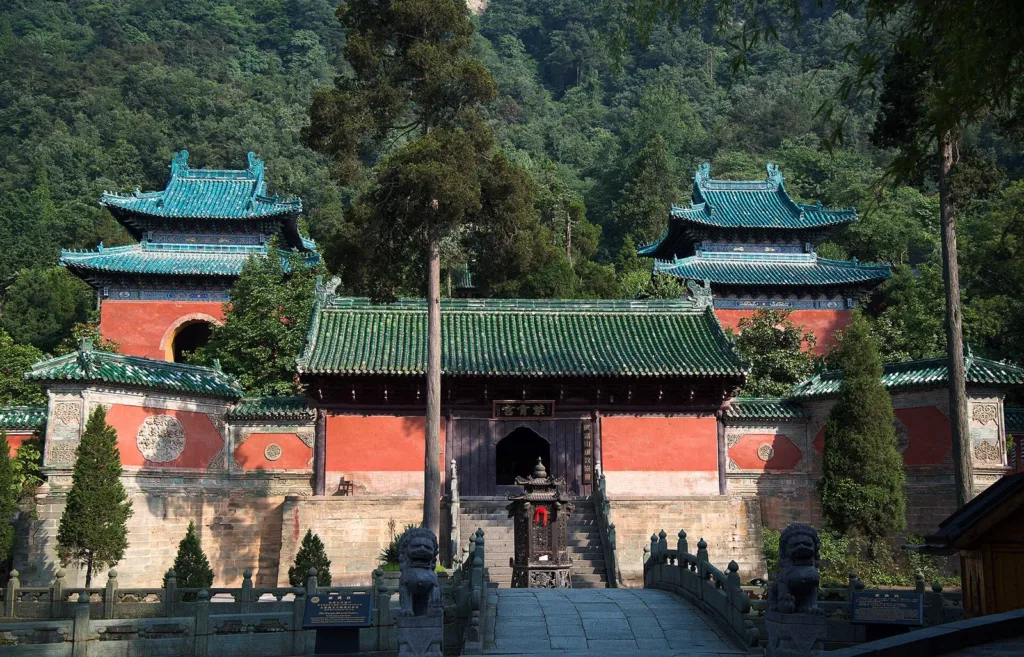
In brief: Purple Cloud Temple (紫霄宫, Zixiao Gong) is a historic Daoist palace below Zhanqi Peak in the Wudang Mountains. Its central-axis halls, timber construction and active religious setting reward a slow architectural visit rather than a quick stop between mountain buses.
Why this place matters
Purple Cloud Temple sits inside the Wudang Mountain scenic area in Danjiangkou, within Shiyan’s wider administrative area. It is a distinct palace from Nanyan Palace and the Golden Summit. The wider Ancient Building Complex in the Wudang Mountains is a UNESCO World Heritage property: its organised Ming-period complex preserves Daoist buildings reaching back to the seventh century and architectural and artistic work from the Yuan, Ming and Qing periods.
The palace is worth visiting for the way it makes religious architecture readable at walking pace. A Hubei government description highlights the Grand Hall’s rare uplift wooden crossbeam construction, its coloured timber decoration and the raised platforms that divide a large palace into smaller structural units. It also identifies the Dragon-and-Tiger Hall, the pavilion housing imperial stone tablets, the reception hall, side halls and the Parents Hall along the palace’s main axis.
Start at the entrance and follow the permitted central route without rushing uphill. Pause to compare the guardian hall with the more formal halls behind it; then look upward at the painted timber, roof junctions and the high platforms that carry the buildings. The large characters on the hall lintels are not just decoration: the official description relates them to Zhenwu worship and to the Daoist idea of a peaceful residence apart from the ordinary world. Keep worship routes clear, lower your voice and ask before photographing interiors or religious activity. The temple is a working religious place, not a staged performance.
Entering and getting there
Entry is controlled through the wider Wudang Mountain scenic area. The official visitor notice says that scenic-area tickets use real-name reservation, normally at least one day ahead through the official mini-program or major booking platforms. It also says that online visitors use identity and face matching to board the scenic shuttle, while an offline manual window serves foreign visitors and Hong Kong, Macao and Taiwan visitors. If your passport or other travel document is not accepted by the online flow, ask at the official visitor-service window rather than assuming that a domestic-ID process will work for you.
The palace’s own opening hours and any separate admission arrangement were not confirmed in the current official pages read for this guide. A 2025 conservation notice lists seven buildings in the repair programme and says that the palace would remain open by sections during a 730-day project. That historical notice does not provide a current, section-by-section reopening bulletin, so confirm what is open on the day you travel.
From the Wudang Mountain Visitor Service Center, use the scenic-area shuttle rather than trying to treat the palace as a city-street stop. A readable route page places 紫霄宫 between 太子坡 (Taizipo) and 南岩 (Nanyan) and identifies a dedicated 紫霄宫 stop. Tell the driver or station staff “紫霄宫站” (“Zixiao Palace stop”), and check the return boarding point as soon as you get off. The sources read here do not publish a dependable current last-bus time or a fixed transfer rule. Before entering, ask whether the next bus toward Nanyan continues through or requires a change at Taizipo; for a return to the Visitor Service Center, follow the signed stop and confirm the final departure with staff. Do not guess an exact walk time from the drop-off or plan to return after the last scenic shuttle.
Allow enough time for the stepped courtyard sequence, the central halls and the possibility that conservation work has closed one section. The old page’s general advice to pause at the entrance and keep the worship route clear is useful, but its named “China Wudang” sources were not preserved as retrievable URLs in the old record; the access and architectural claims above therefore use the independently read sources listed below.
Combine your visit
A suggested order for exploring this place and its immediate setting.
-
Glazed entrance walls紫霄宫八字墙
Examine the ceramic reliefs and gateway layout.
-
Dragon-and-Tiger Hall龙虎殿
Compare the guardian figures and their architectural setting.
-
Inner palace courts紫霄宫内院
Continue through the permitted worship and visitor areas.
Check access to the individual stops. A suggested sequence does not imply a combined ticket or guaranteed transfer.
Find Purple Cloud Temple
武当山紫霄宫 · 十堰市
The pin marks the area, not the entrance.
More places nearby
Approximate straight-line distances between map pins, not travel distances.
South Cliff Palace 武当山南岩宫
1 km awayNanyan Palace is memorable for the way its religious buildings fit a constrained cliff setting. The surviving Yuan-period stone hall shaped later construction, including the offset arrangement of Liangyi Hall. That hall honours…
View guide →Wudang Mountains, Golden Summit area 武当山金顶
3 km awayWudang’s Golden Summit is the high-level precinct around Tianzhu Peak and Taihe Palace. The mountain panorama and the steep approach explain why this summit became the climax of a Daoist pilgrimage. The small Golden Hall is its…
View guide →Golden Hall 武当山金殿
3 km awayThe Golden Hall is a small gilt-bronze building on Wudang’s Tianzhu Peak, remarkable for reproducing the details of timber architecture in metal. Columns, beams, roof tiles and window lattice were cast as components and…
View guide →Sources & visit information
Sources checked on 2 November 2026. Hours, tickets, reservations and transport can change; confirm with the operator before you go.
Image credits & notes (1)
- The symmetrical central façade and stone forecourt of Purple Cloud Temple, backed by wooded Wudang slopes. Photo: liuzr99Photo: CC BY-SA 2.0