

Explore the region
About Tonglushan Ancient Copper Mine Site
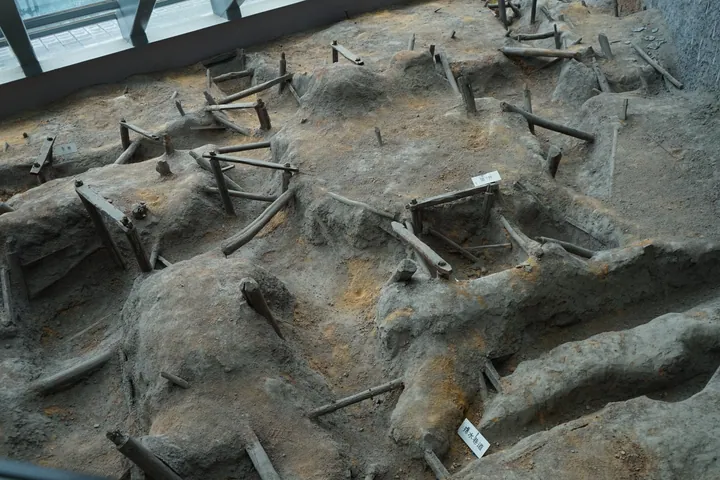
Tonglushan Ancient Copper Mine Site (铜绿山古铜矿遗址) is an ancient copper mining and smelting site southwest of the urban area of Daye (大冶市), in Huangshi (黄石), Hubei. Part of its excavated workings is preserved in place under a site museum.
Tonglushan means "copper-green hill": after rain, green copper rust shows on its soil and stones. The Tongzhi-era gazetteer of Daye County already noted flecks of green "like snowflakes or small beans" after downpours. The Hubei official mining bureau opened a mine here in 1916, and working resumed in 1959. In 1973, while stripping ground at the open-pit mine, workers exposed old shafts and slag, with bronze axes, wooden mallets, shovels and pottery inside the workings. That November, staff of the Museum of Chinese History and the Hubei Provincial Museum judged it a large mine of the Spring and Autumn and Warring States periods, and excavation began in February 1974.
The site covers about 2.5 million m². Digging has cleared several hundred vertical, inclined and blind shafts and more than a hundred horizontal galleries, each roughly 0.8 m square in section. Western Zhou to Spring and Autumn workings go down 20 to 30 m, and Warring States to Han workings 40 to 50 m. Eight Spring and Autumn shaft furnaces for smelting copper and over a thousand tools have also been found. A pit timber was dated to 3,260 ± 100 years before 1982, pointing to late Shang mining. A second round of digging from 2011 uncovered 35 miners' footprints in 2012 and, in 2015, a cemetery of mine managers and workers at Sifangtang (四方塘), the first burial ground tied directly to a mining site in Chinese archaeology. The Hubei Provincial Museum's element comparisons suggest the copper of the Marquis Yi of Zeng bells (曾侯乙编钟) very probably came from here.
The State Council listed the site in the second batch of Major Historical and Cultural Sites Protected at the National Level (全国重点文物保护单位) in 1982. It entered China's World Heritage Tentative List in 1994 and again in 2012, became a National Mine Park in 2005 and national industrial heritage in 2018. The first museum was raised directly over the shafts in 1983, and in 1991 the mine gave up the ore body under the site. A new museum opened on 9 June 2023, fifty years after the discovery, and in 2024 the site's protection and display were chosen as one of ten national model cases by the Chinese Society of Archaeology (中国考古学会) and China Cultural Relics News (中国文物报社).
What to look for
- Ancient shafts and galleries kept in place beneath the original site museum, built over them in 1983
- The 2023 museum designed by architect Cui Kai (崔恺), whose halls step back into the hillside like mine tunnels
- A bronze relief scroll in four parts, including "Southern Copper Shipped North" (南铜北运) and "Copper Helps Chu Rise" (铜助楚兴)
- Themed halls on prospecting, mining, copper smelting and the sources of bronze
- A replica set of the Marquis Yi of Zeng chime bells, installed in 2023
- The modern Tonglushan open-pit mine, which adjoins the site park
Location & getting there
Getting to Tonglushan Ancient Copper Mine Site
- Search for 铜绿山古铜矿遗址 with 黄石市 and 大冶市.
Find Tonglushan Ancient Copper Mine Site
铜绿山古铜矿遗址 · 大冶市
No reliable map pin yet: search by the Chinese name.
Sources & visit information
Written from the linked sources and fact-checked against them on 2026-09-23. Opening hours, admission and access arrangements are not covered; confirm current visitor information with the site.
- 铜绿山古铜矿遗址 - 维基百科,自由的百科全书 ↗
- “世界第九大奇迹”铜绿山古铜矿遗址新馆正式开馆_黄石_新闻中心_长江网_cjn.cn ↗
- 铜绿山古铜矿遗址保护展示入选全国十佳案例_黄石_新闻中心_长江网_cjn.cn ↗
Some facts checked against Wikipedia contributors, "铜绿山古铜矿遗址" · CC BY-SA 4.0.
Image credits & notes (1)
- The excavated ancient mining pit at the Tonglüshan copper mine site, Daye, Huangshi · 黄石大冶铜绿山古铜矿遗址考古发掘现场Photo: Amarespeco · CC BY-SA 4.0 · taken 2017-06-09Resized for the web; the photo itself has not been edited. Thumbnails may show a cropped view.
