

Photo adjustments
The exact downloaded source bytes are separately retained and hashed. Prepared JPEG is proportionally reduced to a maximum 720-pixel long edge; full frame retained, no subject alteration. Final website rendition: full frame retained, proportionally resized to at most 720 pixels and converted to WebP. No additional retouching or subject alteration. Card displays may crop the view.
Explore the region
About Yuquan Temple
Its principal halls give the visit an active religious setting, while the nearby Song-period iron pagoda shows metal cast in the forms of a timber tower. The pagoda’s thirteen-tier silhouette and surviving inscriptions make it a separate architectural focus. Conservation completed a major stage in late 2025; check the currently accessible viewing area and avoid treating the pagoda as a climbable tower.
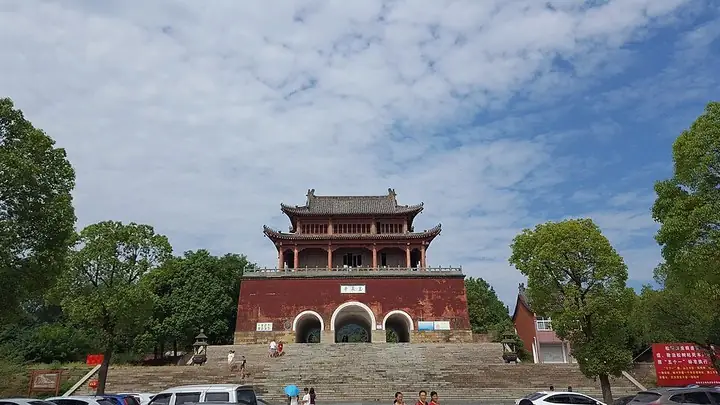
A temple on Fuchuan Mountain (覆船山) was commissioned in 528 by Emperor Wu of Liang (梁武帝). In 593 the monk Zhiyi (智顗) built a temple here on imperial order; after seeing a spring below the mountain as clear as pearls, he renamed the site Yuquan, and Prince Yang Guang (杨广) bestowed the name Yuquan Temple. In 678 the monk Shenxiu (神秀) taught Chan Buddhism here, and in 1021 an empress dowager commissioned the building of Yuquan Temple, with later repairs in the Yuan, Ming and Qing dynasties.
The halls have flying eaves, bracket sets and colourful paintings. A Sui-period iron cauldron weighing 1,500 kilograms stands before the main hall, along with a Yuan-period iron pot and bell, and a stone-carved image of Guanyin attributed to the Tang painter Wu Daozi (吴道子). Old cypress, ginkgo and bay laurel (月桂) trees grow in the grounds, and a spring runs in front of the temple.
Yuquan Temple is a Major Historical and Cultural Site Protected at the National Level (全国重点文物保护单位) and a National Key Buddhist Temple in Han Chinese Area (汉族地区佛教全国重点寺院). The Yuquan Iron Pagoda (玉泉铁塔), cast in the Northern Song dynasty of pig iron, was listed as a Hubei provincial protection unit in 1956 together with the temple, and both were listed nationally in 1982 as 'Yuquan Temple and Iron Pagoda'.
What to look for
- The Buddhist hall-and-hillside setting connected with Tiantai teaching.
- The Song iron pagoda’s tiered form and cast architectural detail.
The surrounding area
A base for the Three Gorges landscape and Three-Gorges Tribe; confirm the actual boat boarding point and transfer.
Location & getting there
Getting to Yuquan Temple
Arrange a road transfer to Yuquan Temple in Yuquan Village, west of Dangyang. Confirm a return pickup at the temple visitor approach; this rural stop is separate from central Yichang and from other temples named Yuquan.
Combine your visit
A suggested order for exploring this place and its immediate setting.
-
Principal temple courtyard玉泉寺主院
Begin with the living Buddhist precinct.
-
Iron pagoda viewing area玉泉铁塔
Compare the cast-metal structure with the temple architecture.
-
Open wooded temple setting玉泉山寺周边
Finish along the permitted paths around the precinct.
Check access to the individual stops. A suggested sequence does not imply a combined ticket or guaranteed transfer.

Find Yuquan Temple
当阳玉泉寺 · 宜昌市
The pin marks the area, not the entrance.
More places nearby
Approximate straight-line distances between map pins, not travel distances.
Yichang Museum 宜昌博物馆
32 km awayYichang Museum explains the Three Gorges region through archaeology, urban history and everyday material culture. The Ancient Xiling section starts with early human settlement, while Ba–Chu interpretation places the city between…
View guide →Chuwang Chariot and Horse Formation Scenic Area 楚王车马阵
38 km awayThe Xiongjiazhong archaeological park, marketed as Chuwang Chariot and Horse Formation, reveals the scale of an elite Chu burial landscape. The chariot-and-horse pits make rank and ceremonial display visible through the…
View guide →Three Gorges Waterfall 三峡大瀑布
39 km awayThree Gorges Waterfall is an inland gorge walk in Yiling, separate from the Yangtze dam and cruise route. Smaller cascades, rock walls and wooded stream sections lead towards the main fall. Its best-known close-up experience…
View guide →Sources & visit information
The sources below support the place-specific description and arrival information. Suggested combinations are editorial planning ideas; confirm current opening, entry arrangements and transport services for your date.
- Tiantai Buddhist history — Yuquan teaching tradition ↗
- Hubei historical account — temple and iron-pagoda architecture ↗
- Yichang government — 2025 pagoda conservation ↗
- Chinese Wikipedia: 玉泉寺 (当阳市) (revision 92583516, 2026-05-08) ↗
Background paragraphs translated and condensed from Wikipedia contributors, "玉泉寺 (当阳市)", Chinese Wikipedia · CC BY-SA 4.0. Source revision 92583516.